




Bus Lifts Reach New Heights
Photo above: Security devices built within ARI-HETRA’s Heavy-Duty Mobile Lift’s electrical system stop the lift in the event of a malfunction.<...
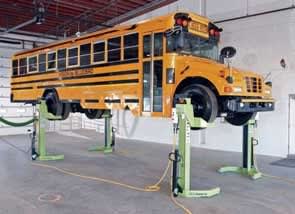
Photo above: Security devices built within ARI-HETRA’s Heavy-Duty Mobile Lift’s electrical system stop the lift in the event of a malfunction.
Vehicle lifts are indispensable when it comes to repairing school buses. Fortunately, many companies offer lifts that are designed to accommodate these vehicles.
With lifting capacities that range from 19,000 to 90,000 pounds, end users have a variety of products to choose from to meet their needs. The following outlines specifications of models from six manufacturers.
ARI-HETRA (Automotive Resources Inc.)
ARI-HETRA’s Heavy-Duty Mobile Lift (HDML-8) is available with either four or six posts, and each post has a lifting capacity of 15,000 pounds. (Total capacity for the four-post is 60,000 pounds; total capacity for the six-post is 90,000 pounds.)
The controls for both systems are top-mounted on the columns, with up-down buttons as well as an emergency stop button. To further increase safety, security devices built within the electrical system stop the lift in the event of an electrical failure or overload.
Because the system is mobile, no installation is required — the lift can be used in any indoor or outdoor environment that has a flat, stable floor and a power source.
Specifications for both configurations include a 2-horsepower motor capacity, 1,100-weight-per-column horsepower and a 105-second lift time.
Gray Manufacturing Co. Inc.
Gray Manufacturing Co. Inc.’s patented Wireless Portable Lift System (WPLS-160) utilizes wireless technology to facilitate communication between its columns. Each column has a control console that operates the system’s self-contained, hydraulic power unit; the system as a whole is powered by a rechargeable, 12-volt deep-cycle battery. Moreover, its wireless design enables end users to have unobstructed access to vehicle components.
“Typically the lifts are used in sets of four, but they can also be used as a set of two or six,” says Nick Limle, marketing manager. Each column in the system has a 16,000-pound capacity, he adds.
Gray Manufacturing also offers Wheel Lift Systems, which are available in three portable models — WL-20 (20,000-capacity), WL-30 (30,000-pound capacity) and WL-40 (40,000-pound capacity) — and come as a pair. Limle says all three models have a patented, built-in support stand feature, allowing for open access to a vehicle.
The Wheel Lift Systems are 100 percent air-operated and can raise one end of a vehicle at least 24 inches. A dual-trigger control valve operates the system, and spring-loaded casters allow each lift’s base to support the weight of the vehicle.
Finally, the Four Post Drive-On Lift (QL-300 QuickLift) has a single-point, pneumatic locking mechanism that enables a load to be secured and released in one location. The system can be surface-mounted, accommodate vehicles with a wheelbase of up to 24 feet and has a maximum lifting capacity of 30,000 pounds.
Mohawk Lifts
Steven Perlstein, sales and marketing manager, says that Mohawk’s TR-19 and TR-25 Four-Post Ramp Lifts are the company’s most popular lifts for school buses. “The advantage of a four-post lift is that you just drive the vehicle on the lift, hit the ‘on’ button and you’re done,” he explains. Mohawk offers discounted government prices for all school boards across the country, Perlstein adds.
The TR-19 is a 19,000-pound capacity lift, and the TR-25 is a 25,000-pound capacity lift. Both can be surface-mounted in indoor or outdoor environments, and their four-post design gives end users full under-vehicle access for maintenance.
The lifts’ runways and approach ramps are covered with diamond plates to enhance tire traction. The runways — which are 24 inches wide — are also adjustable to accommodate vehicles weighing up to 25,000 pounds. A “two-step” runway in front enables end users to drive low-riding vehicles onto the lifts with ease, while fold-down approach ramps at the back of the lifts serve as automatic wheel stops.
The TR-19 and TR-25 are equipped with several safety-enhancing features. A single-position, two-hand safety release aids in lowering vehicles, and each of the lifts’ posts has multi-position mechanical safety locks.
There are also optional features available to accompany the lifts, such as a 15,000- or 25,000-pound capacity hydraulic rolling jacking beam that locks in place once it has been positioned.
Rotary Lift’s MOD30, a heavy-duty in-ground lift, has a modular design to accommodate numerous vehicle applications.
Rotary Lift
Rotary Lift’s Modular and Environmentally Friendly In-Ground Lift is available in two models — the MOD30, which has a 60,000-pound capacity, and the MOD30 3-Post, which has a 90,000-pound capacity.
A desire to protect the environment influenced the lift’s design — it is contained in a 6-foot-deep steel enclosure. “Oil from a vehicle or the lift is trapped inside the containment housing to protect any soil or water surrounding the maintenance facility,” explains Roger Perlstein, heavy-duty sales manager.
The lift features Variable Equalized Control, a system that utilizes a joystick on the control panel to operate the lift’s jacks individually or simultaneously at a variety of different speeds.
Furthermore, an electric drive enhances the performance of the front jack assembly, allowing for multiple wheelbase settings, while an automatic spotting system facilitates trouble-free positioning of the lift’s piston.
The steel housing is recessed, and the lift comes with galvanized shutter plate trench covers to ensure that the pit is covered at all times. A wheel-spotting dish for axle positioning helps guide vehicle placement when prepping for elevation.
{+PAGEBREAK+}
SEFAC Inc.'s S1 Mobile Column Lift can be used indoors or outdoors; its electrical components are housed in metal enclosures to protect against water damage.
SEFAC Inc.
SEFAC Inc. is in the process of launching a lift designed specifically for school buses. The S1 Mobile Column Lift has a 12,000-pound-per-column capacity, resulting in an overall 48,000-pound capacity for a set of four columns.
The lift features a patented, self-locking Acme threaded nut and screw drive; the lift stops immediately when power is removed and cannot move again until power is restored. Allister Collings, president, likens the system to a nut in a bolt. “No matter how much pressure you put on that nut, without the bolt turning, the nut will not move anywhere,” he explains. “The friction between the nut and the bolt is what holds the vehicle in place.”
Because the nut only wears when the load is moving, it is typical to get 20 to 25 years out of a SEFAC lift, Collings adds.
The S1 features motion control to ensure column synchronization; in addition, the columns are monitored during vehicle elevation/descent and will stop in the event of a malfunction. Each post is also equipped with an emergency stop button.
The columns can be operated individually or in pairs using the control on the column(s), or as a group by engaging a switch on the lift’s electrical box.
Stertil-Koni
Stertil-Koni’s Skylift (a platform lift) is available in two models — the SKY-200, which has a lifting capacity of up to 62,400 pounds, and the SKY-250, which has a lifting capacity of up to 78,000 pounds.
Both models are designed for easy installation and ease of use. Due to their modular design, they can either be flush-mounted or surface-mounted. Their platform design also facilitates vehicle elevation without the use of posts.
Moreover, the lifts’ two runways are independent of one another. “Most lifts have crossbeams between the runways, but the Skylift has no crossbeams — it’s completely open, so there is clear-floor access all the way around the vehicle,” President Jean DellAmore says.
Stertil-Koni also offers several mobile lifts. The ST1060 has a 13,000-pound-per-column capacity and is powered by hydraulics. “Each column has a microprocessor that controls the motion of the four columns as they ascend,” DellAmore says. “The microprocessors also ensure that the columns stay in a uniform position.”
The ST1060 has two control options: superior and conventional. Superior control allows the columns to be operated from a panel mounted on each column (up to 28 are available in a set). Operation is possible from any column. Conventional control allows end users to operate up to four columns from one control panel.
More Maintenance
Cummins on Smarter, Simpler Engine Innovation
Cummins discusses its first-ever gasoline engine for school buses, EPA 2027, and why bus fleets still want durable, simpler internal combustion options.
Read More →
Report: 72% of Diesel School Buses Now Use Advanced Low-Emission Engines
New data shows advanced low-emission diesel technology continues expanding across school bus fleets, even as electric bus adoption gains momentum.
Read More →
Vampire Tools' CAIMAN 7.5-Inch Multi-Purpose Screw Extractor Long-Nose Pliers with Crimper
Vampire Tools introduced the VAMPLIERS Caiman 7.5-inch multi-purpose pliers, combining screw extraction, cutting, crimping, and gripping functions into a single tool designed for fleet maintenance professionals.
Read More →
How Advanced Diagnostics Helps Bus Fleets Stay Ahead of Repairs
Chat with Noregon’s Kevin Smallhorn at ACT Expo about bus diagnostic tools, telematics integration, CNG maintenance support, and strategies to help reduce downtime and improve uptime.
Read More →
How School Bus Fleets are Getting Ahead of Breakdowns
Don’t let bus downtime wear you down. Here’s how bus operators are shifting from manual processes to AI-powered, data-driven maintenance systems for improved reliability and safety.
Read More →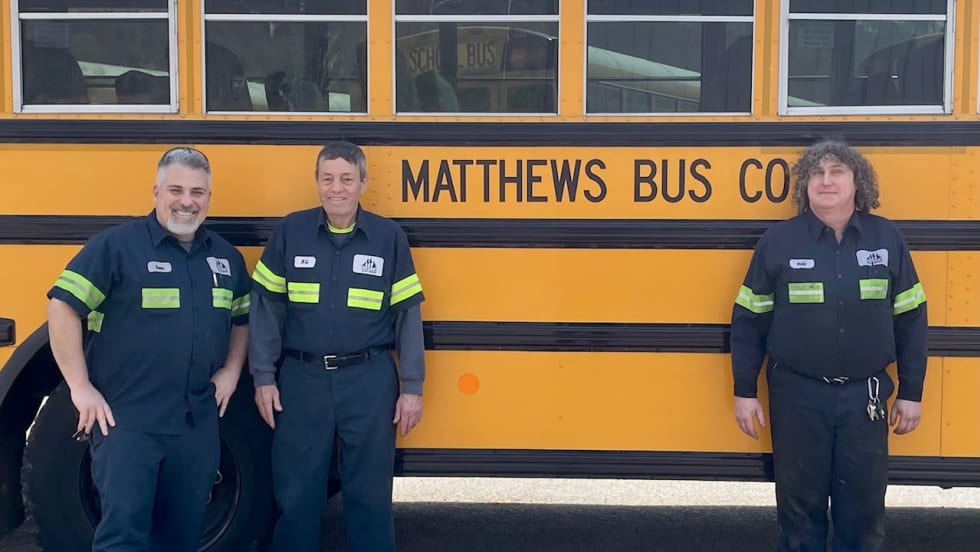
Pennsylvania School Bus Maintenance Team Praised for Dedication to Safety
Matthews Bus Company’s West Jefferson received a letter of commendation from the Pennsylvania State Police for their fleet inspections.
Read More →
2026 State of Student Transportation Report
Student transportation teams are being asked to do more with less, facing driver shortages, rising costs, and increasing safety expectations. This report uncovers how fleets are adapting, where technology is making the biggest impact, and why student ridership tracking is emerging as a top priority. Download the report to explore the key trends shaping 2026 and what they mean for your operation.
Read More →
From Chaos to Clarity: How School Districts Are Running Leaner Transportation Operations
Covering 38 routes on a Friday afternoon. Buses idling while routes overlap. Parents calling nonstop about late arrivals. Sound familiar? This whitepaper explores how district transportation leaders solved these exact problems — and what measurable results followed.
Read More →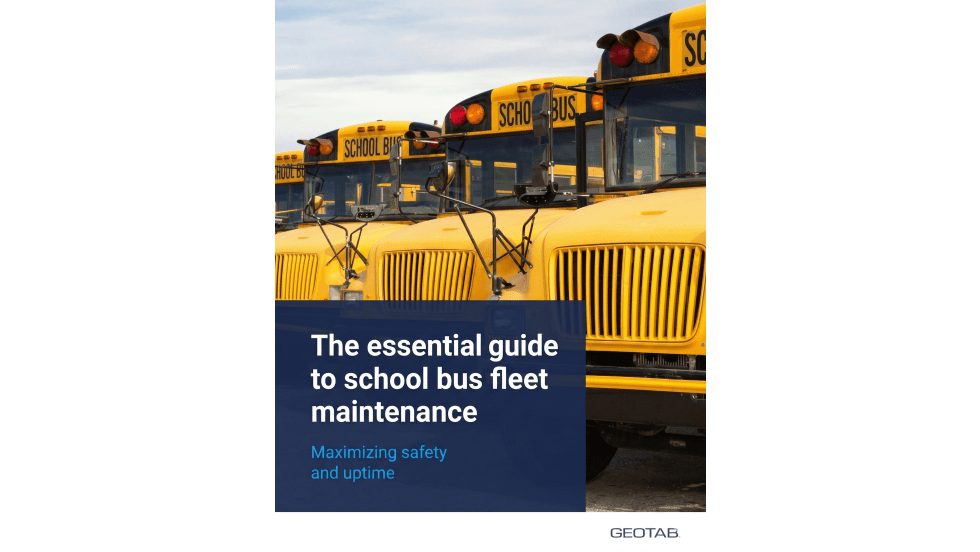
The New Playbook for Safer, Smarter School Bus Maintenance
As school districts juggle aging buses, technician shortages and rising safety expectations, proactive fleet maintenance is becoming essential. This guide explores how telematics, predictive maintenance and real-time vehicle data can help transportation departments reduce breakdowns, extend vehicle life, improve compliance and keep students safer on the road.
Read More →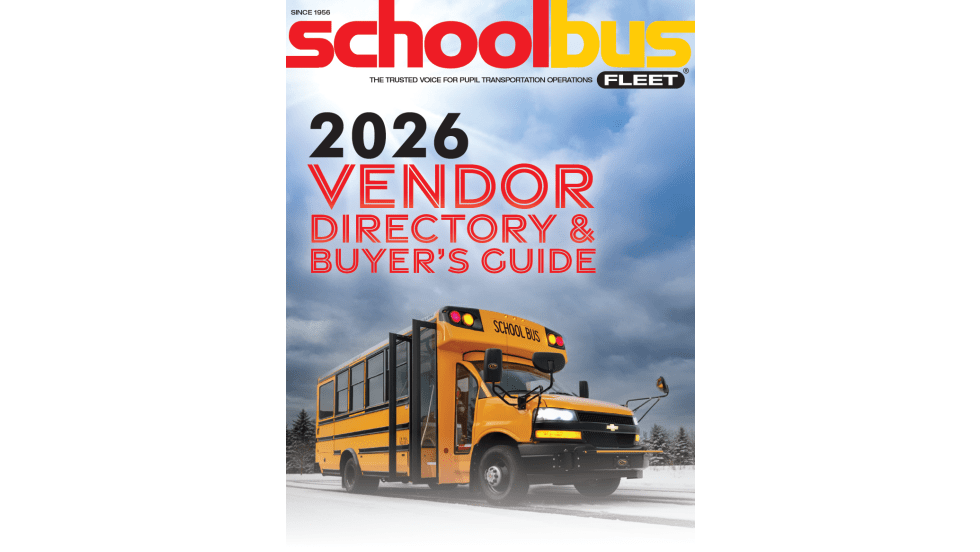
2026 School Bus Fleet Vendor Directory & Buyer's Guide
Searching for the right equipment, technology, or services for your school transportation program? This industry guide brings together manufacturers and suppliers across the entire school bus market, all in one place. Download it to find the partners who can help move your operation forward.
Read More →