




Safety Standards Are Key With Vehicle Lifts
Today’s vehicle lifts have numerous built-in safety features, but technicians still need to know and follow safety guidelines and inspect lifts daily.
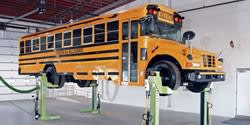
A common train of thought is that in order to learn, we must first learn from our mistakes. But for those who work with vehicle lifts, the trial-and-error learning process is not a safe approach. The first mistake a technician makes around an automotive lift could be his last, because buses can fall from lifts in a split-second.
While some accidents are attributable to improper installation or poor manufacturing, accidents related to improper operator use can be readily avoided through training and proper maintenance.
According to Service Tech Services, a lift safety inspections company in Simi Valley, Calif., more than 15,000 accidents causing death or hospitalization occur every year from lift-related accidents.
The U.S. Department of Labor Occupational Safety & Health Administration (OSHA) Website, www.osha.gov, documents a number of tragic deaths and debilitating incidents that have occurred over the years from vehicle-lift accidents.
Safety first
One of the greatest safety resources available to those who operate vehicle lifts is the Automotive Lift Institute (ALI). The ALI is an association of lift manufacturers focused on promoting safety in the design, construction, installation and use of lifts.
The ALI sponsors a “Program of Certification” for lifts through a contract with Intertek Testing Services, a worldwide testing organization recognized by OSHA.
The ALI recently released a new “Safety Tips” placard, which describes general safety precautions that should be taken to help avoid injuries. The placard, which can be ordered through ALI’s Website, www.autolift.org, should be posted where it can be a constant reminder to lift operators. Here are the 11 safety tips:
1. Inspect your lift daily. Never operate if it malfunctions or if it has broken or damaged parts. Repairs should be made with original equipment parts.
2. Operating controls are designed to close when released. Don’t block open or override them.
3. Never overload your lift. Manufacturer’s rated capacity is shown on nameplate affixed to the lift.
4. Positioning of vehicle and operation of the lift should be done only by trained and authorized personnel.
5. Never raise vehicle with anyone inside it. Customers or bystanders should not be in the lift area during operation.
6. Always keep lift area free of obstructions, grease, oil, trash and other debris.
7. Before driving vehicle over lift, position arms and supports to provide unobstructed clearance. Do not hit or run over lift arms, adapters or axle supports. This could damage lift or vehicle.
8. Load vehicle on lift carefully. Position lift supports to contact at the vehicle manufacturer’s recommended lifting points. Raise lift until supports contact vehicle. Check supports for secure contact with vehicle. Raise lift to desired working height. Caution: If you are working under vehicle, lift should be raised high enough for locking device to be engaged.
9. Note that with some vehicles, the removal (or installation) of components may cause a critical shift in the vehicle center of gravity and result in raised vehicle instability. Refer to the vehicle manufacturer’s service manual for recommended procedures when vehicle components are removed.
10. Before lowering lift, be sure tool trays, stands and other equipment are removed from under vehicle. Release locking devices before attempting to lower lift.
11. Before removing vehicle from lift, position arms and supports to provide an unobstructed exit (see Item 7).
Need a lift?
There are many companies offering different types of vehicle lifts for the school bus industry. Each lift type is designed for a specific lifting capacity and length. Lifting capacities can range from less than 10,000 pounds to more than 130,000 pounds. Here are current models from seven key manufacturers:
[PAGEBREAK]
ARI-HETRA (AUTOMOTIVE RESOURCES INC.)
The Heavy Duty Mobile Lift (HDML) system is the heart of the ARI-HETRA product line. The HDML system is available in configurations of four, six or eight posts. Each post has a lifting capacity from 12,000 to 40,000 pounds.
The system’s controls are top-mounted on each post with up-down buttons and emergency stop buttons. The mobile column lift can be operated from any of the control boxes.
Safety was a key consideration in designing the HDML system. Security devices are built into the electrical system to stop the mobile lift from operating in case of electrical failure or overload.
The main control box has an electrical phase sequence relay, which automatically checks the rotation of the motors and adjusts it accordingly. In addition, if one phase is cut off, the system will stop automatically.
Since the HDML system is mobile, there is no installation. All that’s needed is a flat, stable floor and a power source, so the system can be used inside or outside.
LORISER LIFTS
LoRiser Lifts utilize the in-ground lift design and are built to ensure operator safety, an environmentally friendly installation and high productivity.
The hydraulic system automatically locks when the lift is not active, which allows operators to lock the lift at any desired position.
Double-acting cylinders provide rapid escalation and retraction of the jack. Doors open automatically as the lift raises and close automatically as the lift retracts into the floor, allowing a “clear floor” when the lift is retracted.
The electric-hydraulic lift system utilizes a two-stage pump that ensures rapid movement when no load is on the lift and slower movement when the lift is under load.
MANITOWOC LIFT DIVISION — CONSUMERS INC.
Manitowoc offers the four-post lift MW series, with each post having a capacity of 12,000, 18,000, 25,000 or 30,000 pounds. The MW series has back-up safeties on each post that automatically engage at any height for added protection.
The MW series features an “all chain” design, meaning that there are no cables to adjust or replace. Both runways are completely adjustable to accommodate vehicles of varying widths.
MOHAWK LIFTS
The Multiflex 230-450 High Pressure In-Ground Lift by Mohawk comes in a concrete vault to house both front and rear pistons. This ensures that all service and repairs can be done from the top without the need to dig. The lift was designed to be simple to install, operate and maintain.
Multiflex uses a low amount of oil — six gallons per piston — and has an exclusive high-pressure design to provide years of trouble-free service. The locking system is fully hydraulic and operates automatically whenever the power unit is activated.
ROTARY LIFT
Rotary Lift’s new MOD30 lift has incorporated environmental, safety, functionality and customization concerns into its design. Utilizing an in-ground lift system, the MOD30 combines safety, reliability and reduced installation costs.
The MOD30 lift system comes in a steel enclosure, which is sealed and protected with the exclusive EnviroGuard coating to protect the lift from electrolysis, rust or harsh contaminates. The MOD30 has an in-ground lift capacity of 60,000 pounds.
SEFAC INC.
SEFAC lifts are designed for use in heavy-duty maintenance workshops. The lifts are portable and can be used inside, outside and across multiple workstations. SEFAC columns can be supplied in sets of four or six for different types of vehicles, with each column having a capacity of up to 50,000 pounds.
SEFAC lifts are designed with a parachute nut assembly consisting of a bronze lifting nut and a steel safety nut. The design also includes an irreversible, suspended rolled screw and lifting nut, with no additional mechanical safety latches required to support the load. Each column contains an emergency stop button, and electrical components are protected against water and dust.
STERTIL-KONI
Stertil-Koni offers a selection of mobile column lifts that are suitable for buses. The ST1082 features a hydraulic lifting system with a microprocessor-controlled tracking system that can lift up to 18,000 pounds per column.
Safety features of the lifts include independent, fail-safe mechanical safety locks designed to continually be engaged and emergency stop buttons on all columns.
More Maintenance
Cummins on Smarter, Simpler Engine Innovation
Cummins discusses its first-ever gasoline engine for school buses, EPA 2027, and why bus fleets still want durable, simpler internal combustion options.
Read More →
Report: 72% of Diesel School Buses Now Use Advanced Low-Emission Engines
New data shows advanced low-emission diesel technology continues expanding across school bus fleets, even as electric bus adoption gains momentum.
Read More →
Vampire Tools' CAIMAN 7.5-Inch Multi-Purpose Screw Extractor Long-Nose Pliers with Crimper
Vampire Tools introduced the VAMPLIERS Caiman 7.5-inch multi-purpose pliers, combining screw extraction, cutting, crimping, and gripping functions into a single tool designed for fleet maintenance professionals.
Read More →
How Advanced Diagnostics Helps Bus Fleets Stay Ahead of Repairs
Chat with Noregon’s Kevin Smallhorn at ACT Expo about bus diagnostic tools, telematics integration, CNG maintenance support, and strategies to help reduce downtime and improve uptime.
Read More →
How School Bus Fleets are Getting Ahead of Breakdowns
Don’t let bus downtime wear you down. Here’s how bus operators are shifting from manual processes to AI-powered, data-driven maintenance systems for improved reliability and safety.
Read More →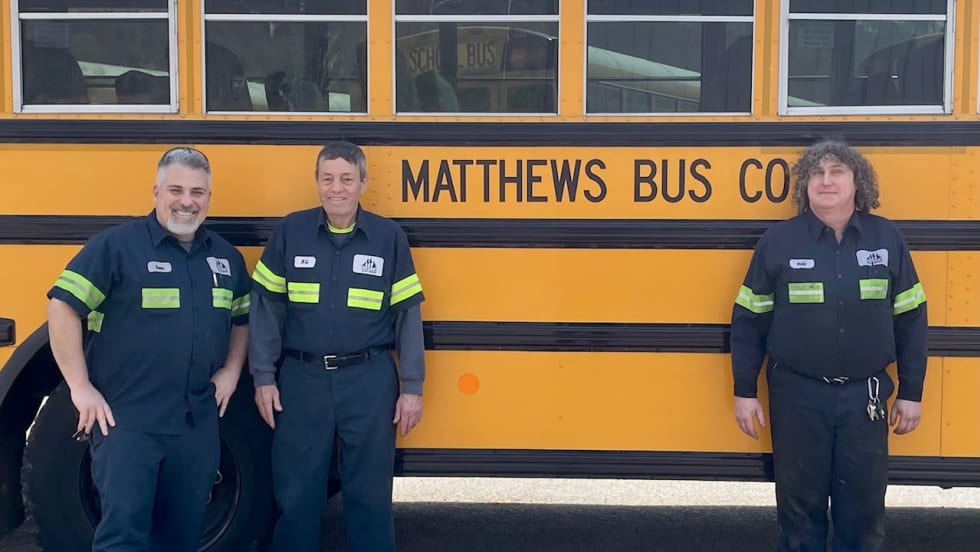
Pennsylvania School Bus Maintenance Team Praised for Dedication to Safety
Matthews Bus Company’s West Jefferson received a letter of commendation from the Pennsylvania State Police for their fleet inspections.
Read More →
2026 State of Student Transportation Report
Student transportation teams are being asked to do more with less, facing driver shortages, rising costs, and increasing safety expectations. This report uncovers how fleets are adapting, where technology is making the biggest impact, and why student ridership tracking is emerging as a top priority. Download the report to explore the key trends shaping 2026 and what they mean for your operation.
Read More →
From Chaos to Clarity: How School Districts Are Running Leaner Transportation Operations
Covering 38 routes on a Friday afternoon. Buses idling while routes overlap. Parents calling nonstop about late arrivals. Sound familiar? This whitepaper explores how district transportation leaders solved these exact problems — and what measurable results followed.
Read More →
The New Playbook for Safer, Smarter School Bus Maintenance
As school districts juggle aging buses, technician shortages and rising safety expectations, proactive fleet maintenance is becoming essential. This guide explores how telematics, predictive maintenance and real-time vehicle data can help transportation departments reduce breakdowns, extend vehicle life, improve compliance and keep students safer on the road.
Read More →
2026 School Bus Fleet Vendor Directory & Buyer's Guide
Searching for the right equipment, technology, or services for your school transportation program? This industry guide brings together manufacturers and suppliers across the entire school bus market, all in one place. Download it to find the partners who can help move your operation forward.
Read More →