




Case Studies: Tips from the Professional Garage
Sometimes the best solution to a specific school bus maintenance problem can’t be found in instruction manuals or previous training. Shop staffers oft...

Sometimes the best solution to a specific school bus maintenance problem can’t be found in instruction manuals or previous training. Shop staffers often need to come up with their own ways of fixing what’s broken. The following five excerpts come from school bus technicians who have done just that.
Maybe your operation has already implemented strategies to overcome similar problems. Or maybe you haven’t experienced any of these problems at all. Nonetheless, learning the ingenuity of these five maintenance programs may help you find tips to apply at your own department.
Greased lightning
School District of Palm Beach County, West Palm Beach, Fla.
Contributed by Joe Reed, assistant director of transportation and maintenance
PROBLEM: In Palm Beach County, many of the school bus routes cover unimproved roads that cause heavy wear on suspension components. Joe Reed, assistant director of transportation and maintenance, and the rest of the transportation department faced the constant grief of having kingpins and bushings wear out quickly. Whenever the problem arose, it would require an inconvenient, all-day job of changing those parts as well as realigning the bus.
Additionally, when the maintenance staff was running grease in the front wheel bearings, spindles would often need to be replaced due to lack of grease on the front wheel bearings. “Like most garages, we would repack wheel bearings whenever a front brake job was done,” says Reed. “But often we found that was not soon enough.”
SOLUTION: Regarding the kingpin/bushing problem, Reed and the maintenance staff established a program in which they would always perform a full chassis lubrication, or a grease job, during every 20-day inspection.
Reed is adamant about using high-quality products to ensure that each bushing, pin and bearing hold the necessary lubricant for the entire preventive maintenance cycle.
To eliminate the problem of grease running out, the staff began adding oil-lubricated front hubs to all school bus chassis that the district purchased new. “This worked so well that, in conjunction with the other members of the Florida School Bus Specifications Committee, we added oil-lubricated hubs to the list of standard equipment on all Florida school buses,” says Reed.
RESULTS: After implementing these techniques, the maintenance crew found that there were no longer any kingpin problems, even on buses that ran on rough, unimproved roads. In fact, the department no longer stocks kingpins in its parts room.
As for the bearings, Reed says that his crew began purchasing oil-lubricated front wheel bearings as options even before Florida specifications standardized them. Since then, they have never had trouble with front wheel bearings or spindles.
“I don’t know that either of these procedures would be considered unique,” says Reed. “But they both make sense, are cost-effective and they make the buses safer and more reliable. That’s the bottom line, isn’t it?”
Brake check
Norfolk City Public Schools, Norfolk, Va.
Contributed by John Hazelette, director of transportation
PROBLEM: For years, the technicians at Norfolk City Public Schools operated independently within what John Hazelette, director of transportation, calls the “acceptable range” when performing brake adjustments. He says that in the days of manual slack adjusters, there was always a variance in making adjustments from technician to technician.
“When the industry changed from manual to automatic slack adjusters, the issue of proper brake adjustment was to be put to rest — or so many thought,” says Hazelette. His crew actually found that the variances still existed, and they had not yet reached the level of consistency they desired.
SOLUTION: After attending an ASE meeting that dealt with brake maintenance, senior technician Larry Cubilla collaborated with the rest of the staff to develop a new brake upkeep technique.
The process starts in the parking stall of the bus yard, where the technician first checks the parking brake by setting it, starting the engine and putting the bus in gear. If the bus moves when he revs it, the parking brake is out of adjustment.
The next step is to pump the brake down to set off a low air pressure alarm. Then the technician builds the pressure back to 120 psi (pounds per square inch) and checks for the compressor to cut out while listening for the air dryer to pop off.
If all is working properly, the bus is then brought into the technician’s bay and raised. A visual inspection of the brake lining thickness is done through the inspection holes, and an overall check is made for loose or missing parts.
At this point, the technician adjusts the brakes to be tight so the wheel will not turn by hand. This will ensure the shoe is in contact with the drum. Then the technician loosens the self-adjuster just enough to allow the wheel to spin freely.
Finally, a co-worker depresses the brake pedal while the technician measures the travel of the brake chamber rod and clevis to ensure proper stroke length. This allows the technician to inspect the brake system while checking one wheel at a time.
RESULTS: Since establishing this new procedure, the shop staff has virtually eliminated the individuality of brake adjustments and inspections. Technicians now have a standard that ensures consistency and provides a much higher level of risk reduction. “We now have a peace of mind in knowing that if we experience a brake problem, it won’t be the result of poor maintenance,” says Hazelette.
Stop the chop
St. Johns Public Schools, St. Johns, Mich.
Contributed by Wayne Hettler, shop foreman and lead mechanic
PROBLEM: Bus drivers at St. Johns Public Schools were coming to shop foreman Wayne Hettler complaining about heavy vibration and steering pull in the front ends of their school buses. The problem, known as chopping, had to do with the balance of the tires.
“When you get the tires out of balance, they bounce straight up and down, and that chops the corners of the tires so they’re no longer smooth,” explains Hettler. He says that chopping will cause vibration in the steering wheel as well as pulling, in which the bus tends to not drive straight.
Hettler and his maintenance staff were forced to remove chopped tires before they were actually worn out, and the costs of buying new tires prematurely and constantly balancing them became a large drain on their budget.
SOLUTION: Hettler began talking with fleet drivers and reading tire publications in search of something that would help him avoid the chopping problem. He came across a tire performance product called EQUAL and decided to put it to the test.
Hettler installed the product in the tires of half his fleet of 32 and left the other tires as they were. With his buses traveling approximately 565,000 miles a year, he ran EQUAL through enough miles in order to be sure it was working.
Hettler compared the performance of tires with the product to that of the tires without it. “I kept a notebook log with my observations, and I was finding that the tires with EQUAL ceased vibrating and chopping,” he says.
RESULTS: Hettler decided to install EQUAL in his entire bus fleet, and he says he hasn’t balanced a tire or replaced one due to chopping since.
“We’ve got no driver complaints, and our tires look good,” says Hettler. “With EQUAL in the tires, you never have to rebalance, take them off or fool around with them, and that saves time and money.”
Cut it out
First Vehicle Services, Monroe, Mich.
Contributed by John Cole, technician
PROBLEM: At Monroe Public Schools, the bus operation was fighting an endless battle against damage constantly inflicted by vandals. The students would use knifes and other sharp objects to slice up seats on the district’s school buses.
“What the school district did before we contracted with them was just put tape over [the cut],” says Karin Maurice, general manager for First Vehicle Services. “Then kids would pull the tape off and rip it bigger, so they would put a bigger piece of tape on it. Well, that doesn’t work for us.”
SOLUTION: Refusing to play an endless game of “tag” with the miscreants, John Cole, school bus technician, decided to seek a more permanent fix. He took an old ripped seat cover home one night and experimented with it. The solution he came up with takes the district’s previous idea a few steps further.
Cole’s strategy involves taking a piece of tape and covering the cut. Then he goes over the tape with a hot glue gun and smoothes it all out with an iron. The last step is to find a fast drying paint matching the color of the seat to spray over the bandaged wound.
RESULTS: In addition to cutting down significantly on the cost of replacing seat covers, Cole says his method makes his work much quicker and easier.
Now, even if a persistent pupil tries picking at the glue, he or she won’t be able to do any real damage. “We can just go right back over it with the glue and paint it, and it’s done with again,” says Cole.
Of course, Cole isn’t the only one pleased with his clever technique. “It has saved the school district umpteen dollars, and they’re just totally thrilled with it,” says Maurice. “Once he paints it and smoothes it all over, you can’t even tell there’s been a repair made there if you’re not looking for it, so the kids are leaving it alone.”
More Maintenance

Cummins on Smarter, Simpler Engine Innovation
Cummins discusses its first-ever gasoline engine for school buses, EPA 2027, and why bus fleets still want durable, simpler internal combustion options.
Read More →
Report: 72% of Diesel School Buses Now Use Advanced Low-Emission Engines
New data shows advanced low-emission diesel technology continues expanding across school bus fleets, even as electric bus adoption gains momentum.
Read More →
Vampire Tools' CAIMAN 7.5-Inch Multi-Purpose Screw Extractor Long-Nose Pliers with Crimper
Vampire Tools introduced the VAMPLIERS Caiman 7.5-inch multi-purpose pliers, combining screw extraction, cutting, crimping, and gripping functions into a single tool designed for fleet maintenance professionals.
Read More →
How Advanced Diagnostics Helps Bus Fleets Stay Ahead of Repairs
Chat with Noregon’s Kevin Smallhorn at ACT Expo about bus diagnostic tools, telematics integration, CNG maintenance support, and strategies to help reduce downtime and improve uptime.
Read More →
How School Bus Fleets are Getting Ahead of Breakdowns
Don’t let bus downtime wear you down. Here’s how bus operators are shifting from manual processes to AI-powered, data-driven maintenance systems for improved reliability and safety.
Read More →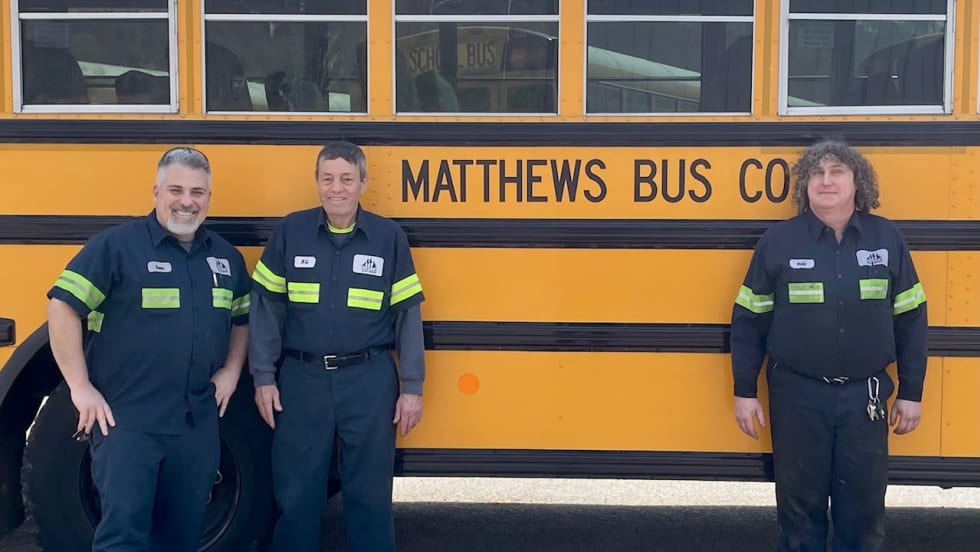
Pennsylvania School Bus Maintenance Team Praised for Dedication to Safety
Matthews Bus Company’s West Jefferson received a letter of commendation from the Pennsylvania State Police for their fleet inspections.
Read More →
2026 State of Student Transportation Report
Student transportation teams are being asked to do more with less, facing driver shortages, rising costs, and increasing safety expectations. This report uncovers how fleets are adapting, where technology is making the biggest impact, and why student ridership tracking is emerging as a top priority. Download the report to explore the key trends shaping 2026 and what they mean for your operation.
Read More →
From Chaos to Clarity: How School Districts Are Running Leaner Transportation Operations
Covering 38 routes on a Friday afternoon. Buses idling while routes overlap. Parents calling nonstop about late arrivals. Sound familiar? This whitepaper explores how district transportation leaders solved these exact problems — and what measurable results followed.
Read More →
The New Playbook for Safer, Smarter School Bus Maintenance
As school districts juggle aging buses, technician shortages and rising safety expectations, proactive fleet maintenance is becoming essential. This guide explores how telematics, predictive maintenance and real-time vehicle data can help transportation departments reduce breakdowns, extend vehicle life, improve compliance and keep students safer on the road.
Read More →
2026 School Bus Fleet Vendor Directory & Buyer's Guide
Searching for the right equipment, technology, or services for your school transportation program? This industry guide brings together manufacturers and suppliers across the entire school bus market, all in one place. Download it to find the partners who can help move your operation forward.
Read More →