




NTSB to Address Findings From 2 Fatal School Bus Crashes
In related news, former school bus driver Johnthony Walker is sentenced to four years in prison for the 2016 Chattanooga crash.

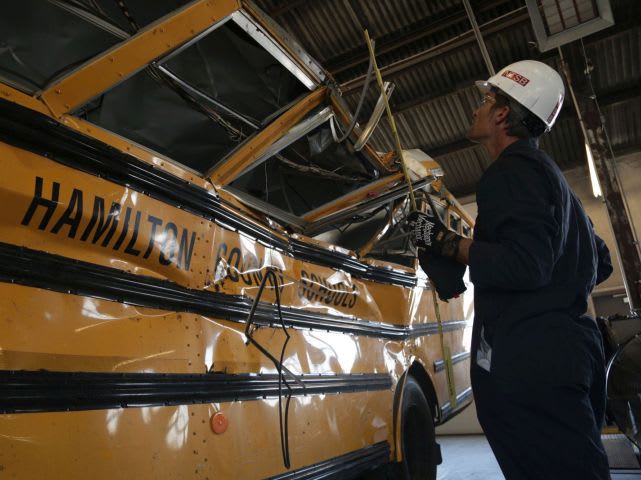
NTSB says its new report “examines selective issues in school bus transportation safety” discovered in the 2016 Chattanooga (pictured) and Baltimore crash investigations. Photo courtesy NTSB
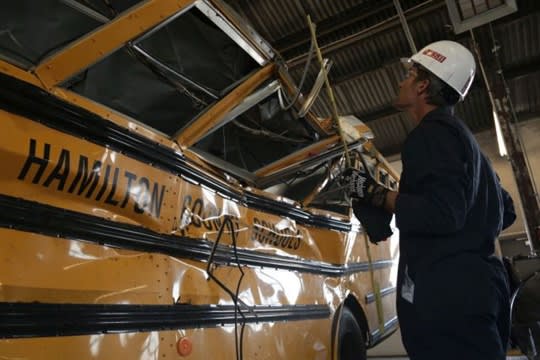
NTSB says its new report “examines selective issues in school bus transportation safety” discovered in the 2016 Chattanooga (pictured) and Baltimore crash investigations. Photo courtesy NTSB
WASHINGTON, D.C. — The National Transportation Safety Board (NTSB) will share findings from two fatal school bus crashes in a meeting next month, the agency announced on Monday.
NTSB has prepared a special investigation report that examines the November 2016 school bus crashes in Baltimore, Maryland, and Chattanooga, Tennessee.
In the Baltimore crash, a school bus struck a car and a pillar, entered oncoming traffic, and hit the driver’s side of a transit bus. The drivers of both buses and four transit bus passengers were killed. No students were aboard the school bus at the time.
In the Chattanooga crash, investigators determined that the school bus departed the roadway to the right, took out a mailbox, veered to the left, struck a utility pole, and then crashed on its side into a tree. Six students were killed and more than 30 were injured.
In related news, former school bus driver Johnthony Walker was sentenced on Tuesday to four years in prison for his role in the Chattanooga crash. He was convicted of criminally negligent homicide and more than two dozen lesser charges in March.
In both the Chattanooga and Baltimore incidents, questions were raised about the qualifications and past performance of the school bus drivers.
In a press release on Monday, NTSB said that its special investigative report on the two crashes “examines selective issues in school bus transportation safety discovered during the NTSB’s investigation.” The agency said that the report will detail the probable cause of each crash.
On May 22 at 9:30 a.m., NTSB will hold a meeting in which the agency’s board will consider the report.
“Despite the overall safety of school buses, the NTSB continues to investigate school bus crashes in which fatalities and injuries occur,” the agency said in the press release. “By combining both investigations into one comprehensive report, the NTSB is able to focus on specific areas of concern found in both crashes, which allows the agency to highlight where recommendations are needed to continue to improve school bus transportation safety.”
The meeting, which is open to the public, will be held in NTSB’s board room and conference center at 420 10th St. SW in Washington, D.C. A link to a live webcast of the meeting will be available shortly before the start of the meeting at ntsb.capitolconnection.org.
More Safety
2 Killed, Dozens Injured in Florida School Bus Crash
A multi-vehicle collision caused a Polk County school bus carrying 37 students to overturn on its way to Winter Haven High School.
Read More →
Illegal School Bus Passing Drops 24% in New York Districts
With fewer than 5% of citations involving repeat offenders, Westchester County officials said enforcement, education, and community partnerships are helping change driver behavior.
Read More →
School's Back. Here's What Happened to Traffic, Speeding & Distraction
What happens to traffic when school resumes? New data analysis examines changes in distracted driving, congestion, and speeding around schools.
Read More →
Geotab Expands Fleet Safety Tools With Video Coaching, Risk Insights
New safety and video capabilities aim to help fleet managers assess risk, support drivers, and take targeted action through video coaching, red-light violation detection, and more.
Read More →
How to Build a Better School Bus Driver Training Program
Is it time to strengthen your driver training? Here’s how to pick the right talent and improve recruitment, retention, and safety. This video is brought to you by IC Bus.
Read More →
Recent School Bus Accidents Leave 2 Dead, 2 Injured
Four school bus crashes in Florida, Illinois, and Georgia highlight risks in transportation lots, at bus stops, and during student loading and unloading.
Read More →
When Every Second Matters, Clarity Keeps Routes Moving
From routine delays to urgent incidents, strong communication practices help drivers, dispatchers, schools, and families respond with confidence.
Read More →
What Happens When a School Bus Catches Fire — and What Can Help
School bus fires are rare but can be devastating. Learn how advances in fire suppression and asset protection help fleets detect fires earlier, reduce damage, and improve safety.
Read More →
Geotab Launches Tool to Help Fleets Investigate Road Incidents
Geotab Investigations combines telematics data, video, documents, and other evidence to help fleets reconstruct incidents, resolve claims, and determine what happened.
Read More →
Texas Sixth Grader Wins 2026 National School Bus Safety Poster Contest
Sai Darshana Yekolu of Moseley Middle School in Prosper, Texas, was named the newest winner for her artwork, bringing the theme of “Safe Rides, Everyday Heroes” to life.
Read More →