




Brake Interlocks Missing in Many Virginia School Buses
According to the Virginia DOE, as many as 4,000 buses may be missing the state-required device, which prevents the parking brake from accidentally disengaging.

RICHMOND, Va. — The Virginia Department of Education (DOE) last week notified the state’s 132 school districts that as many as 4,000 school buses may need retrofitting to install a safety device that prevents the parking brake from accidentally disengaging.
The device — a brake interlock — is required in Virginia on all buses with automatic transmissions purchased after March 24, 2011, when the mechanism was added to the state Board of Education's minimum specifications for school buses. On buses equipped with a brake interlock, the parking brake cannot be released without first depressing the brake pedal.
The Virginia DOE said in a press release that without the interlock, the parking brake could accidentally disengage — for example, if a student were to slip and inadvertently fall against the brake valve.
School districts in the state were alerted to the issue after the Virginia DOE tested individual buses bought after March 2011 and found that none of the vehicles was equipped with the required parking brake interlock. Dealers provided the department with estimates on the number of noncompliant buses sold to districts since the spec was approved by the state board.
"The safety of students is the department's highest priority, and the department will work with school divisions, manufacturers, and school bus dealers to make sure that all noncompliant buses are brought into full compliance with the state Board of Education's equipment specifications as quickly as possible," said Steven Staples, state superintendent of public instruction.
School districts report annually on school bus accidents to the Virginia DOE's office of support services. According to the Virginia DOE press release, the office of support services is not aware of an incident in which a student or other person was injured by a school bus that inadvertently rolled because of an accidentally disengaged parking brake.
The state DOE is surveying districts to identify all of the buses that are in need of retrofitting. Dealers and manufacturers have been directed to submit plans to the department detailing the steps that will be taken to install brake interlocks on all noncompliant buses at no expense to school districts. The retrofitting can be done in about 90 minutes by factory or dealer technicians at districts’ transportation facilities.
Also, the Virginia DOE is asking all school bus manufacturers that are doing business in the state to make sure that interlock devices have been installed and are working as specified on all new buses delivered to Virginia districts.
The state DOE created a video about the interlock issue, which can be viewed below.
More Maintenance
The Essential Guide to School Bus Maintenance and Student Safety
Your district's buses carry students to school every day. This guide shows how predictive maintenance powered by fleet data helps keep buses reliable, drivers accountable and students safer from the first bell to the last stop.
Read More →
Kerry Brothers Grows Michigan School Bus Repair Network
The acquisition of Downriver Truck and Bus expands Kerry Brothers’ school bus maintenance footprint across southeast Michigan, adding repair capacity, diagnostic resources, and state inspection support.
Read More →
Noregon Introduces CAN Bus Diagnostic Tool, Expands JPRO Features
CAN Mentor and the latest JPRO update aim to simplify vehicle network diagnostics and improve repair efficiency for technicians of all experience levels.
Read More →
Cummins on Smarter, Simpler Engine Innovation
Cummins discusses its first-ever gasoline engine for school buses, EPA 2027, and why bus fleets still want durable, simpler internal combustion options.
Read More →
Report: 72% of Diesel School Buses Now Use Advanced Low-Emission Engines
New data shows advanced low-emission diesel technology continues expanding across school bus fleets, even as electric bus adoption gains momentum.
Read More →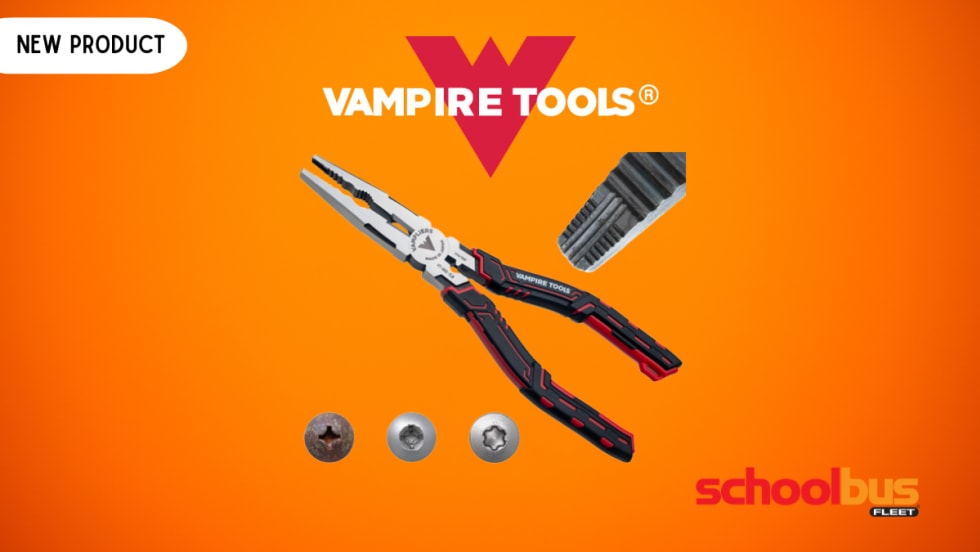
Vampire Tools' CAIMAN 7.5-Inch Multi-Purpose Screw Extractor Long-Nose Pliers with Crimper
Vampire Tools introduced the VAMPLIERS Caiman 7.5-inch multi-purpose pliers, combining screw extraction, cutting, crimping, and gripping functions into a single tool designed for fleet maintenance professionals.
Read More →
How Advanced Diagnostics Helps Bus Fleets Stay Ahead of Repairs
Chat with Noregon’s Kevin Smallhorn at ACT Expo about bus diagnostic tools, telematics integration, CNG maintenance support, and strategies to help reduce downtime and improve uptime.
Read More →
How School Bus Fleets are Getting Ahead of Breakdowns
Don’t let bus downtime wear you down. Here’s how bus operators are shifting from manual processes to AI-powered, data-driven maintenance systems for improved reliability and safety.
Read More →
Pennsylvania School Bus Maintenance Team Praised for Dedication to Safety
Matthews Bus Company’s West Jefferson received a letter of commendation from the Pennsylvania State Police for their fleet inspections.
Read More →
From Chaos to Clarity: How School Districts Are Running Leaner Transportation Operations
Covering 38 routes on a Friday afternoon. Buses idling while routes overlap. Parents calling nonstop about late arrivals. Sound familiar? This whitepaper explores how district transportation leaders solved these exact problems — and what measurable results followed.
Read More →