




Details on the New Diesel Engine Oil Standards
The American Petroleum Institute has approved two new diesel engine oil standards: CK-4 and FA-4. Here’s an explanation of the new categories.
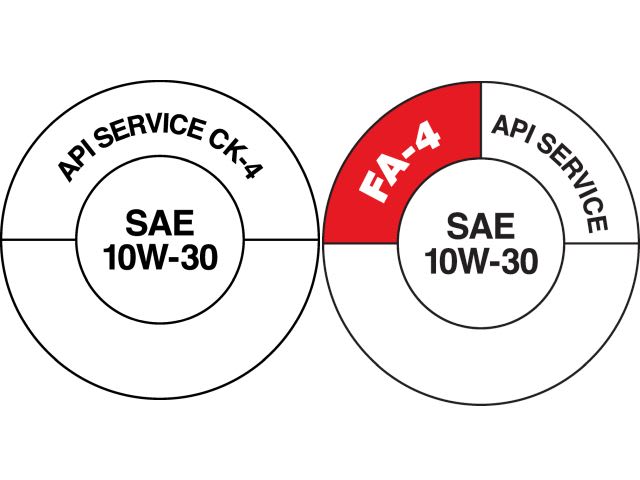
The American Petroleum Institute has approved two new diesel engine oil standards: CK-4 and FA-4. Shown here are the corresponding service symbol “donuts” to help in identifying them.
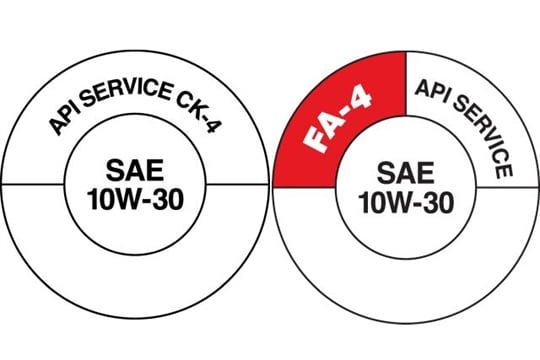
The American Petroleum Institute has approved two new diesel engine oil standards: CK-4 and FA-4. Shown here are the corresponding service symbol “donuts” to help in identifying them.
Earlier this year, the American Petroleum Institute (API) approved two new diesel engine oil standards: API Service Categories CK-4 and FA-4.
These new categories resulted from several years of collaborating among engine manufacturers, oil marketers, and additive suppliers.
When the categories launch on Dec. 1, 2016, it will be the first time since 1994 that there will be two different diesel engine oil categories. Having two categories will require communicating to fleets, technicians, and operators of diesel trucks and equipment about which oil they should use.
The new engine oil standards have been developed to protect engines, meet new government regulations, and ensure engine oil performance. The new service categories improve upon existing standards by providing enhanced protection against oil oxidation and protection against engine wear, particulate filter blocking, piston deposits, and degradation of low- and high-temperature properties.
API CK-4 oils will replace current API CJ-4 engine oils. They will be backward-compatible with current diesel vehicles and will feature improved shear stability, oxidation resistance, and aeration control.
API CK-4 oils will have similar viscosity grades to current API CJ-4 oils. They have been created to easily replace oils used with current engine technologies and will have a minimum high-temperature, high-shear (HTHS) viscosity.
New API FA-4 oils will include lower viscosity grades to meet the needs of next-generation diesel engines built beginning in 2017. They are intended to help increase fuel economy while providing strong engine protection. These oils will have limited backward compatibility, because some older engines were not designed to operate with lower viscosity grades.
API FA-4 oils were intentionally named FA-4 to prevent confusion with CK-4 oils, but FA-4 oils have to provide the same level of protection, except with a lower HTHS viscosity. Engines designed to operate at the lower HTHS viscosity may see a fuel economy benefit compared to oils having higher HTHS viscosities.
API has introduced a special service symbol “donut” to help technicians and consumers easily identify the API FA-4 diesel engine oil and distinguish it from CK-4 oils. The new API FA-4 donut features a shaded section, and the API CK-4 service symbol donut will look the same as the current CJ-4 donut.
For more information on whether your vehicles will need CK-4 or FA-4 oil, refer to your owner’s manual, check with your engine manufacturer, or go here.
Kevin Ferrick is senior manager for engine oil licensing at the American Petroleum Institute.
More Maintenance

The Essential Guide to School Bus Maintenance and Student Safety
Your district's buses carry students to school every day. This guide shows how predictive maintenance powered by fleet data helps keep buses reliable, drivers accountable and students safer from the first bell to the last stop.
Read More →
Kerry Brothers Grows Michigan School Bus Repair Network
The acquisition of Downriver Truck and Bus expands Kerry Brothers’ school bus maintenance footprint across southeast Michigan, adding repair capacity, diagnostic resources, and state inspection support.
Read More →
Noregon Introduces CAN Bus Diagnostic Tool, Expands JPRO Features
CAN Mentor and the latest JPRO update aim to simplify vehicle network diagnostics and improve repair efficiency for technicians of all experience levels.
Read More →
Cummins on Smarter, Simpler Engine Innovation
Cummins discusses its first-ever gasoline engine for school buses, EPA 2027, and why bus fleets still want durable, simpler internal combustion options.
Read More →
Report: 72% of Diesel School Buses Now Use Advanced Low-Emission Engines
New data shows advanced low-emission diesel technology continues expanding across school bus fleets, even as electric bus adoption gains momentum.
Read More →
Vampire Tools' CAIMAN 7.5-Inch Multi-Purpose Screw Extractor Long-Nose Pliers with Crimper
Vampire Tools introduced the VAMPLIERS Caiman 7.5-inch multi-purpose pliers, combining screw extraction, cutting, crimping, and gripping functions into a single tool designed for fleet maintenance professionals.
Read More →
How Advanced Diagnostics Helps Bus Fleets Stay Ahead of Repairs
Chat with Noregon’s Kevin Smallhorn at ACT Expo about bus diagnostic tools, telematics integration, CNG maintenance support, and strategies to help reduce downtime and improve uptime.
Read More →
How School Bus Fleets are Getting Ahead of Breakdowns
Don’t let bus downtime wear you down. Here’s how bus operators are shifting from manual processes to AI-powered, data-driven maintenance systems for improved reliability and safety.
Read More →
Pennsylvania School Bus Maintenance Team Praised for Dedication to Safety
Matthews Bus Company’s West Jefferson received a letter of commendation from the Pennsylvania State Police for their fleet inspections.
Read More →
From Chaos to Clarity: How School Districts Are Running Leaner Transportation Operations
Covering 38 routes on a Friday afternoon. Buses idling while routes overlap. Parents calling nonstop about late arrivals. Sound familiar? This whitepaper explores how district transportation leaders solved these exact problems — and what measurable results followed.
Read More →