




National Stop-Arm Survey Counts Over 74K Violations
Over 96,000 school bus drivers in 33 states participated in this year’s one-day count of stop-arm violations.

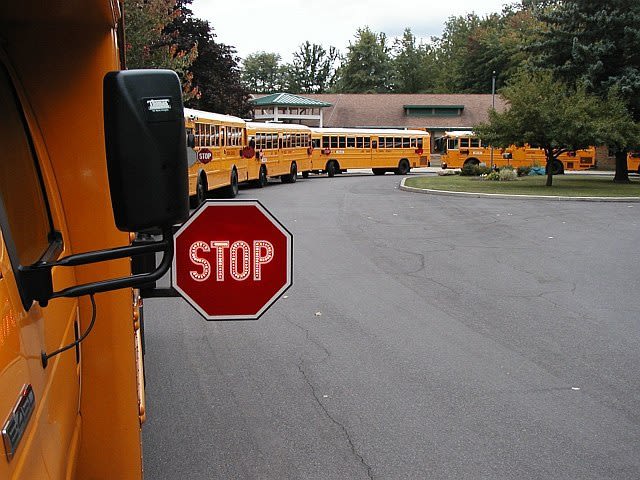
Over 96,000 school bus drivers in 33 states participated in this year’s one-day count of stop-arm violations. Participating drivers reported a total of 74,421 vehicles had passed their buses illegally on that day. Photo by Michael Dallessandro
Over 96,000 school bus drivers in 33 states participated in this year’s one-day count of stop-arm violations. Participating drivers reported a total of 74,421 vehicles had passed their buses illegally on that day. Photo by Michael Dallessandro
Tens of thousands of motorists continue to illegally pass school buses daily nationwide, according to a survey that is spearheaded by the National Association of State Directors of Pupil Transportation Services (NASDPTS).
More than 96,000 school bus drivers in 33 states throughout the U.S., which is almost 20% of the nation’s school bus drivers, according to NASDPTS, participated in a one-day survey to report the number of times motorists passed their stopped buses illegally. On that day, participating drivers reported a total of 74,421 vehicles had passed their buses illegally. NASDPTS officials said that this sample reflects more than 13 million violations in a 180-day school year.
Participation among states was notably higher in this survey compared with last year’s survey, in which 26 states took part in the one-day count. Nearly 80,000 vehicles were found to have illegally passed school buses in that survey.
This is the sixth edition of the survey, which was launched by NASDPTS in 2011.
“We know that students are far safer in school buses, but when they are outside the bus, they are more vulnerable to injury or death,” NASDPTS President Leon Langley said. “This survey captured only a fraction of the violations that bus drivers and traffic officers know all too well are occurring each and every day throughout the United States. It verifies that, unfortunately, motorists continue to pass school buses at an alarming rate.”
Here are some key details on the 2016 survey results:
• Of the total 74,421 stop-arm violations counted, 98.3% were on the left side of the bus (the driver’s side), and the other 1.7% were on the right side.
• Approximately two-thirds of motorists passed buses from the front (59.1%) as opposed to the rear of the bus.
• Slightly more than 46% of the violations occurred in the morning, 4% happened mid-day, and nearly half (49.9%) occurred in the evening.
Results have been consistent since NASDPTS first coordinated the annual survey in 2011. In the 2011 survey results, 76,685 illegal passes were documented during the one-day survey. In 2012, 88,025 illegal passes were reported. There were 85,279 in 2013, 75,966 in 2014, and 78,518 in 2015.
Several states and cities have taken action to cut down on stop-arm running, such as passing laws to allow stop-arm cameras on school buses, and toughening penalties and increasing fines.
In 2016 so far, Alabama passed a law that allows school systems to place stop-arm cameras on school buses and fines to be charged for violations, as did the cities of San Antonio, Texas, and Mercer Island, Washington. Meanwhile, Virginia passed a law that allows tickets to be mailed to the owner of the vehicle involved in the violation (although a school district has delayed installing stop-arm cameras on its buses due to a legal loophole), and a similar bill has advanced in the South Carolina Legislature.
Detailed results from the 2016 survey and from previous years’ surveys can be found at www.nasdpts.org/stoparm.
More Safety

How to Build a Better School Bus Driver Training Program
Is it time to strengthen your driver training? Here’s how to pick the right talent and improve recruitment, retention, and safety. This video is brought to you by IC Bus.
Read More →
Recent School Bus Accidents Leave 2 Dead, 2 Injured
Four school bus crashes in Florida, Illinois, and Georgia highlight risks in transportation lots, at bus stops, and during student loading and unloading.
Read More →
When Every Second Matters, Clarity Keeps Routes Moving
From routine delays to urgent incidents, strong communication practices help drivers, dispatchers, schools, and families respond with confidence.
Read More →

What Happens When a School Bus Catches Fire — and What Can Help
School bus fires are rare but can be devastating. Learn how advances in fire suppression and asset protection help fleets detect fires earlier, reduce damage, and improve safety.
Read More →
Geotab Launches Tool to Help Fleets Investigate Road Incidents
Geotab Investigations combines telematics data, video, documents, and other evidence to help fleets reconstruct incidents, resolve claims, and determine what happened.
Read More →
Texas Sixth Grader Wins 2026 National School Bus Safety Poster Contest
Sai Darshana Yekolu of Moseley Middle School in Prosper, Texas, was named the newest winner for her artwork, bringing the theme of “Safe Rides, Everyday Heroes” to life.
Read More →
Doing More With Less: How Transportation Directors Can Prioritize Safety Amid Budget Uncertainty
With diesel prices soaring and nearly one-third of transportation directors expecting budget cuts, maintaining student safety has never been more challenging. Download this guide to learn how leading districts are prioritizing risk, funding critical safety technology, and building stronger budget cases with data.
Read More →
Walton County Schools Adds Gatekeeper Stop-Arm Enforcement System
The Florida district will deploy Gatekeeper’s updated Student Protector technology, which now incorporates AI to improve video evidence.
Read More →
How To Build a More Secure School Bus Yard During and After Hours
As thefts and overnight security threats continue, school transportation leaders are combining stronger operational practices with AI-enabled surveillance to better protect buses, facilities, and staff.
Read More →
FMCSA Names New Chief Safety Officer: What School Bus Operators Should Know
Steve Dowling is set to lead the federal agency's efforts to advance commercial motor vehicle safety and reduce crashes, fatalities, and injuries on the nation's roadways.
Read More →