




NTSB: Bus driver in Huntsville crash was unbelted
The National Transportation Safety Board’s long-awaited report on the fatal 2006 crash confirms that the school bus driver was not wearing his seat belt, which allowed him to be thrown from the bus before it plunged 30 feet off of a highway ramp.

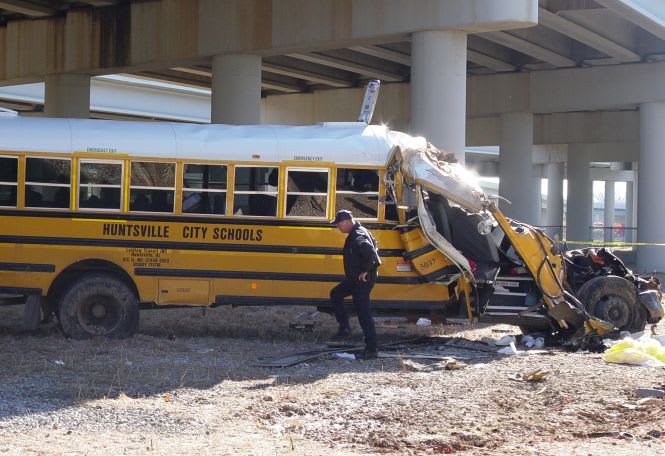
WASHINGTON, D.C. — The school bus driver in the fatal 2006 crash in Huntsville, Ala., was not wearing his seat belt, which allowed him to be thrown from the bus before it plunged 30 feet off of a highway ramp, according to federal investigators.
That finding was part of the National Transportation Safety Board’s (NTSB) long-awaited report on the accident, in which four students were killed and more than 30 others were injured.
The 71-passenger conventional bus was transporting 40 high school students on Nov. 20, 2006. On a two-lane elevated highway transition ramp, a Toyota Celica driven by a high school student attempted to pass the bus in the right lane, according to witnesses.
The car driver later said that as he came alongside the bus, the car began fishtailing and became impossible to control, and he veered to the left, striking the right front tire of the bus. The vehicles remained in contact as they swerved to the left, both striking a 32-inch-high cement bridge rail.
The bus climbed and overrode the bridge rail. The unbelted bus driver was ejected onto the roadway. The bus continued along the top of the bridge rail for about 117 feet before rolling and falling 30 feet to a dirt and grass area beneath the ramp. The bus landed on its front end and then came to rest upright on its wheels.
Probable cause
NTSB found that the probable cause of the crash was “a vehicle loss of control during a passing maneuver around a curve by the Toyota driver attempting to overtake the school bus prior to an impending exit both drivers intended to take.” The bus overrode the bridge rail because the presence of the Toyota restricted its trajectory away from the rail, the agency said.
The fall severely damaged the bus. The steering wheel and column were crushed downward into the driver seat. The roof was crushed about 36 inches into the driver area and loading door. The roof also intruded into the first passenger row, but NTSB said the maximum extent of the intrusion couldn’t be determined because of the use of extrication tools and other devices after the accident.
NTSB said that based on interviews with first responders and bus passengers, there were at least five full ejections and one partial ejection during the accident.
Seat belt potential
The NTSB report addressed how the outcome might have changed if the bus passengers had lap-shoulder belts.
Three of the four killed were front-row passengers; the other was in the second row. “Had the school bus been equipped with lap-shoulder belts, some serious injuries might have been mitigated among occupants seated away from the area of intrusion, such as the fatally injured passenger in the second row and the seriously injured passengers in the rear of the bus, because the belts would have kept these students within their seating compartments during the accident sequence,” NTSB said.
However, the agency said that because it couldn’t be determined whether the roof impinged upon the “survivable space” of the first-row passengers, it’s unclear whether lap-shoulder belts would have saved those students.
The accident rekindled the decades-old debate of whether school buses should have seat belts, and it precipitated the National Highway Traffic Safety Administration’s (NHTSA) 2007 summit to discuss that issue. NHTSA ultimately issued a final rule requiring lap-shoulder belts in small school buses but leaving them optional for large school buses.
In the Huntsville report, NTSB was critical of that final rule, saying it “did not provide a uniform level of safety for all school bus occupants.” However, NTSB noted that NHTSA is currently testing methods to provide passenger protection for school bus sidewalls, sidewall components and seat frames.
On the ramp
In the Huntsville crash, the car driver and passenger were not injured. While investigators found examples of poor maintenance on the car, including mismatched front and rear tires and a loose right-front lower control arm ball joint, NTSB concluded that it was “unlikely that these defects caused or contributed to the loss of control.”
The bus driver sustained serious injuries. NTSB said that since the bus loading door also serves as an emergency exit, the force needed to push the door open couldn’t be so much that it would prevent children from being able to do so. Accordingly, the driver, at 6 feet 2 inches tall and about 340 pounds, would have had sufficient force to open the door as he fell during the accident sequence.
The NTSB report did not address how the outcome might have differed if the bus driver had been wearing his seat belt.
To read the full report, click here.
More Safety

Geotab Expands Fleet Safety Tools With Video Coaching, Risk Insights
New safety and video capabilities aim to help fleet managers assess risk, support drivers, and take targeted action through video coaching, red-light violation detection, and more.
Read More →
How to Build a Better School Bus Driver Training Program
Is it time to strengthen your driver training? Here’s how to pick the right talent and improve recruitment, retention, and safety. This video is brought to you by IC Bus.
Read More →
Recent School Bus Accidents Leave 2 Dead, 2 Injured
Four school bus crashes in Florida, Illinois, and Georgia highlight risks in transportation lots, at bus stops, and during student loading and unloading.
Read More →

When Every Second Matters, Clarity Keeps Routes Moving
From routine delays to urgent incidents, strong communication practices help drivers, dispatchers, schools, and families respond with confidence.
Read More →
What Happens When a School Bus Catches Fire — and What Can Help
School bus fires are rare but can be devastating. Learn how advances in fire suppression and asset protection help fleets detect fires earlier, reduce damage, and improve safety.
Read More →
Geotab Launches Tool to Help Fleets Investigate Road Incidents
Geotab Investigations combines telematics data, video, documents, and other evidence to help fleets reconstruct incidents, resolve claims, and determine what happened.
Read More →
Texas Sixth Grader Wins 2026 National School Bus Safety Poster Contest
Sai Darshana Yekolu of Moseley Middle School in Prosper, Texas, was named the newest winner for her artwork, bringing the theme of “Safe Rides, Everyday Heroes” to life.
Read More →
Doing More With Less: How Transportation Directors Can Prioritize Safety Amid Budget Uncertainty
With diesel prices soaring and nearly one-third of transportation directors expecting budget cuts, maintaining student safety has never been more challenging. Download this guide to learn how leading districts are prioritizing risk, funding critical safety technology, and building stronger budget cases with data.
Read More →
Walton County Schools Adds Gatekeeper Stop-Arm Enforcement System
The Florida district will deploy Gatekeeper’s updated Student Protector technology, which now incorporates AI to improve video evidence.
Read More →
How To Build a More Secure School Bus Yard During and After Hours
As thefts and overnight security threats continue, school transportation leaders are combining stronger operational practices with AI-enabled surveillance to better protect buses, facilities, and staff.
Read More →