




Carrollton bus crash survivor points to the positives
It has been 25 years since the fiery Kentucky bus crash that killed 27 people. Jason Booher, now a high school administrator and coach, recounts his narrow escape from the burning bus and discusses the safety improvements that stemmed from the tragedy.

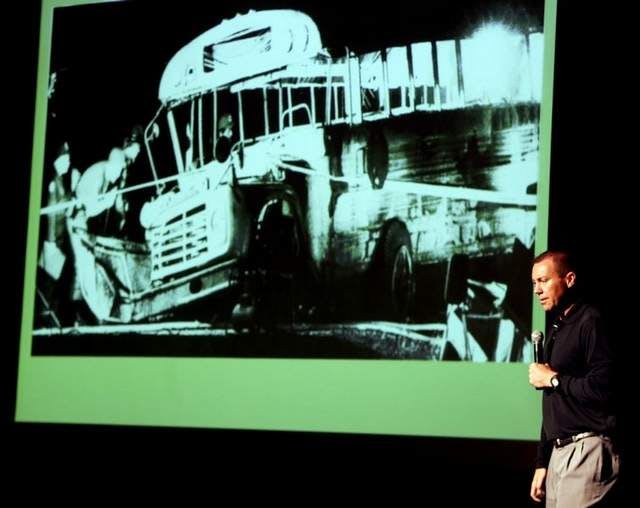
Jason Booher, who was 13 when he survived the Carrollton bus crash, now speaks to students, churches and school bus drivers about the lessons learned from the tragedy.
A church group was on its way home from an amusement park in a retired school bus when disaster struck.
Larry Mahoney, driving a pickup truck with a blood alcohol content of 0.24, barreled head-on into the bus. Gasoline from the bus’ punctured fuel tank was ignited, and fire quickly engulfed the bus as the passengers scrambled to get through the rear emergency exit.
The front door was disabled by the crash and blocked by flames, and there were no other emergency exits on the vehicle — a former school bus that was built just a few days before the critical 1977 Federal Motor Vehicle Safety Standards (FMVSS) for school buses went into effect.
Twenty-seven people — mostly teenagers — died in the inferno.
After that May 14, 1988, crash near Carrollton, Ky., numerous safety measures were implemented to improve school bus safety and to crack down on drunken driving. Among them: FMVSS 217 was revised to require that the total area of emergency exits be based on the designated seating capacity. Many states made concentrated efforts to phase out all pre-1977 buses. And Kentucky significantly enhanced its school bus safety specs and lowered its blood alcohol limit.
One of the survivors of the Carrollton crash was Jason Booher, who is now assistant principal and head boys basketball coach at Holmes High School in Covington, Ky. Twenty-five years after the tragedy, Booher spoke with SBF Executive Editor Thomas McMahon about his escape from the bus, the messages he shares with students and bus drivers, and the safety improvements made in the wake of the crash.
SBF: How old were you at the time of the Carrollton crash?
JASON BOOHER: I was 13.
Do you mind talking about what you experienced during the crash and how you were able to get out of the bus?
We had just filled up. Of course, it was an old bus. We had an unleaded fueled bus, and … we didn’t have a cage around the gas tank. We didn’t have flame retardant seats. The windows didn’t really even work. And it was a little window, so you couldn’t fit out of it anyways. There were no pop-out doors or pop-out tops [roof hatches]. And the back seats, they were full seats instead of half seats, so they covered a little bit of the emergency exit door.
Anyways, we had just filled up with unleaded gas and were driving down the interstate. There was joke telling, and it was loud on there — we were just having fun. Then Larry Mahoney, the drunk driver, hit us head-on. All of a sudden, we were slammed into the seat in front of us. He hit right there on the stairwell where you enter the bus. That’s where the gas tank was — right behind that. He hit that and punctured it, and it splashed gas all the way down the outside side of the bus, on the right side. That’s where I was sitting, against the window.
After we gathered ourselves there in the seat, there was a big ball of fire on the outside of the bus. Nowadays, you can’t have anyone sitting in the stairwell. Chuck, the youth director of the church that sponsored the trip, was sitting in the stairwell, so he stood up, and he was immediately engulfed in flames. He yelled out, “Lord, I’m coming home!” That was unbelievable, to witness something like that.
We had a couple of coolers in the aisle, which you can’t have nowadays. People were sitting on the coolers because it was so crowded on there. The maximum was 67 on the bus, and that’s how many we had on there, but you can’t put 67 teenagers on a bus that’s maxed out at 67.
[PAGEBREAK]
When Chuck stood up and was engulfed in flames, I knew something bad was happening. This bus in 90 seconds was over 1,500 degrees, and it’s not a nice, neat orderly fashion when that’s happening. Most of the kids went down the aisle. We only had one exit to get out, which was the back. We didn’t have all [the additional emergency exits] like they do today.
So everybody tried to get out that back door, because the front was already engulfed in flames. And they tripped over the cooler standing out there, so it was like a domino effect. All those kids pushing and shoving, they just piled up at the back. So instead of going down the aisle, I was already against the right window, so I just stood up on the back of my chair. I was at the fifth seat from the back. So I climbed over a couple of the chairs.
The kids were piled up almost to the top of the emergency door. I saw a little opening up there, and I dove out it, and then I just turned around and we started pulling kids out and so forth. I thought we had everybody out. It was dark and there was all that smoke from everywhere, so you could only see 4 or 5 feet back in the bus, but we finally got all that clear. I thought we had all 67 of us out, but obviously we didn’t. You know, only 40 of us made it out. Many of those 40 were severely burned. I was a lucky one and didn’t have any burns at all. I got out pretty quick.
So you weren’t really physically injured?
No. They treated me for smoke inhalation, but besides that, I was fine. I was one of the few lucky ones. I think there were only like 10 of the 40 that didn’t get burned severely. So I was really fortunate that day.
My best friend since first grade — this was at the end of my eighth grade year — Chad, he was sitting right there in the seat with me, and he didn’t make it out. He tried to go down the aisle, and he got tripped up and then he got really piled up on from people behind him.
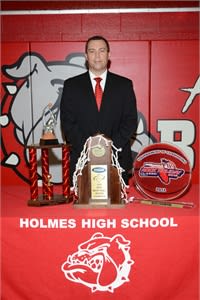
In addition to serving as assistant principal at Holmes High School in Covington, Ky., Booher is the school’s head boys basketball coach.
What kind of recovery process did you go through after this?
Well, school was letting out, so the next week after the bus crash, I spent going to all these funerals — we had 27. That includes being a pall bearer at my best friend’s funeral. That was at 13 years old, and just to go through what I had to see on the bus and then find out 27 of them didn’t make it out, that was unbelievable for that next week. And then most of the survivors were severely burned; they were having to have multiple skin grafts. So after all these funerals that week or so, the next couple months I spent going to Louisville visiting all of my friends. That’s what I did that whole summer after the bus crash. Once we started at North Hardin High School, Hardin County Schools actually hired a specific counselor that deals with tragic events in teenage lives. They brought her in, and she did a really good job of counseling the survivors and the victims, and even those that lost a friend or something. They had her there at the high school for two years, if I remember right, just to help cope and deal with all of that. So it was tough, not just on me, but on that whole community, really.
You’ve said that you’re seeing positives come out of this tragedy. What have those been?
When you go through something like that at such a fragile age of 13, you’re thinking there is no way in the world anything positive could ever come out of this bus crash — 27 lives lost, many of the survivors have to look in the mirror every morning and see their face disfigured for life. So during my high school years, I’m thinking there’s no way that anything positive could come of it.
But with time, I’ve realized there have been probably thousands of lives saved because of it. I usually point out three major things: One is the stiffer drinking and driving laws. At the time, .10 was the legal limit [in Kentucky]. Now, they got it reduced to .08. And there’s been stiffer drinking and driving consequences because of it [the Carrollton crash].
The second thing is the bus safety. Those bus safety features that we have today [for example, Kentucky went on to require nine emergency exits, flame-retardant seats and floors, and other enhancements] are really because of learning from the mistakes from that old bus we were on.
And then the third thing is the educational part that’s come from the bus crash. Some of the survivors — myself and a couple others — go around the state and the nation speaking to young people. We speak to schools and churches. We go to juvenile detention centers. We go to bus driver training. We speak to thousands of people a year about the consequences of drinking and driving.
When you talk to school bus drivers, what are the main points that you try to make?
I always tell them I would have never thought that anything like this would happen to me, and this stuff can happen. So you’ve got to prepare in advance in your head. If something like this happens, how are you going to respond? You’ve got to have all of that mapped out before it happens. That way you can save hopefully all of the kids that are on there. Because their safety is No. 1.
[Another point is] taking these bus evacuation drills seriously each year instead of just going through them to get it done because it’s an annual thing that they have to do.
Are there any other ways that going through this crash has shaped you as a person?
When that happened to me, I said that if alcohol has this big of an impact on not just myself but my community, my family and so forth — I had never tasted alcohol, so I just said, look, that stuff’s not worth it. I’m going to go through life, and I’m going to be able to tell all these thousands of kids that I’m going to speak to that I’ve had more fun than anybody, and I’ve never tasted alcohol, experimented with drugs or anything else. I always tell them that I’m a living witness that you can have a ton of fun without these things.
As assistant principal, is school busing something that you’re involved with — in terms of student discipline, loading zone safety, etc.?
Yes. I usually deal with any discipline problems we have on the bus. This makes 12 years that I’ve been assistant principal. The last 12 years, I’ve dealt with discipline problems on the bus, and I’ve told them that those bus safety issues — there’s a reason why we take that stuff seriously, and it’s because of the Carrollton bus crash. Every year, I speak to the freshman class about the bus crash, so they know my story when they’re called into my office.
Survivors reunite, view documentary
Survivors and family members of those lost in the Carrollton bus crash gathered in Hardin County, Ky., in May to observe the 25th anniversary of the tragedy.
“It was pretty neat, because it had been a long time — since high school — since a lot of us had seen each other,” Jason Booher says. “My best friend, Chad, who was sitting next to me, didn’t make it out of the bus. I hadn’t seen his parents since high school, and they flew up. … It was pretty neat to reunite with them.”
Booher was also asked to speak to students at North Hardin High School. It was the first time he had gone back to his alma mater to share his testimony.
“The kids responded really well,” he said. “You could hear a pin drop.”
After the reunion, survivors and family members got a private viewing of a new documentary about the Carrollton tragedy, Impact: After the Crash.
“It’s really good,” said Booher, who is interviewed in the film. “It reenacts the bus crash perfectly, like you were there.”
To watch trailers for the documentary, go to theimpactmovie.com.
More Safety
HopSkipDrive Reports Progress on Safety Advisory Council
More than a year after forming the council, independent safety experts have helped shape new rider-safety features and policy progress, with a new goal to address rider behavior.
Read More →
What the 2026 National School Bus Safety Month Resolution Means for Student Transportation
The bipartisan resolution highlights illegal school bus passing, student safety during loading and unloading, and the need for driver training and public education.
Read More →
School Bus Stop-Arm Violations Decline 53% Across Verra Mobility Programs
Verra Mobility shares how school bus stop-arm cameras and school zone safety programs are changing driver behavior, reducing violations, and protecting students.
Read More →
Most Bus Crashes Aren’t Your Fault. Here’s How to Prove It.
A guide for what to do in between a school bus crash and a claim: what to preserve, who to notify, and how to keep the facts available when they matter.
Read More →
National School Bus Safety Week 2026: Tips, Toolkits & Resources to Keep Students Safe
School bus safety takes more than awareness. Explore expert tips, enforcement strategies, and free resources to help protect students on every ride.
Read More →
2 Killed, Dozens Injured in Florida School Bus Crash
A multi-vehicle collision caused a Polk County school bus carrying 37 students to overturn on its way to Winter Haven High School.
Read More →
Illegal School Bus Passing Drops 24% in New York Districts
With fewer than 5% of citations involving repeat offenders, Westchester County officials said enforcement, education, and community partnerships are helping change driver behavior.
Read More →
School's Back. Here's What Happened to Traffic, Speeding & Distraction
What happens to traffic when school resumes? New data analysis examines changes in distracted driving, congestion, and speeding around schools.
Read More →
Geotab Expands Fleet Safety Tools With Video Coaching, Risk Insights
New safety and video capabilities aim to help fleet managers assess risk, support drivers, and take targeted action through video coaching, red-light violation detection, and more.
Read More →
How to Build a Better School Bus Driver Training Program
Is it time to strengthen your driver training? Here’s how to pick the right talent and improve recruitment, retention, and safety. This video is brought to you by IC Bus.
Read More →