




NHTSA panel to revisit school bus seat belt issue
The federal agency will convene a group to examine the long-debated topic of seat belts on school buses. A NHTSA spokesman tells SBF that plans for the panel are just getting underway.

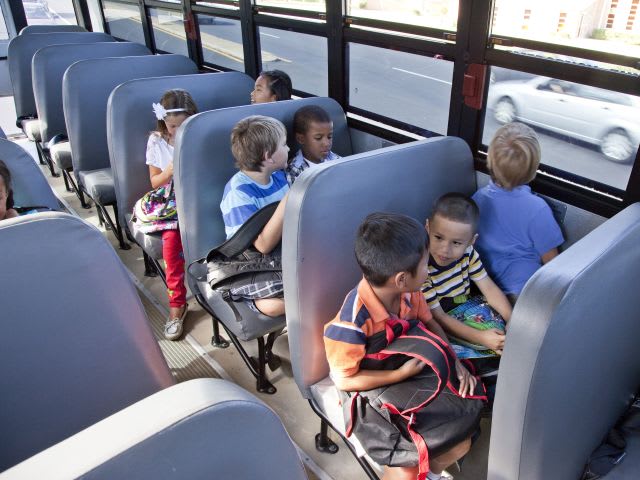
NHTSA has long declined to mandate seat belts on large school buses, but now the agency is convening a panel to examine the issue.
WASHINGTON, D.C. — The National Highway Traffic Safety Administration (NHTSA) will convene a panel to examine the long-debated topic of seat belts on school buses, agency officials said.
A NHTSA spokesman told SBF that the agency has just started putting plans in motion for the panel. The spokesman said that details on what the group will do, and a timeline on when they will do it, aren’t available at this point, but more information will be released as the plans become more concrete.
Lap-shoulder belts are federally required on small school buses — specifically, those weighing 10,000 pounds or less — but NHTSA has long declined to mandate belts on large school buses.
New NHTSA Administrator Mark Rosekind spoke at the American School Bus Council’s Love the Bus event at a school in Arlington, Virginia, on Tuesday. After the event, he told The Detroit News that a group within NHTSA will study the school bus seat belt issue.
“It’s absolutely appropriate for us to look at every possible way we could make things safer,” Rosekind told the newspaper. “It’s very clear there’s a safety issue, and then there’s an economic one — and that’s the discussion everyone has. … We’ve already put a group together that is now examining this issue about safety belts on school buses.”
NHTSA’s last major statement on the topic was an August 2011 denial of a petition from the Center for Auto Safety and others asking the agency to mandate the installation of three-point seat belts for all seating positions on all school buses.
In the Aug. 25, 2011, edition of the Federal Register, NHTSA said that it was denying the petition because it had “not found a safety problem supporting a federal requirement for lap-shoulder belts on large school buses, which are already very safe.”
NHTSA said that the decision to install seat belts on school buses should be left to state and local jurisdictions. The agency also said that a federal requirement for seat belts on large school buses would increase the cost to purchase and operate the vehicles, which could reduce the availability of school bus service overall, and reduce school bus ridership.
However, with a new administrator at the reins, NHTSA appears to be revisiting its stance on the seat belt issue. Before he was sworn in to lead NHTSA last month, Rosekind served a term as a member of the National Transportation Safety Board (NTSB).
In 2013, NTSB effectively endorsed seat belts for school buses after investigating the February 2012 fatal school bus crash near Chesterfield, New Jersey, and the March 2012 fatal school bus crash in Port St. Lucie, Florida. The agency's staff said they believe that lap belts can provide a benefit to most school bus passengers who wear them properly, although the addition of shoulder belts would reduce flailing injuries and provide greater protection.
In response to the Chesterfield crash, the NTSB developed close to a dozen safety recommendations on truck and school bus topics. One of the recommendations asked the school bus industry's national associations to provide their members with educational materials on lap-shoulder belts "providing the highest level of protection for school bus passengers."
NTSB’s recommendations are influential, but they have no regulatory authority. NHTSA is the federal agency that is responsible for regulating school buses, as well as other vehicles.
More Safety

How to Build a Better School Bus Driver Training Program
Is it time to strengthen your driver training? Here’s how to pick the right talent and improve recruitment, retention, and safety. This video is brought to you by IC Bus.
Read More →
Recent School Bus Accidents Leave 2 Dead, 2 Injured
Four school bus crashes in Florida, Illinois, and Georgia highlight risks in transportation lots, at bus stops, and during student loading and unloading.
Read More →
When Every Second Matters, Clarity Keeps Routes Moving
From routine delays to urgent incidents, strong communication practices help drivers, dispatchers, schools, and families respond with confidence.
Read More →

What Happens When a School Bus Catches Fire — and What Can Help
School bus fires are rare but can be devastating. Learn how advances in fire suppression and asset protection help fleets detect fires earlier, reduce damage, and improve safety.
Read More →
Geotab Launches Tool to Help Fleets Investigate Road Incidents
Geotab Investigations combines telematics data, video, documents, and other evidence to help fleets reconstruct incidents, resolve claims, and determine what happened.
Read More →
Texas Sixth Grader Wins 2026 National School Bus Safety Poster Contest
Sai Darshana Yekolu of Moseley Middle School in Prosper, Texas, was named the newest winner for her artwork, bringing the theme of “Safe Rides, Everyday Heroes” to life.
Read More →
Doing More With Less: How Transportation Directors Can Prioritize Safety Amid Budget Uncertainty
With diesel prices soaring and nearly one-third of transportation directors expecting budget cuts, maintaining student safety has never been more challenging. Download this guide to learn how leading districts are prioritizing risk, funding critical safety technology, and building stronger budget cases with data.
Read More →
Walton County Schools Adds Gatekeeper Stop-Arm Enforcement System
The Florida district will deploy Gatekeeper’s updated Student Protector technology, which now incorporates AI to improve video evidence.
Read More →
How To Build a More Secure School Bus Yard During and After Hours
As thefts and overnight security threats continue, school transportation leaders are combining stronger operational practices with AI-enabled surveillance to better protect buses, facilities, and staff.
Read More →
FMCSA Names New Chief Safety Officer: What School Bus Operators Should Know
Steve Dowling is set to lead the federal agency's efforts to advance commercial motor vehicle safety and reduce crashes, fatalities, and injuries on the nation's roadways.
Read More →