




NAPT News & Views — Why you should love the bus
Mid-August through mid-September each year is the perfect time to let everyone know about a project that began in 2007 called “Love the Bus.” I encourage everyone who cares about school buses to learn more about what NAPT and its partners in the American School Bus Council are doing to promote the yellow school bus and help us by spreading the word.

Michael Martin is executive director of NAPT.
Beginning each August and through the middle of each September, millions of parents entrust for another year the lives of more than 25 million of their children to those of you who drive, maintain, repair and otherwise manage America’s largest public transit system.
You, in turn, do a fantastic job of holding up your end of the bargain. Year after year, statistics show that a school bus is the safest way for children to get to and home from school; it has been that way for decades.
That’s why mid-August through mid-September each year is the perfect time to let everyone know about a project that began in 2007 called “Love the Bus.” A small group of us — parents all — realized that we and our children might be among the last to know why school buses replaced the red apple and the lamp of learning as the most recognizable symbol of American education.
Several of us had been working with government officials and policy-makers around the world who were seeking to learn about and replicate the incredible transportation system Americans have come to take for granted. And we thought it was wickedly ironic that at the same time these other countries — many of whom have been labeled threats to our way of life or at least our economic health and vitality — were seeking to build something like what we have, our government officials and policy-makers seemed to be doing the opposite.
Do you know that school transportation is only required in 28 states? Do you know that the percentage of districts nationwide implementing transportation cuts grew from 10% in 2008‐09 and 20% in 2009‐10 to 38% last year? The more we thought about the implications of these facts and trends, the more troubled we became.
So, we decided to begin spreading the word that school bus transportation reduces congestion and pollution, conserves fuel, provides access to education and protects young lives.
Consider these facts:
• School buses reduce congestion. One school bus on average replaces 36 individual vehicles, relieving our national highway system of more than 17 million additional cars, light trucks and SUVs during morning and late afternoon rush hours. Losing school bus service would create traffic chaos and gridlock for commuters and local drivers.
• School buses reduce pollution. Nationwide, the yellow school bus fleet reduces CO2, a major cause of global warming, by 44.3 billion tons per year. Moreover, school buses are leading the move to cleaner diesel vehicles through millions of dollars spent on retrofits and replacement of older buses.
• School buses conserve fuel. By replacing 36 individual vehicles, each school bus saves about 6,500 gallons of gas annually. Altogether, our country saves 2.3 billion gallons of fuel every year through school buses.
• School buses provide access to education. Fifty-five percent of the students in grades K-12 across America rely on the school bus to get to and home from school, and many of them have no other option. For millions of children, the school bus ensures they receive more than an education; it also gives them access to breakfast and lunch, medical care and social services.
• School buses save lives. Among the 25 million students who go to and from school on the bus, there is an average of 20 school bus-related fatalities per year — and just six of them are passengers. Among the other 25 million students who go to and from school some other way — walking, bicycling, or riding in a passenger car, light truck or even an SUV — there are nearly 600 fatalities a year! Teenagers especially are far more likely to arrive alive if they take the bus than if they ride or drive with friends.
• School buses are cost-effective. The per passenger per mile cost of school buses is only about one-third the cost of a transit bus and about 28% of the cost of private vehicles.
In short, school buses are the most effective, efficient form of mass transit in America, if not the world.
In addition, school buses cause less road wear than other commercial vehicles; the average full-size school bus weighs less than 30,000 lbs., compared to 40,000 lbs. for a transit bus, 50,000 for a motorcoach and nearly 80,000 for a semi-trailer. Since, on average, one bus takes the same number of children to and from school as 36 cars, light trucks or SUVs, each school bus actually reduces wear and tear on local roads by 126,000 lbs. during school commute times. Multiplied by the roughly 480,000 school buses across the country, the net effect is a reduction of 60.5 billion lbs. on the nation’s roadways every day.
I encourage everyone who cares about school buses to memorize this information and visit www.
americanschoolbuscouncil.org, www.schoolbusfacts.com or visit (and “Like”)
www.facebook.com/lovethebus or follow @WeLovetheBus on Twitter to learn more about what NAPT and its partners in the American School Bus Council are doing to promote the yellow school bus. Then, help us by spreading the word.
More Management

STA Acquires Sunrise Transportation
Student Transportation of America expands in Illinois and Connecticut through Sunrise's fleet of nearly 1,000 vehicles.
Read More →
EPA Opens $180M DERA Funding Round for Diesel Upgrades
The 2026 Diesel Emissions Reduction Act program seeks applications from eligible organizations to accelerate the retirement of legacy diesel vehicles.
Read More →
HopSkipDrive’s CareEngine Targets the ‘Exceptions’ in Student Transportation
The new platform works alongside districts’ existing transportation management systems to coordinate specialized rides, automate last-minute changes, and turn ride data into operational improvements.
Read More →


The Right Ride for Every Student: Navigating the New Student Transportation Ecosystem
How should districts blend school buses with small-vehicle transportation and other options? EverDriven CEO Mitch Bowling discusses safety, costs, partnerships, and strategy.
Read More →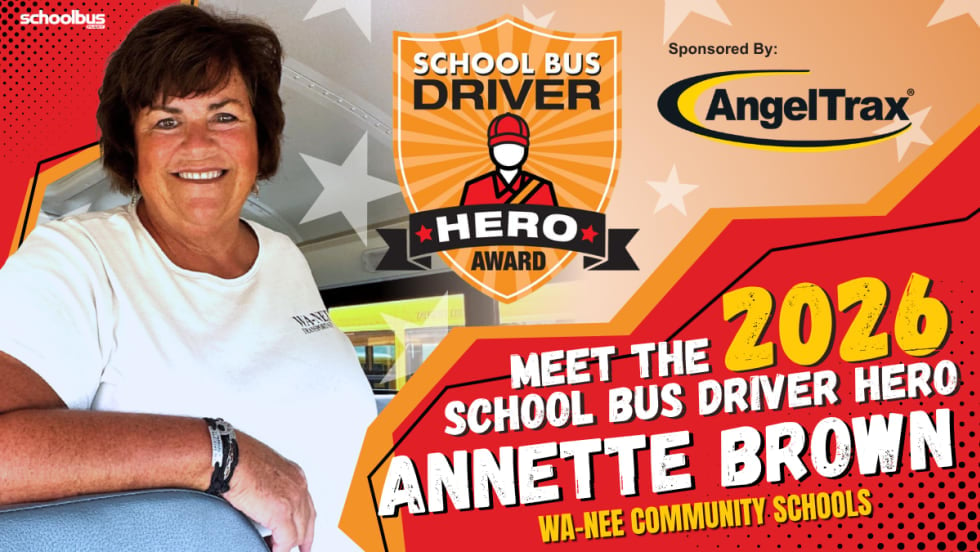
Annette Brown Always Takes the Extra Time: Meet Our 2026 School Bus Driver Hero
For more than 30 years, the Wa-Nee Community Schools driver has treated students like family, combining safety, compassion, and servant leadership to make a lasting difference on and beyond the school bus.
Read More →
How to Build a Better Driver Training Program
Ready to boost up your school bus instructor training? Here’s how to pick the right talent and improve recruitment, retention, and safety.
Read More →
CALSTART and Forth Combine to Form Catalyst Mobility
The new name represents a renewed vision for the nonprofit focused on advancing clean, equitable, and affordable transportation solutions that move people and goods.
Read More →
What Makes a Great School Bus Driver Trainer?
Choosing the right school bus driver trainer takes more than experience. Learn six keys to selecting and developing trainers and evaluating program effectiveness.
Read More →
School Bus Contractors Expand Through New Deals, Acquisitions & Partnerships
STA's Canadian division acquires Ontario-based G&L Stevenson Transport; Durham School Services adds a new district in California; First Student expands in New Jersey; and Minnesota Coaches rebrands and acquires Halo Transportation.
Read More →
Logan Bus Company Rolls Out AI Phone System for NYC School Bus Families
A summer pilot found that AI agents could handle most routine calls, freeing up time for customer service staff to focus on emergencies and complex family concerns.
Read More →