




Building a Greener Future
Virginia Beach City Public Schools’ new transportation facility is expected to save $50,000 to $55,000 per month in energy costs with its many green features, which include wind turbines, solar panels and natural light.
Constructed in 1936, Virginia Beach (Va.) City Public Schools’ outdated transportation facility had in recent years left the district struggling to adapt it to fit the needs of its ever-expanding fleet.
The facility had begun to dictate the types of vehicles the district could purchase, and space had become an issue — despite the addition of three bays in 1956 and the construction of a butler-type building in 1977.
“[The facility] is so old and the bays are so small that we couldn’t buy transit-style buses because we couldn’t get them into the garage bay,” explains David Pace, director of transportation services for Virginia Beach City Public Schools. “It is just a tremendously old building, so we needed to replace it.”
In April, the district opened a brand new, state-of-the-art transportation center, the Pupil Transportation Maintenance Facility. Dills Architects, a firm based in Virginia Beach, won the bid for the project. The $21.8 million dollar facility will serve not only the 761 buses owned by the district, but also 790 other vehicles, including maintenance trucks, motor pool vehicles and other pupil transportation vehicles.
Going green, saving money
Beyond meeting basic capacity needs of the district, the Pupil Transportation Maintenance Facility has achieved the LEED Platinum rating, the highest awarded in LEED certification.
Through energy modeling, the architecture firm has determined that the district will save $50,000 to $55,000 per month in energy costs through use of the facility’s many green features.
“The [LEED certification process] requires a certain level of energy efficiency. We’re beating that by 60 percent,” says Clay Dills, the project’s architect. “So you figure that if you were at an efficiency required by code, we’ve dropped the bill down to only 40 percent of that.”
The facility is the first in Virginia Beach to be equipped with wind turbines (pictured on the cover of this issue), which are expected to counteract a minimum of 5 percent of the total onsite energy usage. The four onsite turbines are fed directly into the site’s meter, and the energy output can slow down the meter or even spin it backward if the buildings are not using any energy at the time. This helps the district keep track of energy gained through wind power and also provides a viable teaching tool for the district’s students.
“All the data from the windmills is fed into the school system,” Dills says. “So if you’re a student in a middle school somewhere, you can actually monitor on your computer how the windmills out at the transportation site are doing.”
“I thought that was one of the big pluses with this: Everything is open to the kids,” Pace says. “They can come and look at it; they can actually see how it works and how it operates. It’s a great teaching tool.”
The facility also saves energy by heating the service bays through radiant floor heating that is fed by onsite solar panels. The energy from the solar panels creates hot water, which then circulates in the floors.
“I don’t know of any other facilities that have done that in the floor of a bus facility, but it actually has cut the heating and cooling bill in half for the whole facility,” Dills explains. “The premise of this is that if you’re in the space and you’re 6 feet tall, you only need to heat 6 feet of the airspace. So you heat the floor with solar panels and then that heat rises up through your body or where you need the temperature and then it’s ventilated out the top.”
Dills adds that this process also brings fresh air into the building, which allows for natural ventilation and efficiency.
The facility also saves energy by incorporating natural light and outside views into 98 percent of spaces, which is 8 percent higher than what is required for LEED certification. Solar screens and building orientation prevent solar gain so that bringing natural light into the building will not increase cooling costs. Similarly, the paving on the site is white and highly reflective to reduce heat island effects.
[PAGEBREAK]
Rain gardens, green roof
Dills Architects has also incorporated rain gardens into the design of the transportation facility. These gardens have a dual purpose: They improve the physical appeal of the site while providing a natural filtration system. The site includes two wet ponds and seven bioretention basins.
As oil and other contaminants enter the facility, they will be washed by storm water into these gardens, which have been purposely landscaped with plants that produce microbes that consume these contaminants.
“It’s called a zero storm water site or a net-zero site,” Dills says. “You treat everything that you do onsite. This is a big deal — there’s probably only a handful in our state.”
Water runoff from the roof is collected into three onsite cisterns that can hold up to 45,000 gallons of water in total. This water is then filtered and used for secondary water uses, such as in toilets, irrigation or the facility’s bus wash.
The cisterns are designed to support the facility’s secondary water needs for up to four months in a drought period. The district projects that it will save 1 million gallons of water per year through this method.
Water is also treated by the green roof on the facility’s maintenance building. A 6-inch layer of soil and plants on the roof treat storm water in the same way as the site’s rain gardens. In addition, the green roof reduces outside noise and actively lowers the interior noise levels to well below a typical office building. These rooftop gardens cover 19,000 square feet and will help to save the district approximately 225,000 gallons of water per year.
The onsite water treatment processes, according to Dills, have effectively reduced the ecological footprint of the facility to resemble that of the farmland that existed before it.
Site’s challenges, advantages
The Pupil Transportation Maintenance Facility is located on a piece of virgin farmland adjacent to the Oceana Naval Air Station, which presented several challenges during construction. The district sought military approval when choosing the site, since it is in the station’s flight path.
The district chose not to rebuild on the site of the current facility; instead, that site is being used as a staging area for the district’s vehicles.
“When you’re building a maintenance facility for 761 school buses, not everyone wants that in their back yard,” Pace says. “Particularly in Virginia Beach, there isn’t a lot of land that size that you could build [a facility] on that was well accepted. Therefore, we had to deal with the navy and the military to get approval to put it on this site. And that was quite a challenge — to the point that we did make some concessions.”
The concessions made by the district, Pace notes, were not big ones. First, fuel tanks could not be installed on the new site. The district continues to fuel vehicles on its old site, which Pace says is perfectly convenient and has helped to keep the new site environmentally friendly.
Also, Dills Architects was required to do extensive height modeling for the site’s wind turbines, which could have potentially interfered with planes leaving or arriving at the naval station.
“The wind turbines are at their height limit for airplanes,” Dills says. “They’re 60 feet — that’s to the blade tip.”
The turbines were the first in Virginia Beach, and “when you’re the first of anything, the city officials don’t really know how to handle what you want to do,” Dills notes. “There’s a generally lengthy and tedious process that comes with that as well. They had to create a zoning ordinance for us to be able to do it.”
Pace says the district’s determination to include wind turbines in the site plan sped up the city’s process. It wasn’t until the turbines had already been installed that an ordinance was created.
“We sort of motivated them because wind-generated electricity is the talk of even our governor, who wants to put windmills out in the Atlantic,” Pace says. “So it’s getting a lot of publicity here in Virginia. Virginia Beach is ahead of the curve.”
The facility’s construction has also been environmentally friendly. The buildings themselves were created using 35 percent pre- and post-consumer recycled content, and over 75 percent of the materials were acquired from within a 500-mile radius. Over 90 percent of construction waste was recycled instead of sent to a landfill.
Much-needed space
The transportation facility’s new location has the added benefit of more space. The district’s transportation offices were previously housed in temporary, offsite modular buildings. With the opening of the new facility, transportation services administration staff will be located in an onsite building dedicated for that purpose. The site is also host to a maintenance building, which includes repair shops, offices, tire storage and a dedicated bus wash.
The site layout has been designed to provide maximum functionality. The maintenance building is equipped with a large double loading area and a mezzanine. Maintenance crew members can easily drive vehicles through the building’s double bays to the other side and then continue on to the tire storage or the bus wash. This creates a convenient traffic flow.
“You can’t put in words what this means to my staff, to my mechanics and my bus drivers,” Pace says of the new facility. “We’ve been in some really dilapidated kinds of spaces. Having this kind of facility — a state-of-the-art facility — coupled with the fact that we’re doing the right thing by investing in the environmental components of this building, it’s just a huge morale builder.”
More Alternative Fuels

CALSTART and Forth Combine to Form Catalyst Mobility
The new name represents a renewed vision for the nonprofit focused on advancing clean, equitable, and affordable transportation solutions that move people and goods.
Read More →
Alt-Fuel Moves: New Buses, Charging Hubs & Real-World EV Testing
Propane and electric school bus deployments continue to grow as districts add new vehicles, expand charging infrastructure, and gather more real-world operating data.
Read More →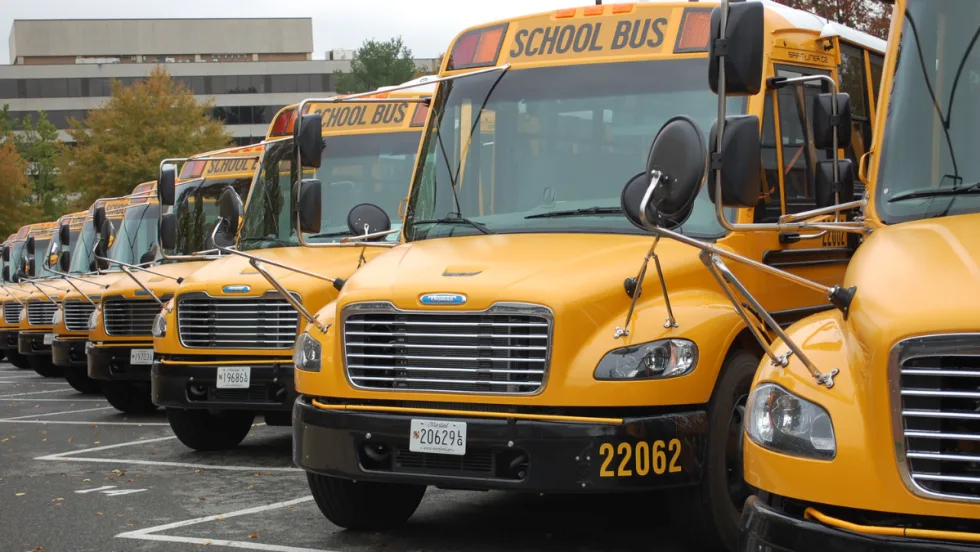
Fewer Electric School Bus Models Reshape the U.S. Market
WRI’s latest buyer’s guide points to a consolidating electric school bus market, but fewer options may reflect a maturing industry rather than fewer meaningful choices for school bus operators.
Read More →
The Fuel Budget You Can Actually Predict: How Propane Autogas Keeps Money in the Classroom
Learn how propane autogas helps school districts manage fuel costs with predictable pricing, lower maintenance, and reduced emissions from former transportation director Joel Stutheit.
Read More →
Hendrickson, Driventic Introduce New Electric Powertrain for School Buses
ELECTRAAX, the electrified, lightweight drive axle offers integrated ePowertrain efficiency and modular flexibility for Class 6–7 school bus use.
Read More →
The Mobility House Joins PowerFlex in Fleet Electrification Deal
The acquisition combines intelligent charging software, bidirectional charging expertise, and fleet electrification services to support the growing adoption of electric school buses across North America.
Read More →
Alt-Fuel Moves: Electric School Bus Investments Hit the Road
See which districts across the U.S. are putting electric school buses into service, expanding charging infrastructure, and planning the next phase of fleet electrification.
Read More →
With Fuel Volatility Ahead, School Districts Turn to Propane
While diesel prices peaked above $5 this spring, districts with propane autogas-powered fleets paid under $2 per gallon, according to PERC.
Read More →
EPA Unveils Proposed Changes to 2027 Heavy-Duty Engine Rules
The federal agency has proposed changes to next year’s targets that would eliminate DEF derates, ease warranty requirements, and retain current NOx emissions standards.
Read More →
Alt-Fuel Moves: EV Charging & Infrastructure Projects Gain Momentum
The latest developments include new funding, charging infrastructure, utility investments, and fleet technologies designed to support the transition to electric school buses nationwide.
Read More →