



Fleet: 1,150 school buses, 410 support vehicles
Total shop staff: 55 (48 technicians)
Number of bus bays: 24, split among 4 facilities
Annual mileage: 13 million
Students transported: 80,000
Cobb County Shop Turns to Gasoline Buses to Cut Costs, Recruit Techs
The Georgia district’s purchase of 25 gasoline school buses, addition of bus bays, and ongoing internship and inspection training programs have also benefited drivers and students.

Nicole Schlosser・Former Executive Editor
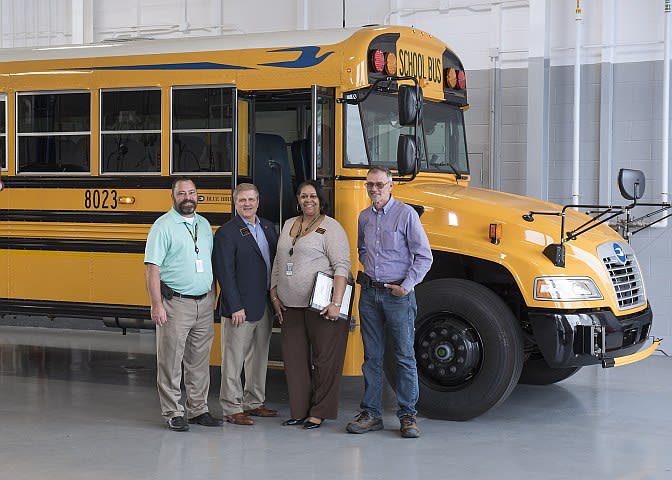
The maintenance department at Cobb County School District has made great strides to cut costs and boost efficiency. Shown here second from the left is Rick Grisham, executive director of transportation, with his maintenance administrative team.
Photo: Cobb County School District
7 min to read
Aiming to boost cost savings and efficiency, Cobb County (Ga.) School District’s transportation department has purchased gasoline school buses, expanded its maintenance facility, and maintained internship and inspection training programs that are benefiting drivers and students as well.
In addition to saving money and time for the technicians, the new buses are expected to open up the pool of new technicians who are already trained to work on gasoline-powered vehicles, and drivers say they like the buses’ quick pickup, lack of cold starts, and that they run quietly.
Meanwhile, four new bus bays will allow technicians to work on more buses. The shop is also using inspections as a training opportunity to keep technicians on their toes, and student interns can pitch in when more help is needed.
New gasoline buses
The transportation department’s purchase of 25 Blue Bird Vision gasoline buses in fall 2016 has already brought significant cost savings and driver satisfaction, says Rick Grisham, executive director of transportation at the district.
“We were looking at options for alternative fuels,” Grisham explains. “In Cobb County, propane and CNG would be difficult to manage due to the size of the fleet and with the majority of our buses parking away from fueling and shop locations. We saw a long-term savings and better cost of ownership based on the savings to purchase [gasoline buses] and the annual upkeep costs versus a diesel engine.”
The buses replaced older rear-engine diesel transit-style buses. The maintenance department’s replacement plan is about 10 to 15 years, and is currently at around 12 years with many buses.
The department is seeing immediate savings of about 5% with the purchase, along with a boost in driver satisfaction.
Drivers have said the gasoline buses offer great acceleration, whether driving on hilly or flat roads, and they have not experienced any cold starts, despite a few recent mornings with temperatures below 20 degrees. Also, when a driver with a gasoline bus is absent, other drivers ask to drive their bus, and drivers who are getting a new bus in the next two years are requesting a gasoline bus.
Although some drivers say it takes extra time to fuel, that time is already built into their schedules.
“People say we’ll be spending a lot of money on extra fueling costs, but we don’t really see that as a problem, because our routes are padded [by] 10 or 15 minutes to allow for fueling, sweeping, doing student management paperwork, etc.,” Grisham says.
One efficiency benefit is that the interval between fueling can be extended with the gasoline buses from half a tank to a quarter tank, says Michael Warner, associate director of fleet maintenance. The fuel tube picks up gasoline from the bottom of the tank, so it will still draw fuel at lower levels.
Conversely, the mileage isn’t as high as with diesel buses, which get 6 to 8 miles per gallon, while the gasoline buses average about 5 to 7 miles per gallon. However, the tradeoff is that technicians don’t have to deal with emissions requirements, such as adding and changing diesel exhaust fluid (DEF).
“It’s a wash between gasoline and diesel when you add DEF fluids and overall costs [for diesel],” says Charles Smith, fleet manager. “When they have been on the road six to seven years from now, we will really see our cost savings come into play.”
The gasoline buses just had the first service according to miles traveled, and no issues were found, Warner says.
“We can already see a reduction in labor cost as well as parts cost in connection to performing preventive maintenance on the gas buses over diesel,” Grisham adds.
The new front-engine buses are also quieter than the district’s diesel conventional buses. Drivers say that they can hear what students are saying throughout the bus and their driver compartment is quieter than in the diesel front-engine buses.
Looking to the future, Grisham envisions Cobb County running a fleet composed of equal parts gasoline, diesel, and another alternative fuel such as propane or CNG.

Drivers have said the gasoline buses offer great acceleration, whether driving on hilly or flat roads, and that they have not experienced any cold starts. With gasoline, drivers also have to fill the tank less frequently.
Photo: Cobb County School District
Helping students develop skills
Meanwhile, in a move to help students develop skills while providing extra help, the maintenance department is investing in potential future employees.
The department participates in two district programs that offer experience working in the garage area: the corporate classroom and Work-Based Learning (WBL).
The corporate classroom recruits special-needs students who are identified as having high-functioning skills and an interest in working with their hands. Smith and Warner have taken on four of these students as interns as they work toward graduating from high school and making the transition to working adult life.
“We’ve had great success with these young people,” Grisham said. “One just left us for full-time employment at a garage working for a private company.”
WBL is designed for technical school students in their junior or senior year, and helps them figure out over the course of a semester if they want to go on to a trade school. Smith taught one of these interns how to install and repair seat covers on the buses, and another intern who just left ended up running the tire program, Grisham added.
Although they wanted to hire the interns, there were no open positions, so the department is continuing to work with them until they find other jobs. (One recently moved on to full-time employment.)
“A gasoline-qualified technician is easier to retain, especially if we get a young person who may find that a school district is a good [employer].”
Michael Warner, associate director of fleet maintenance, Cobb County School District
Expanding technician pool
Like many other school districts across the country, the department struggles to find school bus technicians. It has become harder to find diesel technicians with the required experience, Warner says.
“There is a very limited pool out there,” Grisham adds. “And then pay, retirement, benefits, etc., is a driving factor. If you have a technician with six to 10 years of experience, they are able to go to a dealership and make $25, $35 an hour [whereas] districts are just not going to pay that kind of money.”
Fortunately, the department has been able to bring in about a dozen technicians from dealerships in the last two years.
“[They had] very little diesel experience, but we are able to teach them on the job,” Warner says. “Part of the drive with the gas engine buses was finding gas technicians a lot quicker and easier than diesel technicians. That’s going to help us in the long run when we have to do repairs.”
The maintenance department also sees potential for a larger pool of qualified mechanics who are able to work on gasoline engines from a nearby vocational technical center. The department is considering creating internships for and hiring graduates from that school.
“Sometimes the private sector takes our diesel mechanics because we can’t compete with the corporate and private sector wages,” Warner says. “A gasoline-qualified technician is easier to retain, especially if we get a young person who may find that a school district is a good [employer], because most districts offer a good benefit package, [even] if the wages aren’t up to the private sector.
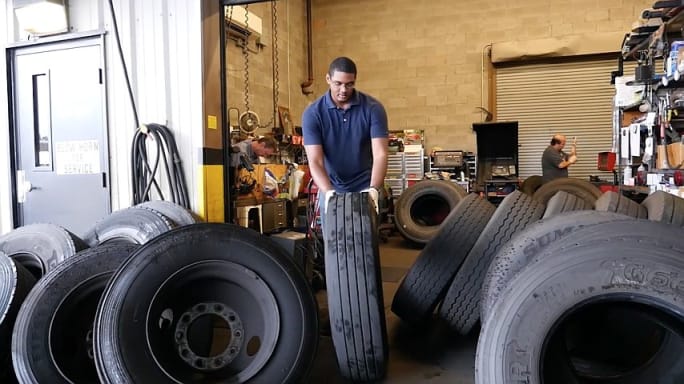
The maintenance department participates in a district program, the corporate classroom, which recruits high-functioning special-needs students and teaches them the skills they need to work in the garage.
Photo: Cobb County School District
Facility expansion
With a bus-to-technician ratio of about 23 to 1, the maintenance department’s four garages rely on efficiency to keep the buses running.
An extension to the main garage that consists of four new bus bays and a body shop was completed in the fall, and it has enabled technicians to work on more buses there.
“Sometimes you have to wait on a part, and a bus could take up a bay for days, and you can’t do anything else in that bay,” Warner says. “Now, we’re able to free up four work areas if we have an extended work order for something like a transmission that takes more time, and we have to tie up a bay. We’re able to get our repairs turned around quicker because we have that extra space.”
Also, for quick access and to stay organized, an in-house parts store helps track assets ranging from school buses to support vehicles to forklifts and details such as warranty repairs. The maintenance department has partnered with NAPA Auto Parts as an in-house parts store for over 15 years, purchasing all its parts from the supplier, which reduces the amount of time needed to procure parts for repairs.
“[NAPA] works with many different vendors [and] suppliers to ensure quality parts at the best prices,” Warner says.
Consistency in inspection training
Over the last couple years, the maintenance department has focused on consistent training for technicians in all four shops on the proper way to inspect the buses. Monthly safety inspections, which are required by the state, are used as training to look for wear and tear and necessary repairs on buses.
The training sessions involving the department’s monthly inspection procedures are taught entirely by staff. Each item requiring monthly inspection is discussed in detail. A standard was put in place that meets, or in most cases exceeds, all federal, state, and manufacturers’ out-of-service standards, Warner says.
“We believe that the inspection is the most important process that we do,” Warner says.
Every July, all technicians receive four days of training to ensure that they have the same guidelines and standards, Warner says. The classes are taught by a mix of vendors, supervisors, and technicians. Vendor-supplied training, which is taught by local dealers for Blue Bird and Thomas Built Buses and by various tire and air-conditioning suppliers, ensures that technicians learn the most up-to-date diagnostic and repair procedures.
Subscribe to Our Newsletter
More Maintenance

Noregon Introduces CAN Bus Diagnostic Tool, Expands JPRO Features
CAN Mentor and the latest JPRO update aim to simplify vehicle network diagnostics and improve repair efficiency for technicians of all experience levels.
Read More →
Cummins on Smarter, Simpler Engine Innovation
Cummins discusses its first-ever gasoline engine for school buses, EPA 2027, and why bus fleets still want durable, simpler internal combustion options.
Read More →
Report: 72% of Diesel School Buses Now Use Advanced Low-Emission Engines
New data shows advanced low-emission diesel technology continues expanding across school bus fleets, even as electric bus adoption gains momentum.
Read More →
Vampire Tools' CAIMAN 7.5-Inch Multi-Purpose Screw Extractor Long-Nose Pliers with Crimper
Vampire Tools introduced the VAMPLIERS Caiman 7.5-inch multi-purpose pliers, combining screw extraction, cutting, crimping, and gripping functions into a single tool designed for fleet maintenance professionals.
Read More →
How Advanced Diagnostics Helps Bus Fleets Stay Ahead of Repairs
Chat with Noregon’s Kevin Smallhorn at ACT Expo about bus diagnostic tools, telematics integration, CNG maintenance support, and strategies to help reduce downtime and improve uptime.
Read More →
How School Bus Fleets are Getting Ahead of Breakdowns
Don’t let bus downtime wear you down. Here’s how bus operators are shifting from manual processes to AI-powered, data-driven maintenance systems for improved reliability and safety.
Read More →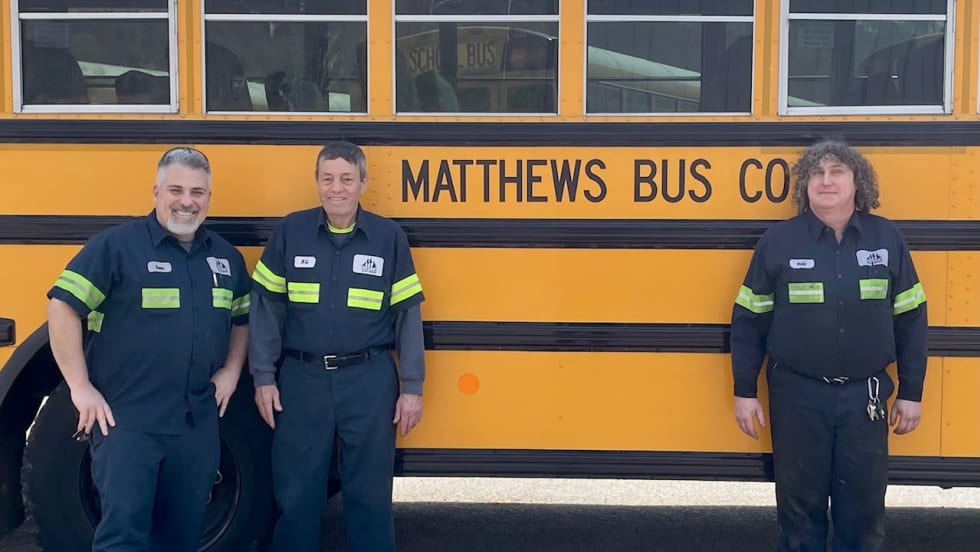
Pennsylvania School Bus Maintenance Team Praised for Dedication to Safety
Matthews Bus Company’s West Jefferson received a letter of commendation from the Pennsylvania State Police for their fleet inspections.
Read More →
Sponsored•April 16, 2026
From Chaos to Clarity: How School Districts Are Running Leaner Transportation Operations
Covering 38 routes on a Friday afternoon. Buses idling while routes overlap. Parents calling nonstop about late arrivals. Sound familiar? This whitepaper explores how district transportation leaders solved these exact problems — and what measurable results followed.
Read More →
Sponsored•March 13, 2026
2026 School Bus Fleet Vendor Directory & Buyer's Guide
Searching for the right equipment, technology, or services for your school transportation program? This industry guide brings together manufacturers and suppliers across the entire school bus market, all in one place. Download it to find the partners who can help move your operation forward.
Read More →
2026 School Bus Maintenance Survey
What top challenges are school bus maintenance teams facing in 2026? Explore new trends from School Bus Fleet’s annual maintenance survey covering fleet composition and age, fuel types, used vs. new purchasing patterns, technician pay and certifications, and the impact of the driver shortage. Survey sponsor: Dayton Parts.
Read More →