




Q&A: App Exec Talks Data Solutions for School Transportation
Patrick Gallagher, SafeStop’s director of sales, shares how the company’s app has increased communication between school districts and parents. Gallagher also foresees more data access as a potential solution to bus driver shortage.



Patrick Gallagher of SafeStop says that today’s parents crave access to information that will help them plan their day and ensure their children are safe. He adds that the SafeStop app’s back end supplies data that can help school transportation staff increase routing efficiency, potentially helping ease bus driver shortage.
As more and more tasks — inside and outside of work — can be completed with smartphones, parents and school staff expect access to more data more quickly than ever before.
SafeStop, an app that was created in 2013 by the company of the same name, lets parents and school transportation providers track students’ school buses and, through an alerts and messaging center, enables transportation providers to alert parents about delays, closings, early dismissals, or upcoming school events, with the aim of getting them information instantly and reducing phone calls.
The SafeStop app is based on a parent-facing system, which provides information such as bus and ridership tracking and school information to parents, and a back-end system, which makes data such as on-time performance, driver performance, and route information immediately available to school transportation staff. The app’s student scanning feature sends in-app notifications to parents when their child scans on or off the bus.
Business for SafeStop has doubled since the beginning of 2015, and is expected to double in size again by the end of this coming school year.
Gallagher, the director of sales for SafeStop, has unofficially been involved in the school bus business his entire life, and started working at Student Transportation Inc. in a marketing role in October 2009. From there, he joined SafeStop and helped create the SafeStop app to help parents and pupil transportation providers. Gallagher spoke with School Bus Fleet about the app, the new generation of parent who expects a constant flow of real-time information, effectively utilizing data, and future technologies to watch for.
SBF: Tell me how SafeStop was created. What inspired the idea for it?
PATRICK GALLAGHER: The idea came in response to the new generation of parents who are sending their child to school on a school bus. Not only do they have smart devices, but they crave access to information that will help them plan their day and ensure their children are safe. SafeStop does that.
We at SafeStop knew that the school transportation industry had the capability to provide valuable information to parents, but no one was utilizing the data being collected with parents in mind. In the school transportation industry, I think we are at the point where people understand the importance of collecting data, but they are not necessarily sure how to use it. So, we figured out a way to use the data to not only provide a service to parents, but also add value for the transportation staff.
We did a limited beta test [on the app] in 2013 all over the country, and from 2014 to mid-2015 we launched a full rollout, but it was limited to about a dozen schools and school districts.
With any app or new service, you want to get it in the hands of your users and see what they like, don’t like, and how you can improve. We found out everything we needed to provide in an app and [used that to] create our version 2.0, which is what we have rolled out nationwide. We are continuing to build out features. In April 2015, we announced the launch of SafeStop nationwide; any school district with GPS or routing software can use it.
What features does SafeStop offer?
The parent-facing app has three basic features. The first is a real-time bus locator, which allows the parent to see the location of their child’s bus, with its position updating on the map every 30 seconds. The second feature is estimated arrival times for each bus stop, so the parent will not only know where the bus is on the route, but also when it is expected to be at their child’s bus stop. That is also updated every 30 seconds. The third feature is an alerts and messaging center, and that is the open communications channel from the transportation staff at the school district or the SafeStop team to communicate to parents transportation-related information that may affect their service on a daily basis.
We also have the back-end system, called SafeStop Analytics, for the transportation staff. It’s a platform that helps them analyze the performance of their transportation system using the same data that we collect and use to provide the app. They can use that for key performance indicators (KPIs), such as on-time performance; route deviation; bus idling; speeding; and harsh braking.
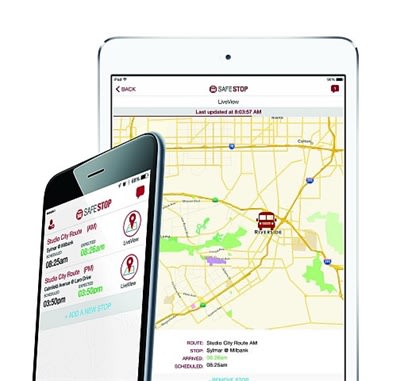
The SafeStop app gives parents access to their child’s bus location and expected arrival time, and school transportation staff access to on-time performance, driver performance, and route information.
How are most districts choosing to set up payment options?
There are several ways to pay for [the app], but the two most popular options are the school-funded option and the school-subsidized option where parents can pay a small monthly subscription.
When you ask parents to pay, you get a lot less participation. We found that the school districts that pay for the service and provide it to parents for free get a huge amount of participation; anywhere from one-third to [nearly two-thirds] of their parents are using SafeStop in some capacity.
That is worth the money, not only in being able to run the transportation system more efficiently, because of SafeStop Analytics, [but] in terms of parents’ questions being answered. [That] makes the transportation director’s job easier, because they don’t have to deal with parents’ phone calls all day. They can actually work on making the transportation system as efficient as possible.
Were there any challenges in rolling out SafeStop? If so, how did SafeStop deal with them?
There are always challenges when you disrupt an industry or provide a new service. But the challenges we find in school transportation are actually opportunities to be proactive and fix issues that may have plagued transportation departments for a long time. The most common problem we face is that routing information is out of date or not maintained properly. While that is a challenge, the SafeStop team helps the transportation department to resolve issues, correct data, and create better reporting.
How many customers use SafeStop today?
We are going to be operating in 13 states this fall. We are doubling in size from the beginning of last year and will double in size again by the end of this coming school year. That means that we are going to have tens of thousands of parents and several dozen school districts and private schools that will be using the app, so nearly 100 different districts and schools using it.
What benefits have customers shared with you as a result of using SafeStop?
It drastically increases communication between the transportation department and the parents, and allows transportation departments to provide a higher level of customer service to parents.
Most importantly, on the back end, SafeStop Analytics [provides] an easy way for transportation departments to use the data that we collect to perform real-time audits and, if needed, to make updates to the routing system. It is information that, when you can compare planned versus reality, a whole new world opens up, allowing them to make decisions quickly and easily. That’s going to make their day-to-day jobs much easier. Customers who are a part of a school district that runs its own transportation system are seeing the benefits of being able to analyze that data in real time. School districts that use contractors can access that information and assess the contractor’s performance.
For parents, this is information that they have never received before. I think when they have it, they feel more confident about the transportation system, and are able to manage their day more effectively.
What other technologies do you see playing a bigger role in school transportation in the near future?
The biggest technology on our radar is student scanning. That currently integrates into SafeStop, and we have a couple school districts using it. It allows the parent to see when their child swipes on and off the vehicle, so it’s a safety tool for parents and the district. It can also track student ridership and [other] information [such as rider location], and how often they ride the vehicle, which is often tied to state funding and managing the budget more effectively. With that information, staff can gain more insight into how efficient the routes are, and can also apply for funding with more accurate data.
More broadly, new types of companies are coming into the fold. In GPS hardware and routing software particularly, we’ll see new, bigger names that want to join the industry because they see the value of what we are doing at SafeStop, and the amount of money spent on school transportation is astronomical. Where there is that much money being spent, there will always be people who are looking for ways to improve or optimize that. So I think you will start seeing some more popular names, like cell service providers and technology firms out of Silicon Valley, pop up in the industry.
What do you see as the top challenges for the school bus industry in 2017? What about the biggest opportunities?
It’s no secret that driver shortage is the biggest issue in the industry. When school districts launch SafeStop and are able to use our analytics platform, they can potentially find routes that can be consolidated or adjusted so that they need fewer drivers and can make their workforce happier.
The other major challenge facing the transportation industry is not to drown in data. Millions of data points are being collected every day, but transportation professionals must find an easy way to use that data effectively without becoming overwhelmed. SafeStop is designed to make it easy to resolve issues in real time, and make data collection much easier. When a transportation department implements a service like ours, there has to be support alongside it. That’s why we have chosen to be software and a service.
More Management

How to Build a Better Driver Training Program
Ready to boost up your school bus instructor training? Here’s how to pick the right talent and improve recruitment, retention, and safety.
Read More →
CALSTART and Forth Combine to Form Catalyst Mobility
The new name represents a renewed vision for the nonprofit focused on advancing clean, equitable, and affordable transportation solutions that move people and goods.
Read More →
What Makes a Great School Bus Driver Trainer?
Choosing the right school bus driver trainer takes more than experience. Learn six keys to selecting and developing trainers and evaluating program effectiveness.
Read More →


School Bus Contractors Expand Through New Deals, Acquisitions & Partnerships
STA's Canadian division acquires Ontario-based G&L Stevenson Transport while Durham School Services adds a new district contract in California, First Student adds a New Jersey contract, and Minnesota Coaches acquires Halo Transportation.
Read More →
Logan Bus Company Rolls Out AI Phone System for NYC School Bus Families
A summer pilot found that AI agents could handle most routine calls, freeing up time for customer service staff to focus on emergencies and complex family concerns.
Read More →
From Intent to Impact: What I Learned About Leadership from TAPT
A Texas transportation supervisor shares lessons on self-awareness, accountability, managing stress and building trust — and why investing in leadership development matters at every stage of your career.
Read More →
NAPT Names 2026 Award Recipients, Hall of Fame Inductee
Who earned national recognition for their work in student transportation? This year, NAPT named five recipients of its 2026 awards for service, safety, and leadership, plus its newest Hall of Famer.
Read More →
2026 State of Student Transportation Report
Driver shortages. Rising costs. Growing safety expectations. More data, but not enough time to act on it. The 2026 State of Student Transportation Report reveals what transportation leaders say is putting the most pressure on their operations—and where they’re investing next. See how your priorities compare.
Read More →
How to De-Escalate an Angry Person: 5 Steps for Handling Workplace Conflict
What makes emotions run high, and how should you handle an angry colleague or parent? Follow these steps for staying calm, listening, showing empathy, and resolving conflict.
Read More →
What Readiness Looks Like This School Year
Learn about the challenges shaping the 2026–2027 school year, from persistent driver shortages and budget pressure to technology and readiness gaps. See how school districts are responding and adapting in Zonar’s 2026 Back-to-School Readiness Report.
Read More →