




SHOP STATS
Fleet: 203 school buses, 27 support vehicles
Total shop staff: 15
Number of bus bays: 9
Annual mileage: 2.2 million
Students transported: 10,300
Shenendehowa Shop Zeroes in on Efficiency, Turnaround Time
The New York school district’s efficient and well-trained maintenance staff gets the majority of its buses back on the road after same-day upkeep, contributing to its low out-of-service rating.
by Brittni Rubin
March 4, 2016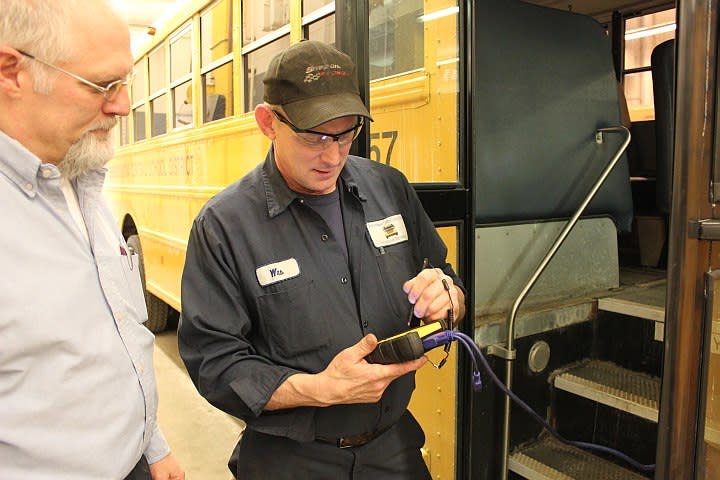
George Geel (left), Shenendehowa Central School District’s fleet maintenance supervisor, and technician Wesley Montgomery run diagnostics on a bus with a PocketMaxx scan tool.
6 min to read
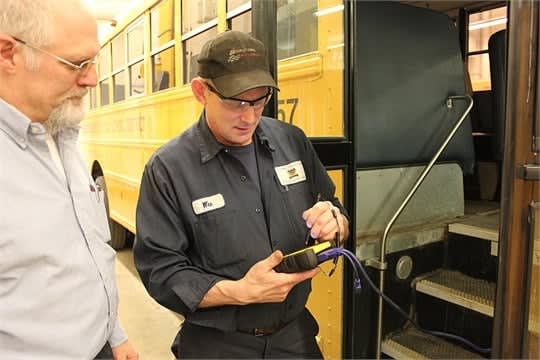
George Geel (left), Shenendehowa Central School District’s fleet maintenance supervisor, and technician Wesley Montgomery run diagnostics on a bus with a PocketMaxx scan tool.
The transportation maintenance department at Shenendehowa Central School District consists of 11 school bus technicians, two body technicians and two mechanic helpers. These 15 employees are responsible for servicing a fleet of 203 school buses and 27 support vehicles.
Even with a heavy workload, the Clifton Park, New York-based district boasts noteworthy figures. For example, technicians are able to accomplish same-day turnarounds for 87% of buses that come in with a defect or issue. Also, Shenendehowa’s transportation maintenance department was recognized at the end of 2015 by its insurance carrier, Utica National Insurance Group, for achieving an out-of-service rating of 1.1% or less over a three-year period.
Between comprehensive vehicle inspections, a unique shift arrangement, and emphasized safety and training programs, Shenendehowa Director of Transportation Alfred Karam oversees a smooth-running and efficient operation.
Keeping buses on the road
Karam and George Geel, Shenendehowa’s fleet maintenance supervisor, attribute the department’s low out-of-service rating mainly to its strong maintenance program and efficient staff schedule.
The shop’s maintenance team checks over 200 points on each bus that comes in for preventive maintenance. The district maintains a fairly standardized fleet, with buses of similar makes and models.
“If we spot an issue, we can go through all of the buses and rectify the problem before it becomes a bigger problem,” Geel says. “This is also a great way to lower our overhead, simplify training and make it easy from an operational standpoint.”
A critical part of the district’s maintenance effort relies on pre- and post-trip inspections conducted by the school bus drivers. Upon receiving information of defects from the drivers, technicians are able to complete same-day turnarounds for 87% of the buses with defects. Seven percent are turned around in two days, while 5% fall between three and six days. The last 1% is over six days.
“We are proud of our technicians’ and school bus drivers’ efforts to make sure our fleet is maintained in tip-top shape and available to support the educational needs of our students,” Karam says. “The communication between dispatch, school bus drivers and bus technicians is outstanding.”
“If we spot an issue, we can go through all of the buses and rectify the problem before it becomes a bigger problem.” – George Geel, Fleet Maintenance Supervisor, Shenendehowa Central School District
Also contributing to the shop’s success is a staggered two-shift effort. Half of the first shift maintenance staff begins their day at 5 a.m., and the other half starts at 6 a.m. The whole second shift arrives together at 2 p.m. and stays until 10 p.m.
Each shift is led by a senior automotive repairer. With this extended schedule, the district is able to keep buses running during the day, saving most of its inspections for second shift. The district is allotted more flexibility and can refrain from repairs during school hours.
The two-shift effort also allows the maintenance department to save on facility space.
“I can do maintenance with only half of the shop space when I split the team into two shifts,” Geel says. “I’d need six more bays if all 15 shop staff members were here at one time.”
Karam adds, “Smaller districts run just a single shift, but because we have 203 buses, the only way to run efficiently with the size of our facility in mind is by staying on top of preventative maintenance and utilizing our two shifts on the same days.”
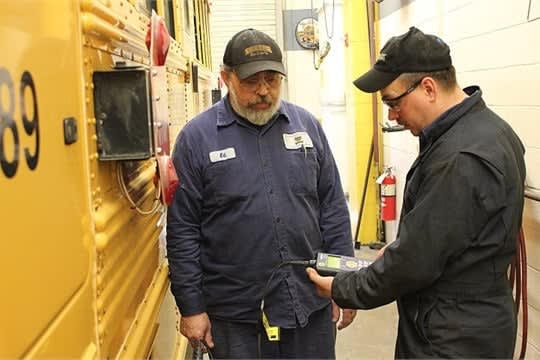
Shenendehowa technicians Eddie Hernandez (left) and Mike Peek use a battery scanner on one of the district’s buses.
Inventory, data tracking
With a maintenance department open until 10 p.m. — when most parts stores have long since closed — it’s important to maintain a healthy and accurately tracked internal inventory of products.
Geel works closely with the department’s parts clerk, Rich Knapick. He has spent the past two years identifying obsolete parts, reorganizing the parts room to make it more efficient, and aligning the parts database with the shop’s actual inventory to best manage its supply and decrease overhead cost.
“We have developed a very fast-moving parts analysis system,” Geel says. “We have about half a million dollars in parts here, but if we don’t use something for a year, we simply won’t stock it in inventory anymore.”
Geel tracks road failures and other on-board trends as well to look for commonalities.
“If one bus does something that raises our interest, we can go look across the fleet to see if other buses are having that same failure,” Geel says.
Geel and Karam are firm believers in the three “D”s: data-driven decisions. The shop uses many electronic diagnostics to track data and help the fleet run more efficiently.
According to Geel, the heart of their electronic tools is Tyler Technologies’ Versatrans Fleetvision, which helps the team track preventive and corrective maintenance, inspection cycles, oil and filter changes, and parts inventory.
Shenendehowa also uses a variety of other maintenance-related programs, including Navistar’s OnCommand Connection, Diamond Logic, NEXIQ Technologies’ PocketMaxx, Cummins’ INSITE, and Snap-on’s SOLUS Edge.
Increased safety measures
In the past year, Shenendehowa has dedicated itself to improving the availability and display of personal protective equipment (PPE).
“Safety plays a huge part in our operation,” Karam says. “We worked hard to try and make sure that there’s no reason any technician can get hurt on the job.”
The added challenge for the department is ensuring that the shop’s second-shift employees, who are working even after the typical business day ends, are also equipped with the same safety amenities.
Each employee is issued his or her own set of PPE. The maintenance department has also established a hub where extra items are always stored, from new pairs of gloves to welding gear. Most extra equipment hangs on a 4-by-8-foot board that Geel brought to fruition just last year.
“With extra equipment always readily available and on display, an employee can really just grab what they need to protect themselves on the spot if something rips,” Karam says.
The district is also focused on upgrading equipment regularly. For example, two portable Bumper Air Lifts were recently purchased, making it easier to work on buses in bays that don’t have in-ground lifts.
“It’s also more efficient and helps reduce injuries, again building a safer operation overall,” Karam says.
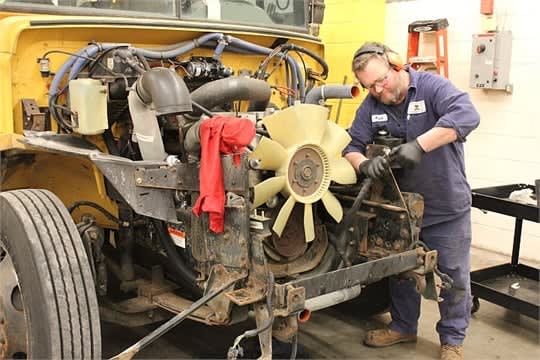
Frank Older is Shenendehowa’s engine rebuild specialist.
Hands-on training
Over the past two years, Geel and Karam have been working together to boost the shop’s training opportunities. Major vendors are scheduled to give the shop’s technicians quarterly training sessions.
The technicians are also members of the New York Head Mechanics Association, by which they get monthly training on different aspects of mechanics. Each year, a technician is also sent to IC Bus’ manufacturing facility in Tulsa, Oklahoma, for education.
“Training is so important because everything changes so quickly from year to year, and we need to stay on top of it all to prevent bus breakdowns,” Geel says.
As for Shenendehowa’s school bus drivers, aside from the state-mandated training hours, the district arranges hands-on training with maintenance staff members. The driver trainers will bring trainees directly into the shop to review bus mechanics from top to bottom.
“A mechanic will personally go through everything with the drivers,” Geel says. “We want everyone to feel part of the team. Rather than an ‘us against them’ mentality, we want drivers and mechanics to know they are working on the same team.”
According to Karam, all transportation department employees spend hours in training to work on understanding all systems on board the bus.
“Through repetition, drivers and mechanics alike become pretty good at identifying defects,” Karam says. “And that’s what keeps our buses on the road.”
Topics:Maintenance
Subscribe to Our Newsletter
More Maintenance
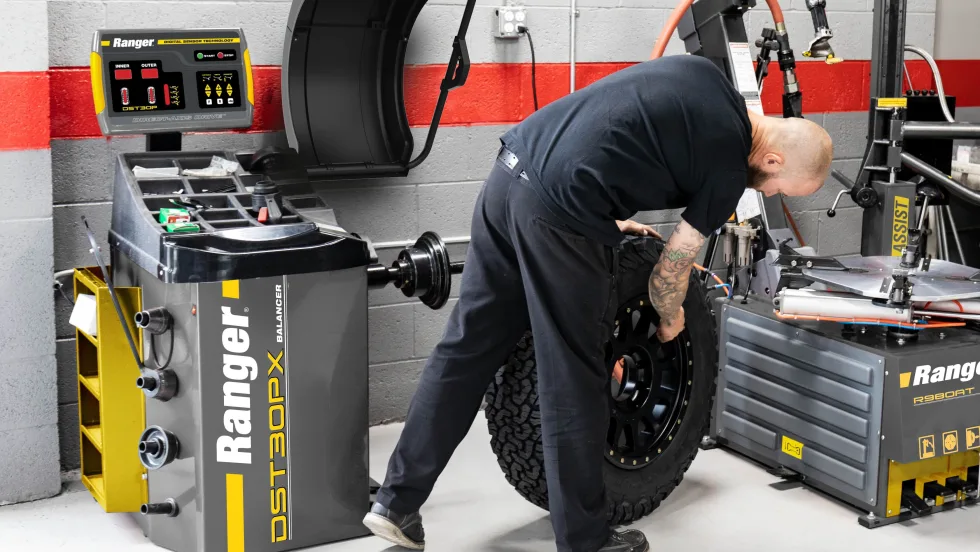
BendPak Launches Ranger DST30PX Wheel Balancer
BendPak's new wheel balancer handles tires up to 43 inches in diameter, with a reinforced design, precise weight placement, and faster service cycles.
Read More →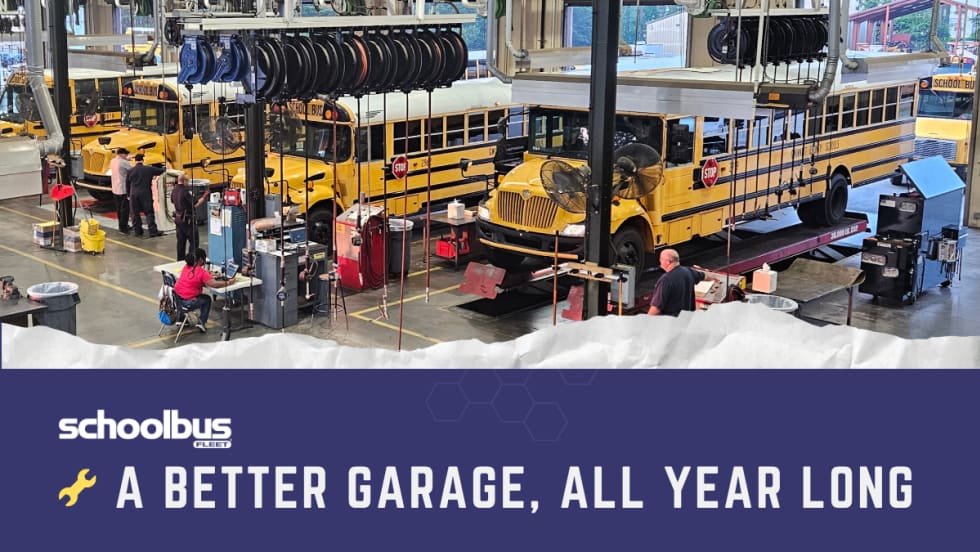
Tips for Ensuring School Bus Garages Are Safe and Warm Year-Round
Cold maintenance bays and rising heating costs? Learn how school bus garages can improve comfort with targeted heating, better airflow, and winter preparation.
Read More →
ASE Highlights School Bus Technician Certification Requirements
ASE is encouraging school bus maintenance professionals to maintain their certifications, highlighting seven specialized tests and five-year renewal requirements.
Read More →
International Adds E-Commerce Capabilities to Fleetrite.com
IC Bus customers can now browse, buy, and track shipments for more than 400,000 aftermarket parts online.
Read More →
The Most Expensive Thing You Do Before Selling a School Bus: Wait
When should you sell an aging school bus? Learn how maintenance, mileage, corrosion, specifications, and timing can affect resale value long before the auction.
Read More →
The Evolution of DEF Header Technology: What School Bus Operations Should Know at Replacement Time
See what school bus fleets should consider when replacing DEF headers to improve reliability, reduce repeat repairs, and control maintenance costs.
Read More →
Sponsored•September 8, 2026
The Essential Guide to School Bus Maintenance and Student Safety
Your district's buses carry students to school every day. This guide shows how predictive maintenance powered by fleet data helps keep buses reliable, drivers accountable and students safer from the first bell to the last stop.
Read More →
Kerry Brothers Grows Michigan School Bus Repair Network
The acquisition of Downriver Truck and Bus expands Kerry Brothers’ school bus maintenance footprint across southeast Michigan, adding repair capacity, diagnostic resources, and state inspection support.
Read More →
Noregon Introduces CAN Bus Diagnostic Tool, Expands JPRO Features
CAN Mentor and the latest JPRO update aim to simplify vehicle network diagnostics and improve repair efficiency for technicians of all experience levels.
Read More →
Cummins on Smarter, Simpler Engine Innovation
Cummins discusses its first-ever gasoline engine for school buses, EPA 2027, and why bus fleets still want durable, simpler internal combustion options.
Read More →