




NAPT News & Views — NAPT acts against violence on school buses
The association is planning to offer several workshops on violence prevention at the NAPT Summit in Memphis, Tenn., later this year. Officials are reaching out to law enforcement and other agencies, legal experts and professional educators to put together an agenda packed with experts on this and other important topics.
Violence seems to be everywhere in our society these days. Sometimes it’s hard to determine if there is actually more of it than in the past, or just more media and Internet coverage. But there can be no denying that it is occurring on and around school buses.
A child boards a school bus with the expectation of safe and peaceful transport to and from school. Half a million buses roll every school day, and that’s almost always the result.
But sometimes the ugly underbelly of life gets acted out on a school bus. An incident in Ocala, Fla., in January is a prime example that these incidents — whether involving students, drivers or both — impact our reputation for safety and dependability and can quickly reach and negatively affect the viewpoint of millions of people.
According to news accounts, a 13-year-old girl boarded her bus for her first day at middle school. The bus was crowded. No one would make room for her. She asked others to “scoot over.” She was told to “sit on the ... floor.” A shoe was thrown at her, and she threw it back.
Then, chaos. The video is shocking. Five girls and two boys, ages 12 to 15, formed a circle around the girl and took turns kicking and punching her. She was beaten unconscious and suffered a concussion and other injuries. At this writing, the seven attackers are charged with felony battery.
When violence occurs in their rearview mirror, drivers must think fast, act quickly and hope they make the right decisions. First, find a safe place to stop and perhaps even pull over. Then, assess the situation. By intervening in an altercation, one puts himself or herself at risk of injury and potentially of other allegations that could have legal consequences when minors are involved. Not acting effectively or fast enough could bring other accusations from parents and school officials.
Witnesses in this case said the driver stopped the bus twice and tried to break up the attack. When he resumed driving, the attack continued. He then drove the bus to the nearest school, and police were called. He resigned soon thereafter.
Did he handle the situation well? Did he do the right things? Could he have done something to prevent the violence on his school bus that day? These questions will probably nag him for a very long time.
Fortunately, dangerous incidents inside school buses are still relatively rare, and most children riding on a school bus will never encounter one. But there are other recent examples.
The school bus industry is caught between the realities of these occasional incidents and limited ability to deal with them effectively.
Yes, we can train drivers to deal with these incidents as effectively as possible. And install security cameras to create a record of what occurs. Most school districts have done both.
But these don’t address the root causes. Violence is aggrandized in our culture; we are exposed to it in our own homes — on television and on the Internet — as well as on the streets of our communities. It seems ubiquitous.
So it should not surprise us when violence becomes the course some young people use to act out aggressions, frustrations, insecurities and more.
All communities need to come to grips with problems often lurking just below the surface that can manifest in places like school buses where adult supervision is solely a driver who is primarily occupied with driving safely. In many cases, what’s needed is a much broader discussion about what triggers the violence, including sensitive societal ills.
A clear distinction must be made between bullying and criminal violence (although sometimes bullying leads to violence). Both must be addressed, but differently.
Assault and battery on a school bus demands a swift and certain police response and appropriate criminal sanctions. No rationalizations. No light sentences because the attackers are juveniles.
NAPT has led the industry on bullying awareness, prevention and resolution, and that will continue. But now we will also turn our attention to violence prevention.
We are going to tackle this issue the same way we tackled bullying. First, we will do our homework and seek feedback from our members. Then, we will consider forging alliances with those who share our ultimate goal, which is to develop programs and provide information to help people in our industry — especially NAPT members — prevent and respond effectively to violence on school buses.
We are planning to offer several workshops on violence prevention at the NAPT Summit in Memphis, Tenn., later this year. We are reaching out right now to law enforcement and other agencies, legal experts and professional educators to put together an agenda packed with experts on this and other important topics. Visit www.naptonline.org for more information.
In the meantime, watch for a series of surveys we will distribute this spring, and help us by giving your opinions and advice whenever you can.
We share as an industry a fundamental commitment to ensure the safety and well-being of the 25 million children who are entrusted to us every school day. We also share the belief that violence on school buses is completely unacceptable. Let’s use these tenants as the premise for working together to improve things for everyone.
Mike Martin is executive director of NAPT. Barry McCahill is president of McCahill Communications Inc. and NAPT public affairs consultant.
More Safety
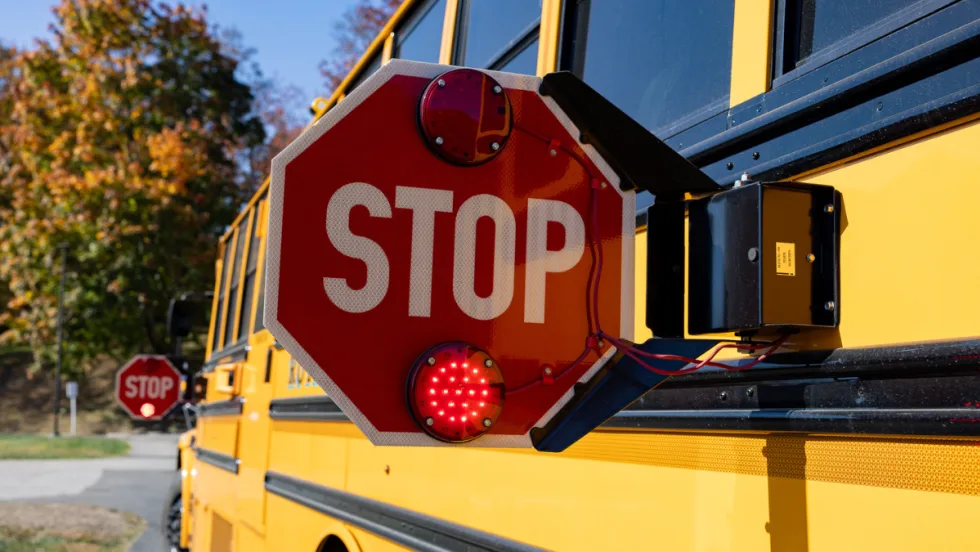
Illegal School Bus Passing Drops 24% in New York Districts
With fewer than 5% of citations involving repeat offenders, Westchester County officials said enforcement, education, and community partnerships are helping change driver behavior.
Read More →
School's Back. Here's What Happened to Traffic, Speeding & Distraction
What happens to traffic when school resumes? New data analysis examines changes in distracted driving, congestion, and speeding around schools.
Read More →
Geotab Expands Fleet Safety Tools With Video Coaching, Risk Insights
New safety and video capabilities aim to help fleet managers assess risk, support drivers, and take targeted action through video coaching, red-light violation detection, and more.
Read More →

How to Build a Better School Bus Driver Training Program
Is it time to strengthen your driver training? Here’s how to pick the right talent and improve recruitment, retention, and safety. This video is brought to you by IC Bus.
Read More →
Recent School Bus Accidents Leave 2 Dead, 2 Injured
Four school bus crashes in Florida, Illinois, and Georgia highlight risks in transportation lots, at bus stops, and during student loading and unloading.
Read More →
When Every Second Matters, Clarity Keeps Routes Moving
From routine delays to urgent incidents, strong communication practices help drivers, dispatchers, schools, and families respond with confidence.
Read More →
What Happens When a School Bus Catches Fire — and What Can Help
School bus fires are rare but can be devastating. Learn how advances in fire suppression and asset protection help fleets detect fires earlier, reduce damage, and improve safety.
Read More →
Geotab Launches Tool to Help Fleets Investigate Road Incidents
Geotab Investigations combines telematics data, video, documents, and other evidence to help fleets reconstruct incidents, resolve claims, and determine what happened.
Read More →
Texas Sixth Grader Wins 2026 National School Bus Safety Poster Contest
Sai Darshana Yekolu of Moseley Middle School in Prosper, Texas, was named the newest winner for her artwork, bringing the theme of “Safe Rides, Everyday Heroes” to life.
Read More →
Doing More With Less: How Transportation Directors Can Prioritize Safety Amid Budget Uncertainty
With diesel prices soaring and nearly one-third of transportation directors expecting budget cuts, maintaining student safety has never been more challenging. Download this guide to learn how leading districts are prioritizing risk, funding critical safety technology, and building stronger budget cases with data.
Read More →