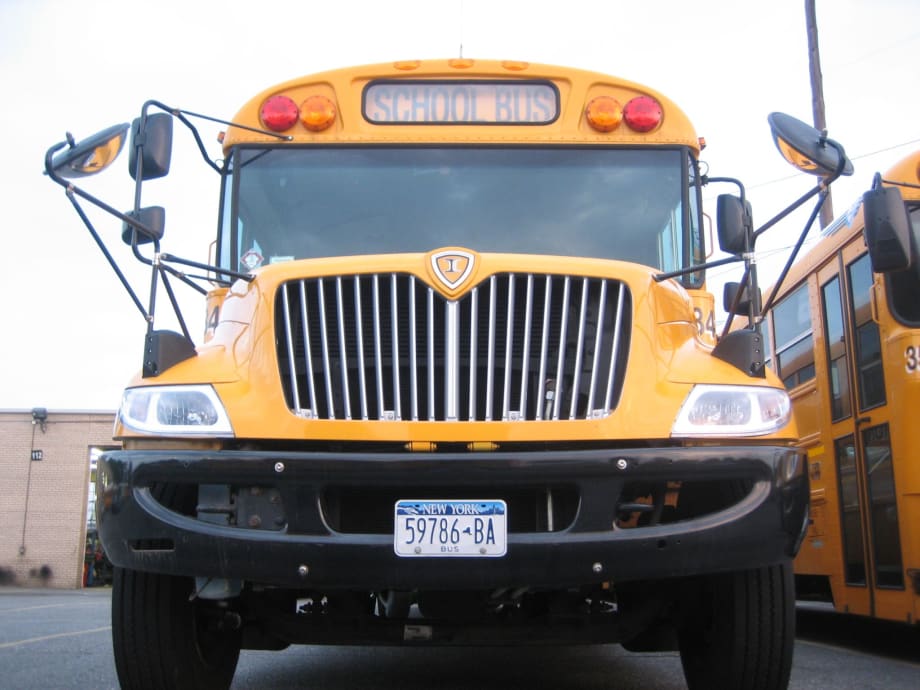
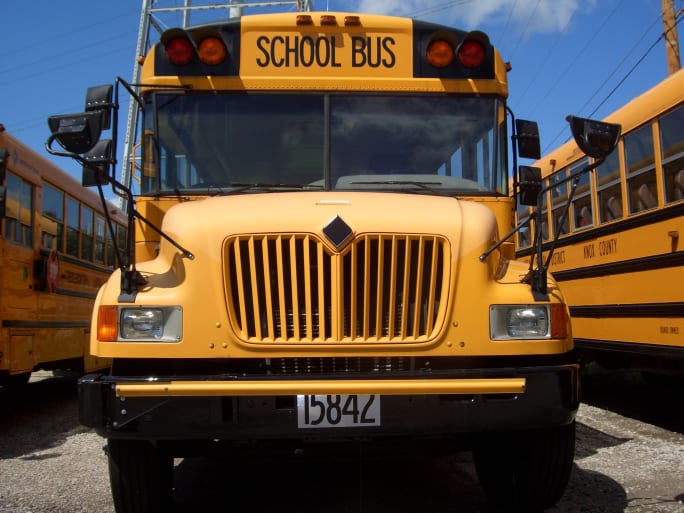
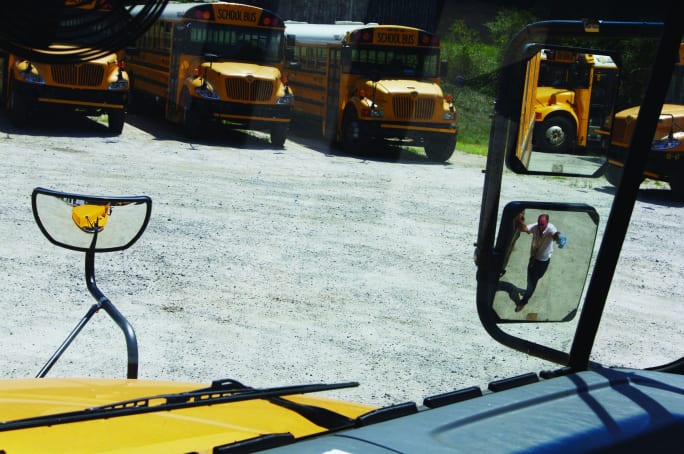
Officials say the most important component of this effort is complying with Federal Motor Vehicle Safety Standard 111, which sets forth field-of-vision requirements. They also provide tips on establishing the danger zone around a bus so it is visible in the mirrors, and they discuss proper mirror adjustment.
A bus’ cross-view mirrors adjusted to meet FMVSS 111. Rosco Vision Systems’ Dave McDonald says it represents a view 12 feet out in front of the bus at the height of a small child, and that you should see the lenses at this location.
8 min to read
A bus' cross-view mirrors incorrectly positioned.
Ensuring that the mirrors on and in a school bus are correctly positioned is essential to safe pupil transportation, as it enables the driver to accurately see motorists, objects and students near and in the bus.
Industry officials agree that the most important component that contributes to proper school bus mirror positioning and adjustment is an understanding of and compliance with Federal Motor Vehicle Safety Standard (FMVSS) 111, which sets forth field-of-vision requirements.
Ad Loading...
“Mirror systems are only as effective as the person or people responsible for their proper use and adjustment,” says Dave McDonald, director of business development and technical sales for Rosco Vision Systems. “One hundred percent compliance [to FMVSS 111] is the only safe way — there are no excuses for noncompliance.”
Tony Pietrowski, design engineer at Tiger Mirror Corp., adds, “The government spent a lot of time coming up with this formula, so you shouldn’t deviate from that. Exterior mirrors need to be adjusted using the schematic/proper layout that the federal government specifies. Doing it without the guide means you’re guessing as to the proper angle of the mirrors.”
You Must See the Danger Zone
In addition to reading FMVSS 111, pupil transportation consultant Dick Fischer, president of Trans-Consult, says that being able to see the danger zone around a school bus is essential to maintaining student safety, and it should be taken into consideration when adjusting and using school bus mirrors.
The danger zone is 12 feet around the bus, so Fischer says that the driver should be able to see at least 12 feet in front of the bus with the mirrors, and at least 12 feet on the right-hand side.
However, Fischer also notes that a driver’s height will impact this number and, therefore, the bus’ cross-view mirrors must be positioned accordingly. For shorter drivers, for example, the vision requirement could increase to 18 to 20 feet if you are using a reference point (such as being able to see over the bus’ hood or over the steering wheel) and you measure from that point to the person’s feet.
Ad Loading...
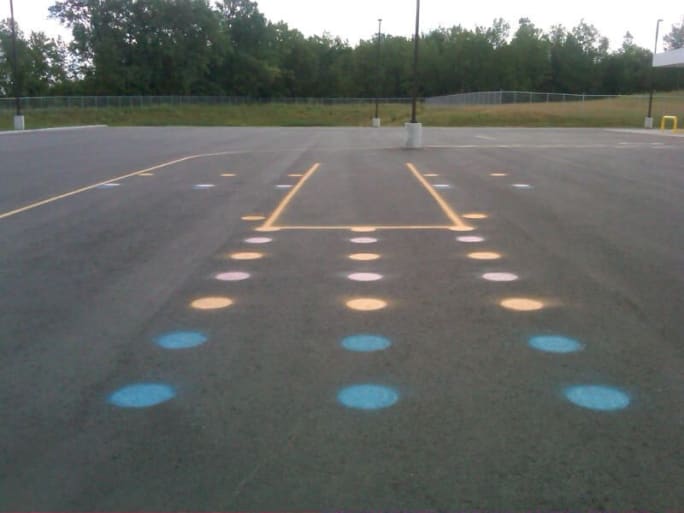
Having the FMVSS 111 cone placement grid painted on your bus lot and using it regularly will ensure proper mirror adjustment.
Fischer and McDonald say that having the FMVSS 111 cone placement grid painted on an operation’s bus lot and using it regularly will ensure proper mirror adjustment.
“You start at the driver’s window and use the bottom of the window [as a guide] — look down and drop a cone,” Fischer says. You should also drop a cone at 12 feet out on the right-hand side of the bus and at 6 feet out at the rear axle on the left-hand side.
Number the Mirrors During Training Sessions
Numbering bus mirrors during training sessions to make it clear which ones the instructor is referring to can help drivers when learning how to position and use them, according to Fischer.
During Fischer’s sessions, he numbers the mirrors as follows:
No. 1: Top left mirror with flat glass
No. 2: Left convex mirror
No. 3: Left cross-view mirror
No. 4: Right cross-view mirror
No. 5: Right convex mirror
No. 6: Top right mirror with flat glass
No. 7: Interior rearview mirror
Ad Loading...
In terms of field of vision, Fischer says that when looking into mirrors No. 1 and 6, you should be able to see 200 feet to the rear. In No. 2, you should be able to see the side of the bus and out 6 feet.
“With No. 3, on the back, you have to see the front tire area by 1 foot, and 6 feet at the rear axle. With the front part of that mirror, you would see 12 feet in front of the bus or more,” Fischer says. “With the No. 4 mirror, you would see 12 feet in front of the bus or more with the front part of the mirror. You would also see the right front tire at 1 foot out, and with the back of the mirror, you would see 12 feet out from the rear axle.”
Fischer and McDonald emphasize that a bus’ cross-view mirrors are designed for use during loading and unloading of students — they should never be used for driving purposes.
“If you use the mirrors for driving, you can’t see more than 3 feet in front of the bus, so you’re in violation of the federal requirements,” Fischer explains.
With mirror No. 5, he says that ideally, you should be able to see out to 12 feet, but because some of those mirrors are smaller, the driver may not be able to see all the way out to the 12-foot line.
Ad Loading...
Exterior Mirror Adjustment Tips
This photo shows the right convex mirror adjusted to enable the driver to see the bus’ entrance door area. Derrill Browning of Mirror Lite Co. says having a good view of this area can help to prevent accidents involving students.
When McDonald conducts field-of-vision workshops, he covers what he describes as three rules-of thumb that are designed to help directors, managers and driver trainers convey proper mirror adjustment in driver training sessions.
“These are intended to be used as a guide only and do not reflect any particular specification or requirement set forth in the FMVSS 111 regulation,” McDonald says.
His tips are:
Hook a tape measure to the center of the bus’ front bumper and extend it forward 6 to 12 feet. At that point, have the driver bend or kneel down to give him or her the approximate height of a small child and have him or her look up at the cross-view mirrors. If the individual cannot see the mirrors’ lenses, a driver would not be able to see a student standing in this location.
Adjust the flat glass lenses inward and upward until the driver has a clear view along the side of the bus and can also see the rear corner marker lamp in the uppermost inboard corner of each lens. This helps to ensure the mirrors are properly adjusted to see the required 200 feet to the rear of the mirror.
When adjusting the cross-view mirrors, start with the mirror heads at an approximate 45-degree angle from their respective front corners of the bus. Adjust each mirror head to enable the driver to see all cylinders in the FMVSS 111 grid with a combination of both mirrors.
“If the cross-view mirrors are turned upward to see the 8-way lamps and/or are positioned parallel to the front of the bus, they are not in compliance with FMVSS 111,” McDonald says.
Ad Loading...
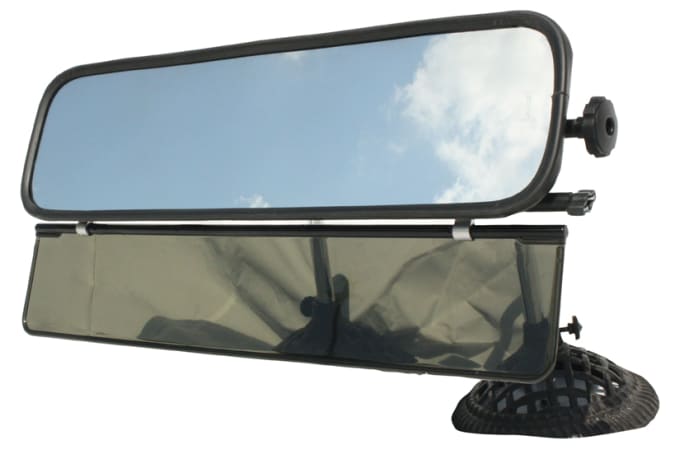
Tony Pietrowski of Tiger Mirror Corp. says a bus’ interior rearview mirror should be mounted in front of the driver. The company’s Mirror and Sun Visor Combo Unit is easy to adjust, according to Pietrowski.
Interior Mirror Adjustment Tips
Equally important to exterior mirror positioning and adjustment is proper adjustment of a bus’ interior rearview mirror.
Pietrowski says that the mirror should be mounted in front of the driver so that all he or she has to do is glance up and he or she will be able to see a lot of the inside of the bus.
Tiger Mirror Corp. created a durable rearview mirror that a school bus driver can easily adjust, and that Pietrowski says is guaranteed for the life of the bus. The Mirror and Sun Visor Combo Unit is a rearview mirror with a sun visor attached underneath the mirror.
Pietrowski says the unit can help bus drivers avoid the problems that can accompany adjusting a rearview mirror after someone has opened the cabinet that is mounted at the front of the bus in the bulkhead area.
“For anyone to use that compartment, you physically have to move the mirror down, and pushing it back up may be difficult because it might be bolted into place. Also, when you push the mirror back up, it can become loose,” he says.
Ad Loading...
Tiger’s Mirror and Sun Visor Combo Unit features a handle on the side with a knob, and engraved into the mirror in the corner are instructions on which way to turn the knob to tighten and loosen the mirror.
Don't Forget a Walk-Around Inspection
Mirrors should be checked by drivers during their daily pre-trip inspections for proper positioning because they can be easily bumped in between runs.
Like Fischer, Derrill Browning, sales engineer at Mirror Lite Co., says it is important to be aware while inspecting the mirrors of the danger zone around a school bus.
“A driver should keep in mind that a child in any area of the danger zone should be able to look up at the bus and see some mirror reflective surfaces pointed toward him or her,” he says.
To perform a walk-around inspection, Browning suggests following these steps, which are in keeping with Fischer’s insight on field-of-vision requirements and McDonald’s tips on mirror adjustment:
Ad Loading...
Step 1. Go to the back rear corners of the bus at the bumpers. Peer down the side panels of the bus toward the front. You should be able to see some portion of the cross-view mirrors extended out wider than the school bus body. Most cross-view mirrors are around 14 inches wide.
“It would be good to see at least 4 to 6 inches of mirror surface extending out beyond the 96-inch width of the bus,” Browning says.
Next, crouch down adjacent to the rear tires. Can you see the cross-view mirrors extending out? Look for at least 30 to 40 percent of the cross-view mirror lens to be visible from your vantage point about a foot out from the rear axle. Check both sides of the bus.
Step 2. Walk out in front of the bus 12 to 14 feet directly in front of the center of the bumper. Look at both cross-view mirrors. You should be able to see some portion of the edges of the mirrors’ reflective surface pointed toward you.
Step 3. Crouch down at the entrance door step well. Can you see your reflected image in the convex mirror? Having a good view of the step well area augmented by the convex mirror can prevent the worst accidents, Browning says. The convex mirror will provide a large image of a child in this area.
While the pre-trip walk-around is important, Browning emphasizes that it is not intended to replace proper visibility and adjustment checks on an FMVSS 111 mirror grid.
Ad Loading...
He adds that oftentimes, cross-view mirrors are swung or positioned inward for compactness at the factory or during delivery. To swing the mirror arms out for the best visibility down the sides of the bus, the brace arm clamps and the main mounting base clamps should be loosened to allow the arms to swing out.
“A typical school bus is generally 96 inches wide, so measuring from outside edge to outside edge of the cross-view mirrors, you should have at least 104 inches for efficient visibility,” Browning says.
Training Resources
McDonald says that Rosco Vision Systems produced FMVSS 111 “Field of Vision” training materials in 1996 and has provided thousands of copies free of charge to school districts nationwide. For a free DVD and FMVSS 111 grid brochure, visit www.roscomirrors.com.
Illegal school bus passing remains a major safety threat as distracted driving rises. This op-ed explores why awareness, enforcement, and stop-arm cameras matter more than ever.
Your district's "exception riders" — students with IEPs, those experiencing homelessness, foster care youth — deserve more than a middleman solution. This handbook breaks down exactly what to look for in a supplemental transportation partner: from driver vetting and regulatory compliance to proactive safety technology. Because getting a ride isn't the same as getting a safe one.
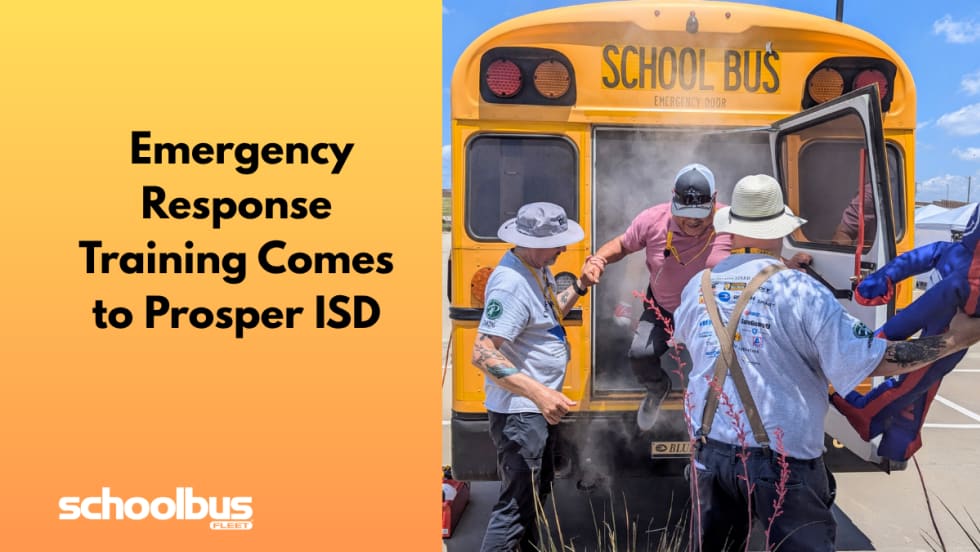
Prosper ISD hosted the third annual training for transportation professionals across 67 districts to learn how to respond to emergencies, such as rollovers and evacuations, and proper use of safety equipment.
After being suspended over due process concerns, Miami-Dade schools and law enforcement are restarting the AI-powered stop-arm camera program with new oversight.
From national bills on seat belts and driver oversight to driver awareness campaigns referencing “Finn’s Rule” and ongoing transportation funding debates in Alaska, here’s the latest in school bus legislation across the U.S.
A Williamsburg community is mourning after a child was fatally struck by a private yeshiva bus, prompting calls for urgent safety improvements at the high-traffic crossing.
The new data shows 99.99% incident-free trips and strong on-time performance, reinforcing how dependable transportation, especially for vulnerable student populations, can help districts combat chronic absenteeism.
The federal agency's report asks NHTSA to require all new school buses to be equipped with vehicle-integrated alcohol detection systems and passenger lap-shoulder belts.
Student transportation teams are being asked to do more with less, facing driver shortages, rising costs, and increasing safety expectations. This report uncovers how fleets are adapting, where technology is making the biggest impact, and why student ridership tracking is emerging as a top priority. Download the report to explore the key trends shaping 2026 and what they mean for your operation.