




Time to Update Your Route Hazards Inventory?
As evidenced by the infamous Fox River Grove crash, documenting school bus route hazards is critical. Detailed, accurate route descriptions are essential, and drivers must be involved in the documenting process.
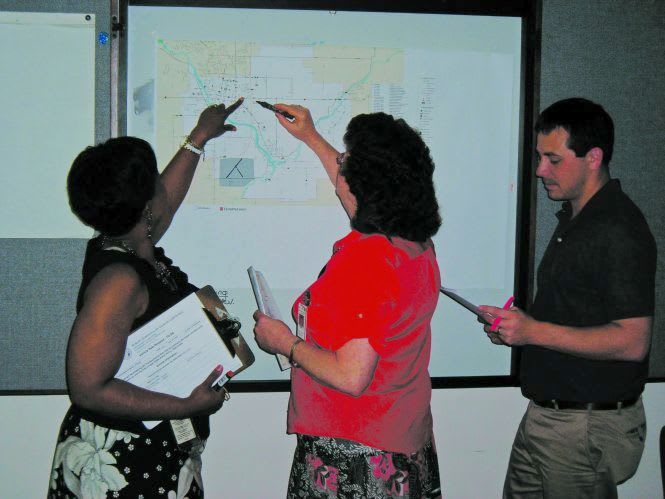
When was the last time you surveyed bus routes for safety hazards?
Some of us remember the 1995 accident in Fox River Grove, Ill., not just as the worst school bus-train crash in recent memory, but for the circumstances and a key contributing factor: an undocumented route hazard.
Telling the story
One of the recommendations from the National Transportation Safety Board (NTSB) to the National Association of State Directors of Pupil Transportation Services (NASDPTS) is to advise members of the circumstances of the Fox River Grove accident. The more pupil transportation providers understand and educate drivers about that crash, the better the chance of preventing similar tragedies.
According to the NTSB report, the school district’s assistant director of transportation was driving the route (for the first time), because neither the regular bus driver nor the regular substitute was available.
After doing a proper stop-look-listen at the railroad crossing, the driver looked ahead to a traffic signal. The driver thought that it was necessary to cross the tracks in order to “trip” the traffic signal from red to green. This was not the case, and, in fact, the regular drivers knew not to cross the tracks until the light was green.
The hazard, known to the regular drivers on the route, was that a bus waiting at the light extended about 3 feet into the path of a train. Seven students lost their lives.
Route hazards
Another recommendation from NTSB to NASDPTS: “Encourage your members to develop and implement a program for the identification of school bus route hazards.”
A report was published for the industry in June 1998. It is available at www.nasdpts.org (click “Operations” and then “Routes and Stops”) to provide guidance on incorporating hazard identification into pupil transportation operations. The report leads transportation providers through the following sequence:
• Develop a list of potential fixed route hazards.
• Implement a specified procedure for conducting on-site reviews of routes.
• Create a means of informing drivers of the presence of route hazards.
Technology tools
Consider the basics to get started every morning: Drivers need keys and their CDL. But, in the interest of safety and efficiency, they also need a good, accurate route description. It must contain basic stop sequences. It also must contain the information relied on by a substitute driver. This includes text that, no matter how routine it seems, the sub has a need to know in order to safely drive the route.
Most school bus routing is now done with computer assistance. And the computer tools make it much easier to stay on top of route hazard documentation and education. Tell the computer the issue and the computer tells the driver. Can it really be that simple?
To answer that question, we turn to NASDPTS Supplier Council members who work with computer routing every day. There are many more capabilities in place than there were in 1995. The industry clearly responded following the Fox River Grove crash.
Routing software providers EDULOG, Trapeze and Tyler’s Versatrans include the ability for users to designate hazards at particular locations so that they will show up in printed route descriptions.
Jason Corbally of EDULOG relates a district’s efforts to use this capability to note stop signs at the top of blind hills.
John Fahey of Tyler’s Versatrans points out a feature that allows districts to produce a single report on all bus routes that pass by a given hazard location.
Steve McKinley of Trapeze emphasizes the importance of storing road hazard information globally for the district, not having to maintain the list route by route.
As a further example of how these data can be used, in North Carolina we report to our state Department of Transportation the number of times per day that a school bus traverses a railroad crossing — including the number of student passengers on board at each crossing. The Department of Transportation uses this information in prioritizing equipment upgrades. All this by running some automated reports!
Beyond pure route hazards, a New Mexico client of software provider Transfinder points out other hazards for students, having provided important information about sexual predators residing around bus stops and schools. We’ll explore that topic in more detail in a future article.
[PAGEBREAK]
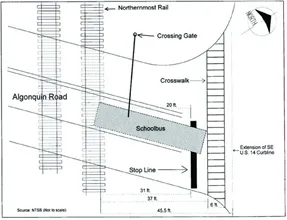
In the 1995 Fox River Grove accident, the back of the school bus extended into the path of a train
while the bus waited at a traffi c signal. The diagram is from an NTSB report on the deadly crash.
Loading the data
Software can significantly help providers to manage their route hazard inventory and pass along relevant cautions to drivers. But there is still the task of gathering that inventory to start with.
There is no doubt that drivers are the front line. They need to understand the importance of documenting hazardous situations, and they must be included in the process.
Kyle Martin of consulting group TransPar reported an experience in creating an initial (paper) map in the driver’s room so that drivers could identify blind corners, railroad crossings, etc.
“The result was heightened safety awareness,” Martin says. “Every driver felt obligated to share as much information as possible. I believe the activity is probably more valuable than the final product.”
A call for renewed attention
It’s been nearly 16 years since the Fox River Grove crash. Is that too long for us to remember the lessons learned? Have we been so vigilant that no accidents or injuries have resulted because a driver didn’t have complete information about the route he or she was driving?
Tim Ammon of Management Partnership Services suggests that it is critical for school districts to place more emphasis on establishing policies and procedures related to both hazard definition and evaluation. Beyond hazard identification, Ammon emphasizes the importance of setting procedures for how the department will assess each situation, including regular review and reassessment.
The technology is here to help us — now more than ever. But documenting the hazards, updating our computer systems and educating drivers are ongoing processes that must be part of mainstream route planning and maintenance.
They say knowledge is power, so let’s empower our drivers to provide the safest transportation possible.
Derek Graham, an SBF editorial advisory board member, has been the state pupil transportation director in North Carolina for 16 years. He is a past president of NASDPTS.
More Safety

How to Build a Better School Bus Driver Training Program
Is it time to strengthen your driver training? Here’s how to pick the right talent and improve recruitment, retention, and safety. This video is brought to you by IC Bus.
Read More →
Recent School Bus Accidents Leave 2 Dead, 2 Injured
Four school bus crashes in Florida, Illinois, and Georgia highlight risks in transportation lots, at bus stops, and during student loading and unloading.
Read More →
When Every Second Matters, Clarity Keeps Routes Moving
From routine delays to urgent incidents, strong communication practices help drivers, dispatchers, schools, and families respond with confidence.
Read More →

What Happens When a School Bus Catches Fire — and What Can Help
School bus fires are rare but can be devastating. Learn how advances in fire suppression and asset protection help fleets detect fires earlier, reduce damage, and improve safety.
Read More →
Geotab Launches Tool to Help Fleets Investigate Road Incidents
Geotab Investigations combines telematics data, video, documents, and other evidence to help fleets reconstruct incidents, resolve claims, and determine what happened.
Read More →
Texas Sixth Grader Wins 2026 National School Bus Safety Poster Contest
Sai Darshana Yekolu of Moseley Middle School in Prosper, Texas, was named the newest winner for her artwork, bringing the theme of “Safe Rides, Everyday Heroes” to life.
Read More →
Doing More With Less: How Transportation Directors Can Prioritize Safety Amid Budget Uncertainty
With diesel prices soaring and nearly one-third of transportation directors expecting budget cuts, maintaining student safety has never been more challenging. Download this guide to learn how leading districts are prioritizing risk, funding critical safety technology, and building stronger budget cases with data.
Read More →
Walton County Schools Adds Gatekeeper Stop-Arm Enforcement System
The Florida district will deploy Gatekeeper’s updated Student Protector technology, which now incorporates AI to improve video evidence.
Read More →
How To Build a More Secure School Bus Yard During and After Hours
As thefts and overnight security threats continue, school transportation leaders are combining stronger operational practices with AI-enabled surveillance to better protect buses, facilities, and staff.
Read More →
FMCSA Names New Chief Safety Officer: What School Bus Operators Should Know
Steve Dowling is set to lead the federal agency's efforts to advance commercial motor vehicle safety and reduce crashes, fatalities, and injuries on the nation's roadways.
Read More →