




20 Ways to Bolster Safety
From loading procedures to proper footwear to student discipline, pupil transportation professionals share their tips for reducing risks on and off the bus.
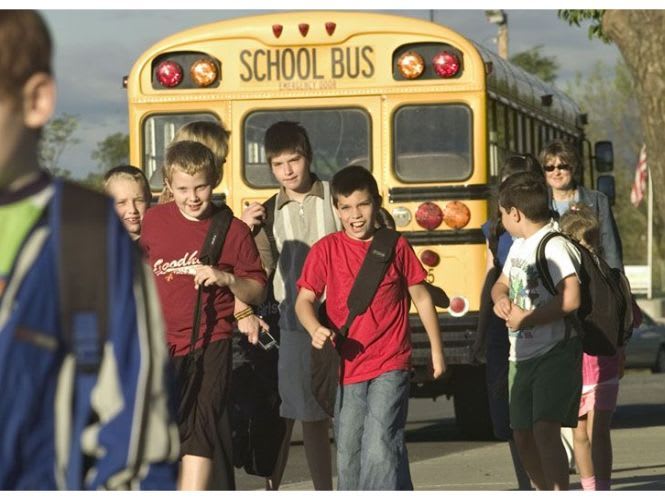
Shenandoah County Public Schools unloads just three buses at a time at its largest campus to minimize the number of students and maximize supervision.
1. Deter speeding
"No need to speed" is a message emphasized at Virginia Beach (Va.) City Public Schools.
"Our drivers are taught that safety trumps schedule at all times," says David Pace, director of transportation services.
To make sure that policy is being heeded, the transportation department uses an unmarked radar car to perform random speed checks.
"We also have GPS on all our buses that allows us to monitor individual buses and their speeds," Pace says.
2. Keep back bus seats empty
For Tom Young, transportation director at Central Springs High School in Manly, Iowa, taking extra precautions to keep students free of injury while they ride buses isn't superfluous.
He has stressed to his drivers to leave the back two sets of seats empty whenever possible, a tip passed on to him by Max Christensen, executive officer of school transportation at the Iowa Department of Education.
"We try to do so as often as we can," Young says. "It goes back to several bus crashes that I have seen online. Most bus crashes happen from the rear of the bus."
3. Safety in loading, unloading
At Shenandoah County (Va.) Public Schools, buses are unloaded at the district’s largest campus three at a time to allow a minimum number of students on the ground with the maximum amount of adult supervision, Transportation Supervisor Martin Quigley says.
“We have more than 700 vehicles that come in and out of our largest campus in the morning, and this creates an environment where accidents can be severe if we do not follow our procedures and keep students’ safety in the forefront.”
At school bus stops, the counting procedure is vital. “Children are the most vulnerable when they are loading and unloading,” says Charlie Hood, Florida state pupil transportation director. “The bus operator must count and account for every child, every time, at every stop, until each student is safely out of harm’s way.”
4. Have drivers wear proper shoes
At Sweetwater County School District #2 in Green River, Wyo., Transportation Director Randall Jensen says he often has to tackle the problem of his drivers failing to wear proper footwear while operating their school buses, particularly during the summer months.
Under the policy he has given his drivers, all footwear must have a hard sole, have a covered toe area, and be tied or strapped on tight enough to withstand an impact.
“With all of the problems with pedal misapplication, I think it is very important to have proper footwear when you drive a bus,” Jensen says.
[PAGEBREAK]
5. Bus drivers signaling students
Many in the industry recommend the use of a signal procedure for safe street crossings and urge parents to educate their children about road safety.
“I think too many times, parents take for granted that a school bus is invincible and nothing bad will happen,” says Amy Noggle, transportation director for Wayne Trace Local Schools in Haviland, Ohio. “Make sure parents are educated in the dangers of [the road] and that they reinforce the safety rules when children are young.”
At Waupaca (Wis.) School District, “If children must cross the street, they are to do so only with the driver directing them,” Transportation Director Lee Nowicki says.
Chloe Williams, vice president at B.R. Williams Inc. in Woodstown, N.J., describes her company’s crossing procedure.
“The students look directly at the driver, the driver checks and double checks that all traffic is stopped and then gives the students a thumbs-up. At that point, the students move into and across the road to board the bus.”
Eric Fritz, energy services manager at Escambia County School District in Pensacola, Fla., says that “[the signal system] helps the driver reinforce positive behaviors, and the students learn to trust their bus drivers because they know they are there for the students’ safety.”
In New York, bus drivers use a two-part signal, Fairport Central School District Director of Transportation Peter Lawrence notes. First the thumbs-up signal indicates that the coast is clear, and then the index finger points in the direction to travel.
6. Emphasize turning techniques
When making left turns, drivers should keep their front wheels pointing forward until it is clear to turn, "thus preventing being knocked into oncoming traffic if the bus is rearended," says George Horne, president of Horne Enterprises in Metairie, La.
Drivers should also employ the "rock and roll" maneuver. "Move forward and back, side to side, to ensure you have actually checked all areas for pedestrians or other vehicles that may be hiding in your dead spots," says Allan Jones, state pupil transportation director for Washington.
Continual, correct use of school bus mirror systems — and keeping mirrors adjusted correctly — are key in reducing accidents. "Having the awareness of your blind spots — behind the mirror itself, for instance — is critical," Jones says.
7. Keep the shop clean
"A clean shop is a safe shop" is the motto of Brad Barker, shop manager at Park City (Utah) School Distict.
Floors should be kept as clean as possible to avoid slipping. Oil and grease should be wiped up when spills occur. Air hoses should be kept clean and leak-free; tools should be clean, orderly and in easy access for the job at hand. Additionally, the work area should be well lighted.
Barker also notes the importance of being careful when working under buses raised on hoists. "Before walking under the bus, look down to inspect for tripping hazards or open holes at the sliding hoist plates," he says. "Look around for any other hazards, and look up for anything hanging low that you could bump your head on."
8. Be vigilant in seating, discipline
Making sure that students are properly seated is a key safety factor.
"Ensure that passengers are resting fully within the 'safety compartment' of the seat — i.e., there no body parts protruding into the aisle," says consultant Horne. "If students' buttocks, arms or legs extend beyond the edge of the seat, the seat is overcrowded."
Because student discipline problems can negatively impact others on the bus, they should be addressed swiftly.
Jill Segal, transportation supervisor for Walled Lake (Mich.) Consolidated School District, says that drivers should be the first point of contact with students' parents. "Keep the school administrators in the loop and enlist their help if need be," she adds. "Track the bus violations to monitor improvement."
Drivers at Miller Transportation in Indianapolis compiled a list of discipline tips for the operation's driver handbook that Todd Edwards, school bus operations manager, says they use frequently to help prevent and attend to student discipline problems. Among the tips are:
Be very consistent.
Intelligence in handling youth consists of thinking faster than they do. If they can out-think you, you are not using your maturity and the advantage of your education and training — you should see possibilities before they become results.
[PAGEBREAK][IMAGE]543[/IMAGE]9. Keep loading zones free of cars
If motorists enter school bus loading and unloading zones, it can be dangerous for both students and drivers. John Clements, director of transportation at Kings Canyon Unified School District in Reedley, Calif., says that a private school near his district recognized this and staged the photo above as a reminder to parents to stay out of the zones.
“It is also a good safety reminder that as school facilities personnel and administrators plan for new schools and remodel existing schools, parents’ cars should not mix with school buses in the same loading and unloading areas,” Clements says.
10. Don’t succumb to distraction
Staying focused and avoiding distractions are critical in operating a school bus.
Lawrence of Fairport Central School District recommends limiting the use of radio communications. “This applies to both dispatchers and drivers,” he says. “Relaying unnecessary information back and forth clogs up the radio channel and tends to force drivers to mentally tune out the chatter.”
Chris Telarico, transportation supervisor at Santa Ana (Calif.) Unified School District, says that, unfortunately, the most common distractions are things that need to be dealt with, such as an unruly child or a complaining parent.
“If a parent comes up to the bus to complain about students trampling her lawn, we need to ask her to wait until the students have finished unloading so we can give her our undivided attention,” Telarico says. “Or if you have students having problems on the bus while you are driving, you need to pull over and deal with the situation. When you finish with the problem at hand, take the time to reassess what is happening around you — checking mirrors, traffic, students, etc.”
Montana state pupil transportation director Maxine Mougeot adds that to avoid fatigue, drivers should take a break every three hours on long trips.
11. Rewarding good bus behavior
Kenny Adams, a bus driver for Covington (Ohio) Exempted Village Schools, started a program in which he presents a monthly Safe Rider award to his elementary school passengers. At the end of each month, the students who best follow the rules — staying seated while on the bus, walking and not running to board, being polite and helpful, and keeping the bus tidy — are awarded certificates.
"This has made my bus a lot safer, as students are quieter and help each other more, and just [behave] a lot safer when around buses," Adams says. "They all look forward to the last day of the month to see who wins."
[IMAGE]544[/IMAGE]12. Relay bus safety rules, laws
Communicating bus rules with students, particularly new riders, is key to maintaining an orderly, safe environment on and around the bus. Christopher Zeitvogel, student transportation manager at the DoDEA-Pacific Misawa (Japan) Student Transportation Office, says that his operation has drafted a list of safety standards that students must adhere to.
Several of the standards are:
• Wait for the bus well back from the curb. Do not approach the bus until
it is stopped and the door is opened. Never run towards your bus as the
bus arrives.
• Students are not permitted to talk to friends or pass items through the windows, nor run after or chase the bus.
• Pens and pencils may cause injury if the bus hits a bump, and so are not allowed to be used on the buses.
“On the first day of school, the bus attendant goes over these rules with
their riders,” Zeitvogel says.
Bus safety information and laws should also be shared with the public. David Twiddy, transportation director at Dare County Schools in Nags Head, N.C., has made a practice of running a safety information page in the local papers during the two weeks prior to the start of a new school year.
“It tells everyone to be on the lookout,” Twiddy says. “It also provides the laws dealing with stopped school buses.”
[PAGEBREAK]
13. Be careful if backing is needed
Backing a school bus should be avoided as much as possible, and done very carefully when it becomes necessary.
“Scan the road ahead for any situation that might cause you to back,” Pace of Virginia Beach City Public Schools recommends to drivers. “Only back if you can’t go safely forward.”
Dennis Rothery, director of transportation at the O’Neal School in Southern Pines, N.C., says that he sometimes notices drivers and mechanics looking over their shoulders while backing buses.
“They cannot see what is next to the bus — they must learn to back using their mirrors,” Rothery says. “I have them sit in the driver’s seat and try to see me on the right side by looking over their shoulder. I am 6’5” and cannot be seen by them, but I can see them in the mirror — this proves my point.”
Cyndi Henk, safety trainer at Comal Independent School District in New Braunfels, Texas, adds this advice: “When backing a school bus, always apply your four-way flashers and honk twice before moving, even with the backup beeper going.”
[IMAGE]545[/IMAGE]14. Driver escort ensures safety
School bus passengers are most vulnerable when they’re outside of the vehicle — particularly when they need to cross the street. In California, school bus drivers are required to escort children across the street to ensure their safety.
State pupil transportation director John Green says that there has not been a documented case of a student in California being killed while being escorted across the street by a bus driver.
The state requirement, which has been in place since the 1950s, is for pre-K through eighth-grade students, but Green says that most school districts also make it a policy for high school students.
Here’s how the procedure works: When the bus driver arrives at a stop where a student must cross, the driver shuts down the bus, sets the brake and takes the key — while leaving the red lights flashing. The driver then takes a hand-held stop sign — the same type that school crossing guards use — and walks with it to the center of the road. When the driver establishes that it’s safe to cross, he or she signals the student to do so.
“It’s a fairly simple procedure,” Green says. “It’s about adding the adult human element — getting the driver out there in the street.”
Ron Kinney, a school transportation consultant and former California state director, also recommends the escort procedure. He reminds drivers to “be sure to check traffic in both directions before entering the roadway. Cross the pupils only when it is safe to do so.”
15. Maintain accountability
Ron Love, state pupil transportation director for Delaware, offers this advice for school bus drivers: “Drive as you would if your supervisor, a law enforcement officer or parent was on board.”
Along those lines, Love says that drivers should communicate road or bus stop condition changes and suspicious activities to supervisors.
[IMAGE]546[/IMAGE]16. Give tips, avoid complacency
Giving school bus drivers a quick tip over the two-way radio every morning is a good way to keep safety on their minds.
“Pick a time that all the buses can hear your message,” says Donald Sexstone, customer service manager for Durham School Services in Rochester, N.Y.
Sexstone pulls many of his daily messages from a school bus safety handbook or state regulations. An example: “Keep your eyes continually moving. Scan for hazards all around your bus — in front, to the sides and behind.”
Venus Hart, transportation director at Lake County School District in Leadville, Colo., stresses the importance of constantly thinking about safety.
“There are some situations that you can’t be prepared for, but if you have the training and follow logical steps — judgment calls — everything should work out,” Hart says.
Maryland state pupil transportation director Leon Langley says that “becoming complacent is a recipe for disaster.” He offers this quote from recently deceased coaching great John Wooden:
“It is what you learn after you know it all that counts.”
[PAGEBREAK]
17. Addressing bullying
While the school bus industry tends to gauge its safety record by fatalities, many parents look at it another way. This was shown in a North Carolina State University study of parents’ perceptions of school bus transportation.
“Not surprisingly, parents don’t think of safety in terms of fatalities,” North Carolina state pupil transportation director Derek Graham says, referring to the survey results. “Rather, they think in terms of whether or not their child is safe — protected — from things that are unsafe. And at the top of the list is bullying.”
The study found that many parents choose the family car over the school bus because they feel that their child is not well protected from other kids on the bus.
“I don’t pretend to have a magic answer to this problem, but the first step is recognizing that this is a big deal to students and parents,” Graham says. “It needs to be more than a workshop topic for school bus drivers or supervisors; it somehow needs to be entrenched in our overall approach to providing safe transportation for students.”
18. Checking the bus for students
There are many approaches to preventing children from being left on school buses.
Kris Pavolich, transportation manager at Geminus Head Start XXI in Merrillville, Ind., implemented a policy to provide double checks: Children have to be signed on and off the bus by parents, teachers must sign off upon receiving the children, and drivers have to know exactly how many teachers will be delivering children back to the bus at the end of the day.
At Virginia Beach City Public Schools, Pace says that most buses are equipped with child-check reminder systems, but for those that aren’t, drivers are reminded to “walk the bus” during the morning safety announcements. Additionally, the first violation of the child-check policy is a termination offense, he says.
Transportation Supervisor Vicky Guy of Bullhead City (Ariz.) Elementary School District #15 uses a magnetic checkmark sign.
“The driver will walk to the rear of the bus and place the sign in the window,” she explains. “We have a person walk behind all buses. If a sign is not visible, the bus will be checked for children.”
[IMAGE]547[/IMAGE]19. Enhance visibility with vests
To boost safety in school bus lots, some operations require employees to wear reflective safety vests. First Student, the largest school bus contractor in North America, is one of them. Lake Shore Central School District in Angola, N.Y., recently implemented a vest policy after a fatal accident.
In December 2007, Lake Shore bus driver Brenda Chiapetta was walking across the lot to her bus just after 6 a.m. Besides the darkness, there was a driving rain. At the same time, a mechanic was driving a bus into the shop for his first service of the day. The bus struck Chiapetta, killing her instantly.
“This was a traumatic thing for our department and for our school community,” Transportation Supervisor Michael Dallessandro says. In the aftermath, there were many safety-related suggestions “coming at us from all angles, and we did not want to make any knee-jerk reactions.”
This year, the district decided to require that drivers and monitors wear reflective safety vests whenever they are on the clock.
“It’s amazing how well you can see our staff members now in all types of light and weather conditions,” Dallessandro says.
[IMAGE]548[/IMAGE]20. Offer training early, evacuation drills often
Offering school bus evacuation training for students is essential, particularly at the elementary level. Segal of Walled Lake (Mich.) Consolidated School District recommends practicing three bus evacuations annually with elementary students and establishing a district safety program for the younger elementary students.
“We use puppets and skits with Buster the Bus and go to each elementary in the early fall and do a presentation for grades K-3 in conjunction with our first bus evacuation of the year,” Segal says. “Drivers create it and act in it — it’s very well received by the kids and the staff.”
Maggie Graff, transportation director for Ridgway (Colo.) School District R-2, also encourages beginning a training program with elementary students as soon as possible once the school year begins.
“The kids are ready to do something physical since they have not been required to sit still all summer,” she says.
Also, providing a photo of the driver for each route will help students who are new to the district, Graff says.
Adds Illinois state pupil transportation director Cinda Meneghetti: “We have new students every year, and we need to make sure they receive the safety training. … Plus, we need to keep reiterating it to all students annually so everyone knows what to do in an emergency and how to stay safe.”
More Safety

Recent School Bus Accidents Leave 2 Dead, 2 Injured
Four school bus crashes in Florida, Illinois, and Georgia highlight risks in transportation lots, at bus stops, and during student loading and unloading.
Read More →
When Every Second Matters, Clarity Keeps Routes Moving
From routine delays to urgent incidents, strong communication practices help drivers, dispatchers, schools, and families respond with confidence.
Read More →
What Happens When a School Bus Catches Fire — and What Can Help
School bus fires are rare but can be devastating. Learn how advances in fire suppression and asset protection help fleets detect fires earlier, reduce damage, and improve safety.
Read More →

Geotab Launches Tool to Help Fleets Investigate Road Incidents
Geotab Investigations combines telematics data, video, documents, and other evidence to help fleets reconstruct incidents, resolve claims, and determine what happened.
Read More →
Texas Sixth Grader Wins 2026 National School Bus Safety Poster Contest
Sai Darshana Yekolu of Moseley Middle School in Prosper, Texas, was named the newest winner for her artwork, bringing the theme of “Safe Rides, Everyday Heroes” to life.
Read More →
Doing More With Less: How Transportation Directors Can Prioritize Safety Amid Budget Uncertainty
With diesel prices soaring and nearly one-third of transportation directors expecting budget cuts, maintaining student safety has never been more challenging. Download this guide to learn how leading districts are prioritizing risk, funding critical safety technology, and building stronger budget cases with data.
Read More →
Walton County Schools Adds Gatekeeper Stop-Arm Enforcement System
The Florida district will deploy Gatekeeper’s updated Student Protector technology, which now incorporates AI to improve video evidence.
Read More →
How To Build a More Secure School Bus Yard During and After Hours
As thefts and overnight security threats continue, school transportation leaders are combining stronger operational practices with AI-enabled surveillance to better protect buses, facilities, and staff.
Read More →
FMCSA Names New Chief Safety Officer: What School Bus Operators Should Know
Steve Dowling is set to lead the federal agency's efforts to advance commercial motor vehicle safety and reduce crashes, fatalities, and injuries on the nation's roadways.
Read More →
New Study Finds School Zone Speed Safety Cameras Cut Speeding Violations 97%
A Florida university's research demonstrates that Verra Mobility's automated enforcement changes driver behavior and significantly improves school zone safety.
Read More →