




Iowa governor signs illegal bus passing bill
Under the legislation, which takes effect immediately, drivers face a fine of up to $675 and up to 30 days in jail for a first offense. Max Christensen, executive officer of school transportation at the Iowa Department of Education, discusses the provisions of the law with SBF and also provides an update on additional statewide efforts to combat the problem of stop-arm running.

Gov. Terry Branstad (front row, right) signed "Kadyn's Law" at Northwood Elementary School on Friday. Branstad reportedly spoke to Kadyn Halverson's classmates, pictured here, before signing the bill.
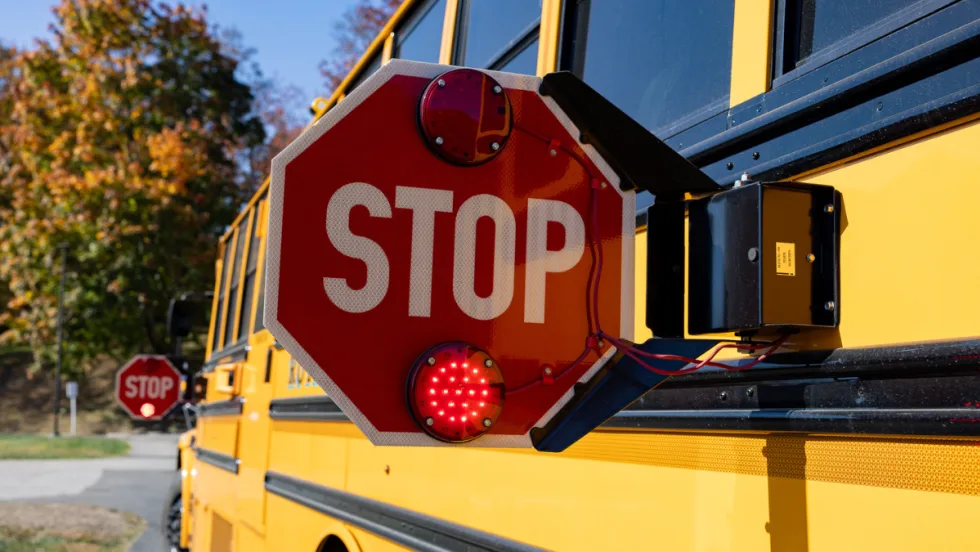
NORTHWOOD, Iowa — On Friday, Gov. Terry Branstad signed “Kadyn’s Law” — legislation that increases the penalties for motorists who illegally pass stopped school buses.
The bill, which takes effect immediately, is named after 7-year-old Kadyn Halverson, who was struck and killed by a pickup truck last year as she was walking across a road to board her school bus. Branstad signed the bill at Northwood Elementary School, which Halverson attended.
Under the legislation, drivers face a fine of up to $675 and up to 30 days in jail for a first bus-passing violation. (Previously, the penalty was $200 with no possibility of jail time.) Motorists face stiffer penalties if they cause a serious injury or death in a bus-passing incident.
“I think it’s high time that we increase the penalties for passing a stopped school bus here in Iowa,” said Max Christensen, executive officer of school transportation at the Iowa Department of Education (DOE), of the legislation in an interview with SBF on Friday. “The fine has been quite low — in fact, I think we’ve been one of the lowest ones in the nation, and quite frankly, it’s been one of those things we’ve been advocating for years, but oftentimes it takes a tragedy to get people’s attention on what needs to be done.”
Christensen went on to say that increasing the bus-passing penalties won’t be a determining factor in terms of how successful the legislation is since sometimes the motoring public does not know what to do when they come upon a stopped school bus.
“There has to be an education piece in this in order for us to consider it to be successful,” he said, and he noted that Kadyn’s Law addresses this.
It calls for the state Department of Transportation, the Department of Public Safety and the DOE to jointly conduct a study related to school bus safety, and establish educational programs to help increase public awareness of motor vehicle laws and safe driving behaviors around school buses.
In terms of the school bus safety study, Christensen said it will focus on determining the effectiveness of stop-arm cameras on school buses as well as how effective it would be to require schoolchildren to be picked up and dropped off on the side of the road on which their home is located.
Christensen said he is not sure how the study will be conducted because to his knowledge, there are no criteria that have been established for it. He added that the state Department of Transportation, which will be the lead agency in organizing the study, has the option of contracting out for it, so officials there may be able to find an outside entity that already has some knowledge in this area.
“I’m not sure how much input I’ll have on this study, though I’m hoping I do have some part in it,” Christensen said. “In preparation of that, I have already conducted a survey of NASDPTS [National Association of State Directors of Pupil Transportation Services] state directors to determine if any other state currently mandates same-side pickup/drop-off. I’m still sifting my way through the results of that survey, but initially it doesn’t seem same-side pickup/drop-off is widely mandated.”
Under Kadyn’s Law, the findings and recommendations from the school bus safety study must be reported to the Legislature by Dec. 31.
Also by Dec. 31, the state Department of Transportation must make available to local law enforcement agencies, electronically through the Iowa traffic and criminal software, the form for requesting departmental re-examination of a person who may be physically or mentally incapable of operating a motor vehicle safely.
(As SBF previously reported, Aaron Gunderson pled guilty to vehicular homicide by reckless driving in Halverson’s death. A more serious charge of vehicular homicide while intoxicated was dismissed as part of a plea agreement.)
Finally, when SBFspoke with Christensen last year shortly after Halverson’s death, he said that he talked with transportation directors from several school districts, and they decided to form a state task force to work on more ways to fight the stop-arm running problem.
At the time, he said that efforts could include additional training for drivers and students, production of public service announcements, and working with law enforcement and judicial entities to bring more attention to the problem. Another idea was to have a standardized crossing signal for the whole state.
“We’re in the process of developing a transportation advisory group, and we’re still getting the group set up,” Christensen said last week. “These are the issues that the group will be addressing.”
More Safety
Illegal School Bus Passing Drops 24% in New York Districts
With fewer than 5% of citations involving repeat offenders, Westchester County officials said enforcement, education, and community partnerships are helping change driver behavior.
Read More →
School's Back. Here's What Happened to Traffic, Speeding & Distraction
What happens to traffic when school resumes? New data analysis examines changes in distracted driving, congestion, and speeding around schools.
Read More →
Geotab Expands Fleet Safety Tools With Video Coaching, Risk Insights
New safety and video capabilities aim to help fleet managers assess risk, support drivers, and take targeted action through video coaching, red-light violation detection, and more.
Read More →

How to Build a Better School Bus Driver Training Program
Is it time to strengthen your driver training? Here’s how to pick the right talent and improve recruitment, retention, and safety. This video is brought to you by IC Bus.
Read More →
Recent School Bus Accidents Leave 2 Dead, 2 Injured
Four school bus crashes in Florida, Illinois, and Georgia highlight risks in transportation lots, at bus stops, and during student loading and unloading.
Read More →
When Every Second Matters, Clarity Keeps Routes Moving
From routine delays to urgent incidents, strong communication practices help drivers, dispatchers, schools, and families respond with confidence.
Read More →
What Happens When a School Bus Catches Fire — and What Can Help
School bus fires are rare but can be devastating. Learn how advances in fire suppression and asset protection help fleets detect fires earlier, reduce damage, and improve safety.
Read More →
Geotab Launches Tool to Help Fleets Investigate Road Incidents
Geotab Investigations combines telematics data, video, documents, and other evidence to help fleets reconstruct incidents, resolve claims, and determine what happened.
Read More →
Texas Sixth Grader Wins 2026 National School Bus Safety Poster Contest
Sai Darshana Yekolu of Moseley Middle School in Prosper, Texas, was named the newest winner for her artwork, bringing the theme of “Safe Rides, Everyday Heroes” to life.
Read More →
Doing More With Less: How Transportation Directors Can Prioritize Safety Amid Budget Uncertainty
With diesel prices soaring and nearly one-third of transportation directors expecting budget cuts, maintaining student safety has never been more challenging. Download this guide to learn how leading districts are prioritizing risk, funding critical safety technology, and building stronger budget cases with data.
Read More →