




How to Cut Costs by Mastering Time and Space, Part 1
Manipulating time and space to optimize system design sets a foundation for efficiency in special-education transportation. Here is an introduction to the concept and three examples in which its application could have saved countless dollars.
Photo by Katrina Falk
I was not born knowing about cost-cutting.
By luck, at a time when I was not even qualified for it, I was handed the task of directing the U.S. Department of Transportation (DOT)’s first nationwide examination of special transportation services for elderly and disabled individuals — more than a decade before the Americans with Disabilities Act (ADA) was promulgated. In 1980, the DOT published the three-volume manual I authored about my findings.
In the course of this examination, I discovered the six principles that govern efficiency. A bold statement, yes. But merely review the essay on the home page of my website titled “Principles of Paratransit System Design,” and you’ll see why.
One thing you’ll learn from a quick skim of that essay is that systems in low density areas whose designers actually knew what they were doing achieved efficiencies nearly 10 times those of system designers in high-density areas who had no clue. How can this possibly be?
Read on and begin learning how you can apply these principles to the design of your special-education transportation systems. You may be able to achieve substantial two-digit percentages in cost savings in the process.
Regularly recurring trips
Even today, these principles seem radical to most paratransit directors. But they should not seem radical to school transportation directors providing special-education transportation, whose curb-to-curb system efficiencies are several times greater than those of their paratransit counterparts.
This key principle is the provision of regularly reoccurring trips: service to the same passengers, to and from the same places, at the same times, day after day.
In the paratransit world, such trips are referred to as “subscription” trips or “standing orders,” and the ADA actually limits the trips of this type that may be provided to 50% of the total. In special-education service, they represent practically every trip.
Optimizing this single principle by building one’s schedules around a core of subscription trips is mere common sense. Yet so are the other five principles included in this essay, most of which have not been optimized by those providing either paratransit or special-education transportation.
The essence of doing so is nothing more than the management of time and space — the exact same principles that apply to the game of jacks and ball, a game that many children mastered. Yet somehow, when they became adults and were placed in charge of designing transportation systems, they forgot all about it.
This memory lapse has led to the frittering away of countless dollars in unnecessary mileage, and millions of hours of longer-than-necessary ride times, over the decades since special-education pupil transportation service began.
The emergence of computerized scheduling software helped translate the chaos stemming from a total lack of design into at least the optimization of chaos. However, what was left behind was the notion that one can design and arrange the spatial and temporal components of a system into a form that scheduling software can usually optimize further.
Computer scheduling software was indeed an astonishing advance. Yet while it helped many a transportation director improve efficiency and lower costs, it brought with it two issues:
It camouflaged the notion that what really leads to optimum efficiency is the effort of actually designing the system as a starting point.
While scheduling software generally improves the efficiency of a somewhat coherent “system design,” it can worsen the efficiency of a poorly designed system.
The latter point is so because, while this software can certainly improve upon pure chaos, it otherwise serves to exaggerate the characteristics of a system’s design. Following this principle, when a system’s design is half-decent, applying scheduling software to refine it usually delivers improvements — sometimes substantial ones.
When a system’s design (i.e., the pattern for deploying vehicles in time and space) has been close to optimized, the application of scheduling software to it can produce results that are almost dazzling. But, again, a somewhat rational system must exist as a starting point.
To a reader who has never given any thought to such notions, they must seem radical. Yet one has to merely look at a handful of examples of chaotic systems to understand how deeply dysfunctional the failure to design a transportation system around these principles can be. So let’s begin by looking at three such examples where the magnitude of waste is so obvious and so obscene that many readers will feel outraged by the amount of taxpayer money that was frittered away.
More importantly, by noting the folly of these examples, these same readers will hopefully feel the stirrings of tremendous opportunities for cost savings. Methods of achieving them will form the content of the articles in this series to follow.
As a starting point, let’s first look at three examples of colossal waste.

Author Ned Einstein says that a key principle in system efficiency is the provision of regularly reoccurring trips.
Poor use of storage yards
Shortly after the turn of the century, I helped an East Coast district examine some issues haunting its special-education system from a class action lawsuit.
While it would take an entire book to even gloss over the challenges that lawsuit created, I was struck by a single aspect of the system and the astonishing explanations for it I received.
The huge service area encompassed hundreds of square miles, yet the district stored hundreds of vehicles in five storage yards scattered randomly throughout the service area.
When I asked where the “boundaries” were for each storage location’s “service area,” management did not even understand the question. Simplifying it, I then asked, “What’s the farthest distance from a typical storage yard that you would transport a student?”
I was assuming, naively, that the students would be transported by those vehicles stored pretty much closest to their origins or destinations. Instead, I was told not only that the sole determinant of a storage yard’s location was the availability of one that was affordable, but also that, otherwise, there was no rationale whatsoever linking any trip for any student to any storage yard.
In other words, this system — which was carrying an average of four students per vehicle when they all traveled and which was deploying mostly full-size school buses — had no rationale whatsoever for pairing vehicles with the origins or destinations of its passengers spread throughout a huge area.
We could only wonder about the extraordinary amount of deadhead time and resources wasted, much less the unnecessarily long ride times that many of these special-education students experienced — even though the lawsuit’s consent decree placed limits on this parameter that effectively undermined its efficiency.
I felt intuitively that roughly 20 to 30% of the system’s entire budget flowed down the sewer from this single failure alone.
A move could have saved money
For 10 years, I directed a 70-vehicle paratransit system in a suburban and rural service area in northern Los Angeles County.
Roughly one-sixth of our 950 physically and developmentally disabled adults and infants in the lower San Fernando Valley service area attended a single program located in the far eastern corner of it. More than 60% of them lived west of the 405 Freeway, which effectively split “the Valley” into an “East Valley” and “West Valley.”
Many of this program’s attendees were forced to ride for more than 90 minutes one way. Intimately familiar with every color-coded client and program on my 11- by 7-foot map of the service area, I spent one weekend rerouting all 950 “dots” — with the single, out-of-the-way program “relocated” to the center of the service area.
I told my lead agency that if it moved this single program to the center of the Valley, I could save it $38,000 a month (in a $6 million per year program). They responded by pointing out that they were using the existing facility “rent free.” When I asked them what the rent would likely be for a similarly sized building located in the center of the service area (my guess, in 1985, was $3,000 a month), they changed the subject.
In other words, this anointed guardian of the state’s treasury simply had no interest in reducing its transportation costs by a full 10% if doing so required them to pull their collective hands from beneath their collective … well, you know.
School choice created chaos
Several years ago, the educational intelligentsia in a Florida county decided that competition between schools would improve the quality of their education. As a consequence, they abandoned their scores of small, concise school districts and instead allowed any student to attend any school within the entire 308 square miles of the school district.
The chaos this decision wrought on the transportation system was not only a cost fiasco, but a safety fiasco. As an expert witness, I effectively walked away from defending the school district in its third and fourth crossing fatalities.
Cost-wise, the negligibly expanded budget to perform this insanity was so grossly underfunded that no live humans had time to personally examine any of the stops selected by a software program that ignored amenities like crossover bridges.
When, under intense political pressure, the district’s transportation staff was actually ordered to physically examine each stop, they found 300 as dangerous as the 10-lane, un-signalized intersection of a 70 mph highway with two staggered, intersecting cross streets that led to one of the cases I effectively walked away from. (In that location, elementary school-age students were forced to dash across five freeway lanes in between gaps of high-speed traffic to reach a median strip full of broken sewerage pipes, barbed wire and piles of jagged garbage.)
The cost in safety was obscene. But the cost of service, had it even been provided intelligently — which the board’s policy pretty much made impossible — was impossible to even estimate.
Many trips to and from school that had previously involved a handful of miles — when they were not within walking distance — now escalated into 10- to 20-mile trips “as the crow flies.” And the rides were obviously much longer, time-wise, because the full-size school buses on which these students rode now meandered through a maze of origins and destinations in all directions within the huge service area to bring their students to their selected schools.
The transportation realities were so overwhelming for the students that they operated as a constraint to force them back to attending schools much closer to where they lived, defeating the educational purpose of the folly that triggered this temporary exodus to begin with.
In addition to a handful of wasted lives, the monetary costs of this experiment — the transportation department obviously overran its budget by a huge margin — were obscene.
System design matters
In these three examples — which are three of the worst I’ve personally encountered — ignorance about time-and-space relationships was easily costing two of them a significant two-digit percentage of their entire budgets. I could not begin to know how much money was wasted in the third fiasco.
Not surprisingly, none of the officials in charge of these systems, nor the vast majority of pupil transportation directors I have met, have ever even heard of the concept of “system design.” Yet while such vast cost savings are possible simply by intelligently manipulating the variables that affect system efficiency, desperate school districts have been eking out virtually negligible cost savings through approaches like consolidating bus stops (which compromises passenger safety) or investing in marginally more effective fuel sources (like corn-based biofuels).
The best and brightest of the pre-ADA paratransit systems knew how to create enormous efficiencies in service areas with practically no density, simply by manipulating the handful of variables noted in the essay on my website. But the majority of special-education and paratransit service providers are not even aware that such opportunities exist.
Clearly, the pupil transportation community as a whole is far more advanced than its paratransit cousins in some important ways. For example, one of the six keys for providing efficient service is the almost universal provision of “subscription service” (or regularly reoccurring trips), which has been the basic approach to providing school bus service practically since its origins.
Further, the lion’s share of school districts have actually created “system designs,” or at least have grasped a major key to it, by evolving their provision of service into two or three tiers — often three morning and afternoon tiers. In the process, they have reduced deadhead time and created longer shifts that have helped to attract more qualified drivers and bus monitors.
This approach is a significant achievement, and its application has spread rapidly. So, important inroads have already been made by those members of our community willing to break away from lethargic traditions and make much-needed changes.
At the same time, while these inroads have brought about reductions in travel costs, they have only scratched the surface.
Using the example of tiers, the separation of students into these tiers partly reflects the fact that high schools operate the longest number of hours, while elementary schools operate the shortest. But it also reflects the notion that mixing students of these three age groups is problematic as a safety matter. At the same time, the addition of one or two bus monitors and the application of even basic safety technology (e.g., video cameras and the regular examination of their evidence) would enable vehicles to increase their efficiencies significantly — particularly in low-density areas — by combining students of all ages into the same vehicles and routes.
Looking to the future
In future installments of this series, I will provide additional examples of what can be done to achieve dramatic cost savings through simply putting the right things in the right places at the right times, and coordinating the places that vehicles go with the places they start from.
I will also explore some perfectly safe yet non-traditional methods of transporting students of all ages — many of which already exist in “pockets of wisdom” strewn around the country in both big cities with thick fleet and user densities and in rural areas with neither.
I will expose a plethora of wasteful practices, like assigning attendants to buses whose students do not need them. And I will help readers unleash their imaginations to explore how to mold the characteristics of their service areas into far more efficient ones simply by manipulating the countless temporal and spatial variables at their disposal.
Finally, I accept feedback. So I am expecting those readers with a knowledge of the practices I suggest — and perhaps some that are even better — to share them with me so that I can pass them along to SBF readers in general. I cannot promise to return every e-mail. But I will promise to read and consider them.
The proper management of time and space may not be the last frontier for cost savings without sacrificing passenger safety and employment. But, to date, it is the frontier that offers exponentially more opportunity to reduce costs than any other (other than perhaps bigger and bigger buses and longer and longer ride times).
Most exciting of all, the greatest constraints to finding these solutions are merely the limits of our knowledge and open-mindedness. The more creative and knowledgeable we become, and the more ideas we are willing to share with fellow members of our community, the more opportunities we will begin to see.
No better proof of this may be found than on the essay I noted above where an enlightened system — intelligently and creatively designed in a low-density rural area — achieved nearly 10 times the productivity of a high-density urban system.
Make no mistake about it: Manipulating time and space, and correctly aligning the many variables that may have to be modified to squeeze the maximum cost savings out of these changes, is the aspect of special-education transportation where the greatest costs savings, by far, are achievable.
And if that is not enough, along the way, we may even find ways to apply some of these same principles to reducing the costs of general-education school bus service.
Ned Einstein is a consultant and forensics expert in various transportation fields, including school bus, transit, paratransit and motorcoach. He welcomes comments, criticism and feedback. He can be reached at einstein@transalt.com.
To read Ned Einstein’s “Principles of Paratransit System Design” essay, which has applications for special-education transportation, go to www.transalt.com.
More Management
School Transportation Data Is Only as Powerful as the Story It Tells
Leaders say turning operational metrics into student-centered narratives can help districts justify investments and improve service.
Read More →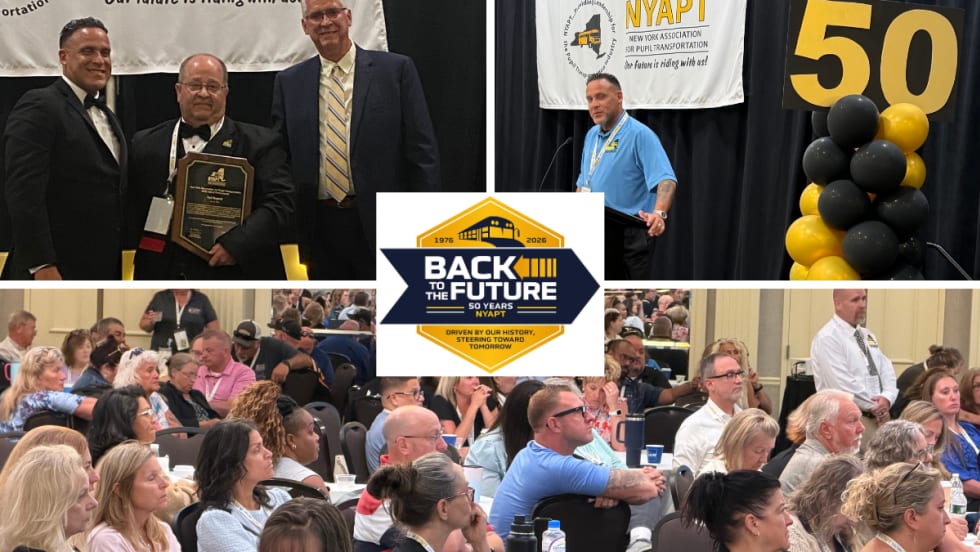
Photos: NYAPT Celebrates 50 Years at 2026 Conference & Trade Show
See highlights from NYAPT's 50th anniversary conference in Saratoga Springs, featuring educational sessions, awards, a trade show, networking, and more.
Read More →
Ohio Transportation Workgroup Calls for End to 'Impractical to Transport' Payments
A final report from Ohio's Pupil Transportation Workgroup proposes ending "impractical to transport" payments and expanding transportation options through regional partnerships, but not all industry pros agree on the approach.
Read More →

Transfinder Expands California Footprint with Multiple School District Wins
Six California school districts selected the company's routing platform and related transportation technology as Transfinder continues expanding its presence across the state.
Read More →
NSTA's Curt Macysyn on Student Transportation History and What's Next
Hear from NSTA's executive director as we discuss student transportation's role in American history, federal regulation, driver recruitment, illegal passing, AI, and what might be next, in this Route interview.
Read More →
NSTA on 250 Years of America and the Road Ahead for Student Transportation
Curt Macysyn joins The Route to discuss student transportation's role in American history, federal regulation, driver recruitment, illegal passing, AI, and the industry’s future. Sponsored by IC Bus.
Read More →
Photo Highlights: Inside the 2026 Michigan Association for Pupil Transportation Conference
Snapshots from the 2026 MAPT conference, where Michigan's school transportation professionals gathered for training, technology updates, awards, networking, and more.
Read More →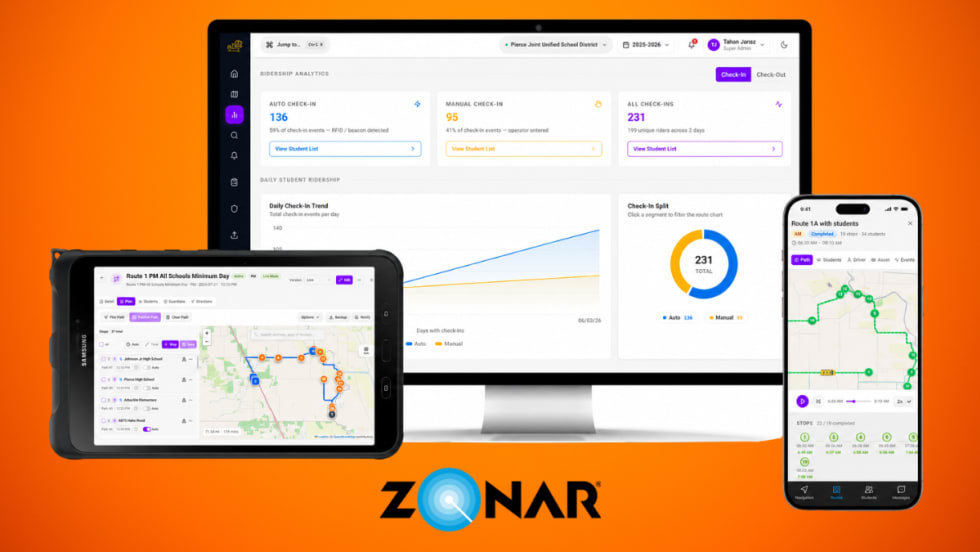
Zonar Launches Reimagined Bus Suite Web Portal
Can one platform replace your transportation software stack? Zonar says its new Bus Suite unifies routing, dispatch, field trips, GPS, and parent communication.
Read More →
Indiana Association Announces 2026 Award Winners
See who earned top honors at the 2026 School Transportation Association of Indiana conference, recognizing excellence in school transportation statewide.
Read More →
Student Transportation of America Acquires Massachusetts Contractor
Tremblay’s Bus Company and its 400-bus fleet joins the STA family of brands as the company grows its presence across the Northeast U.S.
Read More →