




Aging fleets: How do we compete for resources?
If the fleet gets past a certain age, we can count on higher maintenance costs, reduced dependability, driver frustration, the need for more mechanics and maybe not meeting our school customers’ expectations.

Michael Shields says that when developing a bus replacement plan, it is important to ask yourself who should help you develop the plan.
We are facing a dual-edge sword during these difficult financial times: that of the need to replace our school buses as they age and the need to be sensitive to limited cash flow that may have resulted in reductions in force and other major cuts to the budget.
Nevertheless, if the fleet gets past a certain age, we can count on higher maintenance costs, reduced dependability, driver frustration, the need for more mechanics and maybe not meeting our school customers’ expectations.
If you are in the same predicament as many other transportation departments/companies, you are finding that you are not in a position to replace all the buses you wish to replace.
If we begin to develop a bus replacement plan now, then we can be prepared with information for when our districts begin their financial recovery.
Do your homework
How do we begin? By understanding the financial situation in our districts.
The position we find ourselves in is that of competing with other support services and classrooms for precious dollars. What are we to do?
If you are a business manager or the chief financial officer, you have to ensure:
• that students are able to get to school, or they cannot be taught,
• that they are kept warm or cool in a dry, clean place, or they cannot learn,
• and that they have food, or they cannot focus.
This is a tough balancing act for our friends in the fiscal office.
So let’s begin by doing some of your own homework with questions and data. Without a map, you do not know what road will lead to success. Consider the following:
• What needs to be included in the plan on how and when to replace buses?
• Who should help you develop the plan?
• What information do you need to develop the plan?
• What questions do you need to ask, and of whom?
• Where do you get your data?
The comforting thing is that you do not have to reinvent the wheel. You have colleagues who have been down this trail before and have plans in place.
Ask them how they succeeded, what process they used and what information they included. Ask for permission to use their process, formulas and materials.
Attend workshops and conferences to learn how others have worked their magic.
Analyze fleet data
Begin by listing your buses by year, and compute the average age. Note the prior purchasing patterns — i.e., how many buses and what types were purchased each year.
The fleet data will show the total number of buses in the fleet each year (I break these down by large capacity and small capacity) and the number of students transported.
Gather this information as far as back as you can. You may have to find where the district archives are kept. If that is too much work, then take the last five years.
What do the data tell you? How many years or miles is a bus kept? What capacity and type of bus has the district purchased? How many buses per year have been purchased?
Other relevant questions: Will you continue with the current bell times, or can you make changes to reduce the needed number of buses? Are schools being added or closed, and what impact will that have on fleet needs?
To compute how many buses you will need in the future, it is best to examine your service levels (determining service levels is another story for another time).
While service levels are important and one of the foundations of developing your bus plan, a major player in your decision model is understanding the state rules for bus depreciation and retention. How long does your state allow you to retain a bus? What type of financial system does the state use in covering transportation expenses — in this case, bus purchases — if they do at all?
[PAGEBREAK]Further factors
Here are other key factors to look at:
• The annual costs of maintaining your buses
• The optimum age to avoid major maintenance
• The financial and purchasing philosophy that your district follows (e.g., lowest purchase cost, life cycle cost purchasing, paying cash, lease purchase, focus on the environment by going green, etc.)
• If lease purchasing a bus, what the length of repayment period is (five, seven or 10 years, for example) and whether it aligns with the state’s length of bus retention
• The amounts of monies that are available in your district for capital acquisitions
• The historical purchase patterns for when buses have been replaced
• The oldest bus(es) in the fleet
If, for example, you were to replace buses every 10 years, how many buses would you purchase each year to maintain a 10-year life? In a 100-bus fleet, you would replace 10 buses each year.
If state rules allow you to keep the bus 12 or 15 years, then you may wish to adjust your plan, based on miles traveled, condition of the bus and monies available, to a longer replacement cycle. A 100-bus fleet with a 12-year replacement cycle would be about eight buses replaced per year.
If your replacement is based on number of miles, then you will need to compute the expected miles traveled based on your history by the type of bus. As examples, Type D buses might be replaced at 200,000 miles, while Type A buses might be replaced at 120,000 miles.
Once you have answered some of these questions, get the information into a spreadsheet that will list the financial information, number of buses in the fleet (number of route buses plus 10% for maintenance), and number of buses you need and/or wish to replace each year.
Remain hopeful and plan ahead. Remember: “Success is when opportunity and preparedness meet.” You can be prepared.
Michael Shields is director of transportation at Salem-Keizer Public Schools in Salem, Ore. He is also a member of SBF’s editorial advisory board. He can be reached at shields_michael@salkeiz.k12.or.us.
To download an example of a school bus replacement plan, go here.
More Management

How to Build a Better Driver Training Program
Ready to boost up your school bus instructor training? Here’s how to pick the right talent and improve recruitment, retention, and safety.
Read More →
CALSTART and Forth Combine to Form Catalyst Mobility
The new name represents a renewed vision for the nonprofit focused on advancing clean, equitable, and affordable transportation solutions that move people and goods.
Read More →
What Makes a Great School Bus Driver Trainer?
Choosing the right school bus driver trainer takes more than experience. Learn six keys to selecting and developing trainers and evaluating program effectiveness.
Read More →

School Bus Contractors Expand Through New Deals, Acquisitions & Partnerships
STA's Canadian division acquires Ontario-based G&L Stevenson Transport; Durham School Services adds a new district in California; First Student expands in New Jersey; and Minnesota Coaches rebrands and acquires Halo Transportation.
Read More →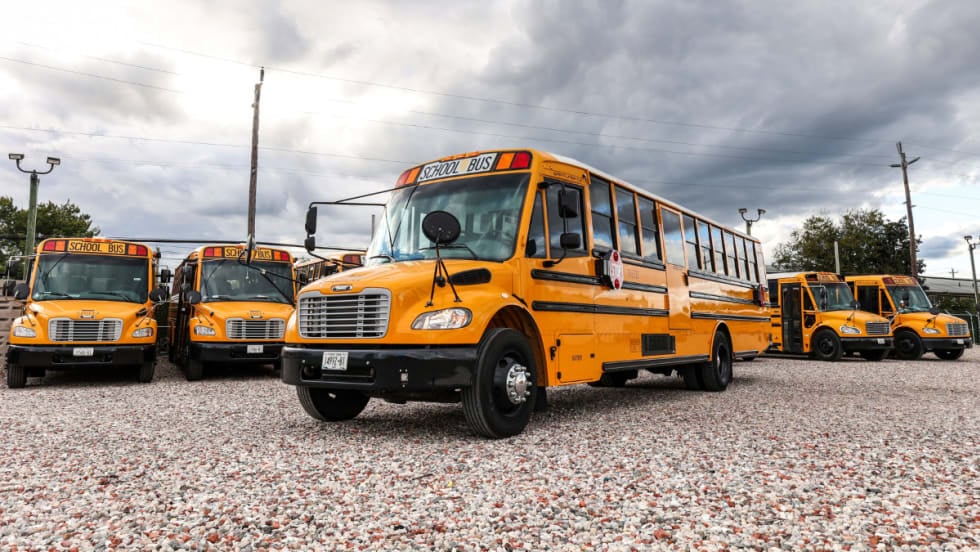
Logan Bus Company Rolls Out AI Phone System for NYC School Bus Families
A summer pilot found that AI agents could handle most routine calls, freeing up time for customer service staff to focus on emergencies and complex family concerns.
Read More →
From Intent to Impact: What I Learned About Leadership from TAPT
A Texas transportation supervisor shares lessons on self-awareness, accountability, managing stress and building trust — and why investing in leadership development matters at every stage of your career.
Read More →
NAPT Names 2026 Award Recipients, Hall of Fame Inductee
Who earned national recognition for their work in student transportation? This year, NAPT named five recipients of its 2026 awards for service, safety, and leadership, plus its newest Hall of Famer.
Read More →
2026 State of Student Transportation Report
Driver shortages. Rising costs. Growing safety expectations. More data, but not enough time to act on it. The 2026 State of Student Transportation Report reveals what transportation leaders say is putting the most pressure on their operations—and where they’re investing next. See how your priorities compare.
Read More →
How to De-Escalate an Angry Person: 5 Steps for Handling Workplace Conflict
What makes emotions run high, and how should you handle an angry colleague or parent? Follow these steps for staying calm, listening, showing empathy, and resolving conflict.
Read More →
What Readiness Looks Like This School Year
Learn about the challenges shaping the 2026–2027 school year, from persistent driver shortages and budget pressure to technology and readiness gaps. See how school districts are responding and adapting in Zonar’s 2026 Back-to-School Readiness Report.
Read More →