




Identifying and evaluating school bus route hazards
To ensure students’ safety, transportation managers must implement a procedure for this effort that includes scheduled onsite reviews and a means to efficiently communicate the hazards to staff. School bus drivers, local and state police, and local emergency operations centers should be involved.
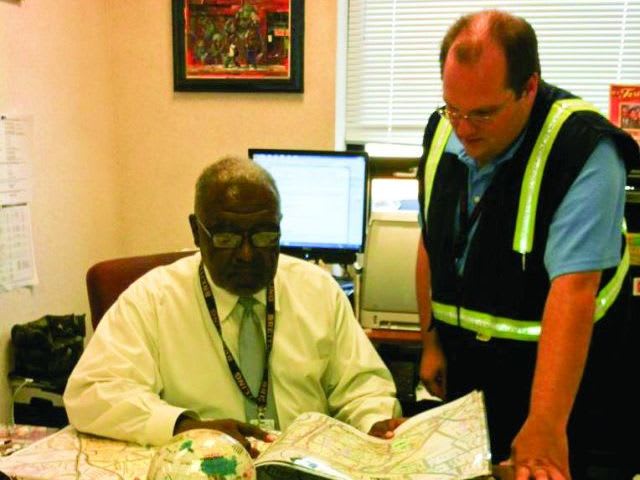
Arlington (Va.) Public Schools Director of Transportation Gregory Sutton (left) communicates with his drivers regularly to keep abreast of potential hazards on their routes. He’s pictured with Justin Kirby, one of the operation’s swing/lead bus drivers.
With the nation’s highways rapidly expanding, most notably in rural communities, and the increase in vehicular and pedestrian traffic, school bus drivers face a great challenge today while on their routes and at their stops: maneuvering safely through the various hazards along the way. In this article, I will discuss how you as a transportation official can help regular and substitute bus drivers recognize and report new or changing hazards so that they are on the safest routes possible, and students have safe locations to meet the bus.
To assist managers in establishing safe routes, the National Association of State Directors of Pupil Transportation Services (NASDPTS), under a grant from the National Highway Traffic Safety Administration, released a report that provides guidelines on how transportation officials can implement procedures for identifying and evaluating route hazards. (Go to www.nasdpts.org and click on “Operations,” and then “Routes and Stops.”)
Developing a program for this effort not only involves the school bus driver, it includes such outside agencies as local and state police, department of transportation personnel and local emergency operations centers.
What is a route hazard?
A route hazard can best be described as a driving hazard — either fixed or non-fixed — that is encountered while operating a school bus. A fixed route hazard is one that can be readily identified. Some examples of fixed route hazards are railroad grade crossings, bridges, tunnels, overpasses/underpasses, dangerous intersections, steep downgrades, curves and pedestrian areas.
A non-fixed route hazard is one that occurs without advance warning, such as unexpected animal crossings, downed power lines, fallen trees or rocks and inclement weather conditions, such as flooded roadways, black ice or snowstorms.
School bus route hazards are grouped into two distinct categories: 1. driving hazards encountered while operating a school bus, whether they are fixed or non-fixed, and 2. school bus loading zone hazards. Drivers encounter these hazards around school bus stops, and they include narrow streets and lack of shoulders and/or sidewalks.
[PAGEBREAK]

Fox River Grove crash hazards
It is imperative that your regular drivers and your substitute drivers not only know their respective routes, but also the characteristics of their bus, including the length and seating capacity.
In the tragic Fox River Grove, Ill., crash that occurred on Oct. 25, 1995, the bus driver was a substitute, and she was the assistant transportation supervisor. Her unfamiliarity with the route caused her to unknowingly fail to completely clear a train track while the school bus was stopped at a traffic light. She undoubtedly did not take into account the length of her school bus as well. As a result, a commuter train struck the left rearmost side of the school bus and it rotated counter-clockwise, dislodging the body from the chassis.
In the aftermath, seven students were killed, 24 sustained minor injuries and four were not injured. The school bus driver sustained minor injuries. The estimated 120 passengers and three crewmembers on the train were uninjured.
There were several major safety issues discussed in the accident investigation report, some of which were the appropriateness of the bus driver’s performance; the adequacy of the school district’s bus routing and the driver’s monitoring and evaluation procedures; road design; the railroad/highway signal interaction; the coordination and communication between the Illinois Department of Transportation and the Union Pacific Railroad Co. and their oversight of the signal system integration; and the injury and survival factors in the bus.
Components of accident prevention
How can we prevent such tragedies as the Fox River Grove accident? The first step is through constant communication with all of your drivers. You must also have some type of refresher course or training program for veteran drivers. This program should be conducted at least annually. It must include, at a minimum, safety tips for your drivers when crossing at railroad grades, driving during adverse weather conditions, school bus crash awareness with special emphasis on the danger zone, and accident reporting procedures.
As stated earlier, pupil transportation officials must also develop a program to assist their drivers in identifying route hazards. What I have done at my operation is incorporate the model developed by NASDPTS into my own program.
According to NASDPTS, there are three major components that should be considered in identifying school bus route hazards: 1. a list of potential driving hazards, 2. a specific procedure and schedule for conducting onsite reviews, and 3. an efficient and effective means of informing school bus drivers of the presence of potential route hazards.
Although my school district is only 25 square miles, it is impossible for me to know where every potential hazard exists. Therefore, I rely heavily on my drivers to inform me when they encounter potential school bus route hazards.
I also do route and weather checks on a routine basis in the course of performing my duties as a transportation director. Not only do I observe the bus driver and other motorists, I observe the students on the bus. If the bus is not overcrowded, I insist that no students sit in the rear seats. (In the Fox River Grove crash, all of the students who were killed were seated in the rear of the bus.)
I perform what you might call an onsite review as well. I annotate potential route hazards in my daily log, and on a weekly basis, I prepare an activity report where I recap the highlights of the week. If there are routes that need to be checked for hazards, I maintain a separate log and audit those routes on a priority basis.
The third and most important component — developing an efficient and effective means of informing bus drivers of potential school bus route hazards — I accomplish through written memoranda, monthly driver newsletters, monthly driver in-service training and a soon-to-be-implemented school bus route hazard checklist. The purpose of this checklist will be to have the drivers provide me with a written report of potential school bus route hazards. I feel this is important because unless the drivers are aware of these route hazards, the potential exists for another Fox River Grove-type incident.
As a pupil transportation director, the most important aspect of my job is ensuring the safety of all the passengers being transported to and from school and school-related activities. Having a proactive plan of identifying and evaluating potential route hazards not only makes sense, it makes the students safer.
Gregory Sutton has served as director of transportation at Arlington (Va.) Public Schools for the last decade. He has over 35 years of management experience in the transportation industry, 15 of which have been spent as a transportation director. He retired from the U.S. Army Reserves as a lieutenant colonel with the Transportation Corps, and he holds a master’s degree in transportation and business logistics.
More Management
13 Industry Leaders Describe School Transportation in One Word
What word best describes the school bus industry today? We posed that question to over a dozen manufacturers, resulting in a revealing mix of perspectives on the challenges and opportunities ahead.
Read More →
Tyler Technologies Adds New AI, Transactions Leadership Roles
Two company executives are promoted to newly created C-suite positions to accelerate the company's long-term growth in both artificial intelligence and payments.
Read More →
Pro-Vision Acquires Convoy Technologies
The deal aims to broaden customer relationships and adds specialized vehicle video capabilities for commercial fleets.
Read More →


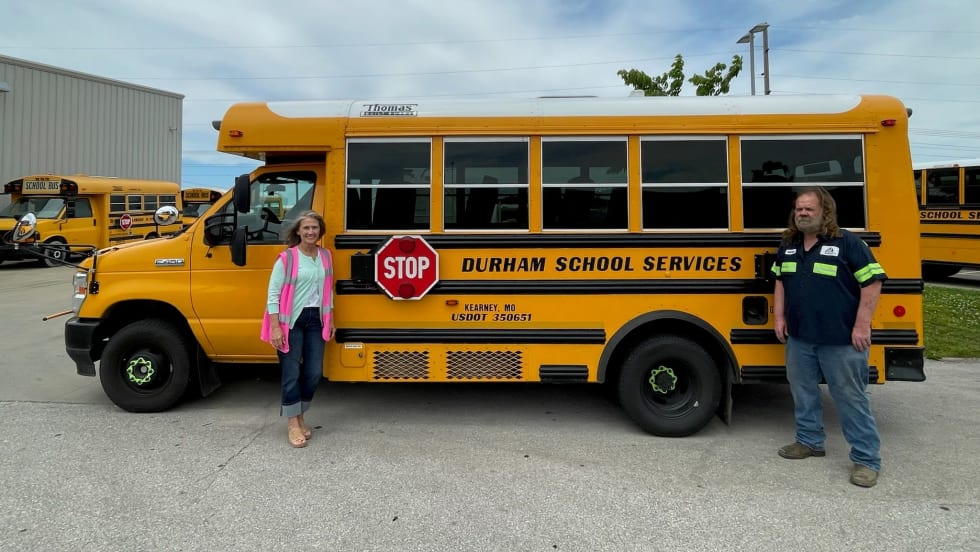
Durham School Services Maintenance Teams Earn Missouri Fleet Excellence Awards
Eight of the contractor’s school bus fleets achieved a distinction few maintenance teams earn during the state’s rigorous annual inspection program.
Read More →
How Incentives, AI, and Energy Markets Are Reshaping School Transportation
Sit down with Joe Annotti of TRC Companies to talk district grant funding, utility challenges, AI, and why school buses are evolving from transportation assets into energy assets.
Read More →
Inside the Contracting Shift: What School Transportation Operators Are Seeing Now
School transportation contractors weigh in on recent trends, costs, driver shortages, and the rise of multimodal student transportation.
Read More →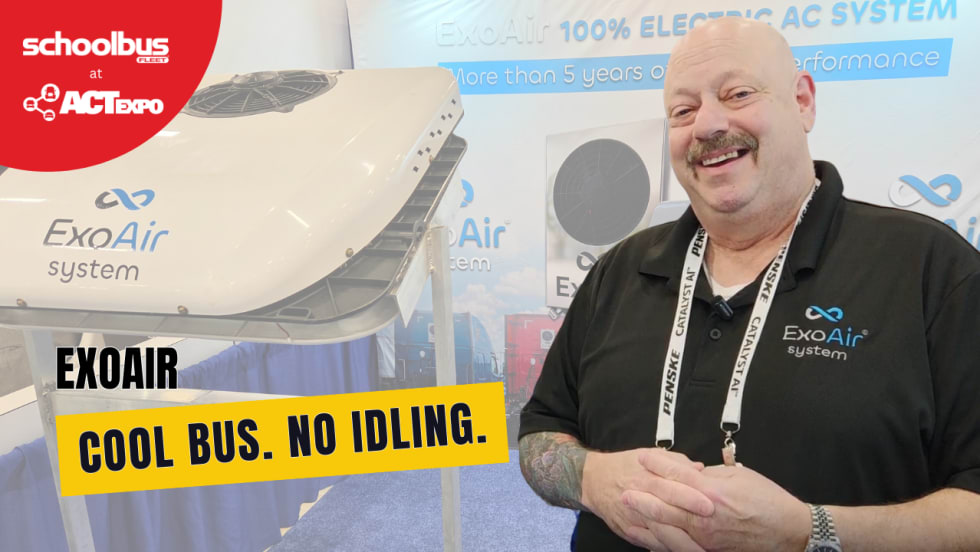
The No-Idling School Bus AC System
Take a peek at ExoAir Systems’ battery-powered cooling solution designed to run for up to 10 hours without the engine on, reducing fuel use and improving comfort for drivers and students.
Read More →
Geotab on Three Major Trends in School Transportation
School bus fleets are becoming more proactive than ever. From AI driver alerts to vehicle-to-grid opportunities, Geotab outlines the biggest technology trends transforming school bus operations.
Read More →
Gatekeeper Lands Major School Bus Deals as Revenue Surges
The video solutions provider announces contracts with Atlanta Public Schools and other fleet operators as it records quarterly revenue growth and expanding subscription business.
Read More →
Building Leaders Who Last: Creating a Successful Mentorship Program in Student Transportation
Discover five strategies for building an effective mentorship program to strengthen leadership development and support staff retention.
Read More →