




Achieving inventory efficiency
Adjusting your parts inventory to fulfill the needs of your technicians and to address the repairs that occur most will help bus maintenance and parts ordering in your shop run smoothly.

Maintaining a smaller inventory at your shop can help cut costs.
Managing the parts inventory in your shop can be both time consuming and costly. To address these issues, SCHOOL BUS FLEET spoke with industry experts to see what manufacturers offer in terms of parts ordering, and what best practices they suggest for maintaining a balanced inventory.
Smaller inventory cuts costs
It’s not necessary for a shop servicing school buses to have every part on hand at all times. However, maintaining a reasonable parts inventory that reflects your most frequent repairs can help you fix buses more quickly and lower costs.
“A repair shop can determine their technical areas of focus and labor efficiencies based on technician skills ... then focus on a specialized inventory in those areas, build a relationship with their local dealer, and the dealer can service the inventory,” explains Chuck Galusha, director of aftermarket part sales for Blue Bird.
You can also reduce costs and inventory size by keeping the number of bus models to a minimum, says Brent Stephens, parts manager for Starcraft Bus.
“[This] will allow the pupil transporter to keep his parts inventory low while still fulfilling parts requests on a timely basis,” he says.
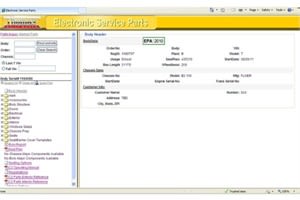
Thomas Built Buses dealers and end users can search for parts and access manuals on the company’s website.
Manufacturer websites ease parts search
Bus manufacturers are increasingly using the Internet to make searching for and ordering parts easier.
“Collins Bus dealers have access to the Collins Bus online parts ordering system and VIN number search online,” says Glennys Tedder, aftermarket parts manager, Collins Bus Corp. “The majority of our dealers’ parts orders are placed online.”
Thomas Built Buses launched an information portal in 2001 that allows dealers and customers who request access to search parts, manuals, tutorials and more.
If a technician has a box with an unidentified part in it, entering the number on the box into the system will pull up technician drawings, installation guides and other useful information, according to Brian McCool, manager, parts marketing and specialty sales for Thomas Built Buses.
E-commerce definitely a trend
Starcraft will have an online parts ordering system available in April 2012. “The bus industry is moving in the same direction as other industries because our customers have a desire to have more information at their fingertips,” Stephens says.
Brian Barrington, sales manager at Trans Tech Bus, says that while the company currently only offers online parts ordering to dealers, “We’re debating on whether to open that up to the general population.”
“I believe there’s a lot more companies moving towards the e-commerce type of ordering or automatic type replenishment orders,” says Steve Helriegel, manager, integrated solutions and continuous improvement for Navistar Parts Group.
[PAGEBREAK]
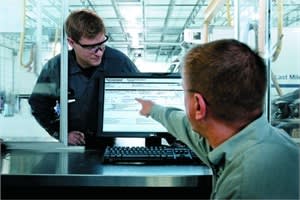
Software such as Navistar’s OnCommand Maintenance and Inventory Management can help shops keep track of parts more easily.
Manufacturers strive for quick shipping, delivery
Collins Bus Corp. offers “same-day shipping, expedited shipping [and] international shipping from our centrally located distribution facility,” says Tedder, which “allows quick order turnaround and delivery to ourcustomers.”
Getting necessary parts quickly is essential to achieving speedy repair. This has led some of Blue Bird’s dealers to try out new technology.
“Some dealers are currently providing Blue Bird parts cataloging and support via iPad technology,” Galusha says. “Blue Bird is developing broader applications, first for internal use to our dealers and then to be rolled out between the dealers and the customers.”
Software effectively manages inventory
Using software to manage parts inventory can be quicker and easier than other methods.
“A lot more people are going to electronic inventory systems and barcoding,” Barrington says.
Helriegel suggests that software such as OnCommand Maintenance and Inventory Management, produced by IC Bus’ parent company, Navistar, “does provide the inventory management tools that most fleets are looking for, or that most fleets could utilize.
“[Inventory management software] can really help keep buses on the road and out of the shop,” he says.
PACCAR’s Managed Dealer Inventory system
TRP Bus Parts, retailed through PACCAR dealers, is a new line of all-makes parts specifically for buses. The parts fit a variety of buses, including those manufactured by Blue Bird, IC Bus, Thomas Built and more.
According to Dale Puhrmann, national sales manager — bus segment, TRP Bus Parts inventory is managed by PACCAR dealers through the company’s Managed Dealer Inventory (MDI) software.
“The MDI system automates the adjustment of inventory levels at the dealership to accommodate seasonal and historical trends while improving product availability,” he explains.
The MDI software offers recommended stocking lists to dealers and helps maintain inventory based on customized criteria at each dealership.
School transportation officials can reduce the cost of inventory by working closely with dealers, according to Puhrmann. Additionally, PACCAR offers Connect software for school transportation departments to better manage parts inventory and bus maintenance and repair.
More Management

Logan Bus Company Rolls Out AI Phone System for NYC School Bus Families
A summer pilot found that AI agents could handle most routine calls, freeing up time for customer service staff to focus on emergencies and complex family concerns.
Read More →
From Intent to Impact: What I Learned About Leadership from TAPT
A Texas transportation supervisor shares lessons on self-awareness, accountability, managing stress and building trust — and why investing in leadership development matters at every stage of your career.
Read More →
NAPT Names 2026 Award Recipients
Who earned national recognition for their work in student transportation? This year, NAPT named five recipients of its 2026 awards for service, safety, and leadership.
Read More →

2026 State of Student Transportation Report
Driver shortages. Rising costs. Growing safety expectations. More data, but not enough time to act on it. The 2026 State of Student Transportation Report reveals what transportation leaders say is putting the most pressure on their operations—and where they’re investing next. See how your priorities compare.
Read More →
How to De-Escalate an Angry Person: 5 Steps for Handling Workplace Conflict
What makes emotions run high, and how should you handle an angry colleague or parent? Follow these steps for staying calm, listening, showing empathy, and resolving conflict.
Read More →
What Readiness Looks Like This School Year
Learn about the challenges shaping the 2026–2027 school year, from persistent driver shortages and budget pressure to technology and readiness gaps. See how school districts are responding and adapting in Zonar’s 2026 Back-to-School Readiness Report.
Read More →
Changing Lanes: Executive Moves at Summit School Services, Zum, STA, Cummins, Transit Technologies, Driventic, & Cadex
See who's been hired, promoted, and appointed to leadership positions at various school transportation industry suppliers and private contractors.
Read More →
Industry Moves: Companies Expand Fleet Service & EV Infrastructure Footprints
The new facilities and regional hubs could mean faster access to shop equipment, charging support, and transportation technology for fleet operators.
Read More →
Doing More With Less: How Transportation Directors Can Prioritize Safety Amid Budget Uncertainty
With diesel prices soaring and nearly one-third of transportation directors expecting budget cuts, maintaining student safety has never been more challenging. Download this guide to learn how leading districts are prioritizing risk, funding critical safety technology, and building stronger budget cases with data.
Read More →
Zum Reaches 19 States With New York Expansion
The addition of the Empire State to the student transportation company's roster marks a growing expansion in the Northeast as it scales its tech and school bus services.
Read More →