




Finding multiple ways to generate revenue
Bus companies and school district transportation departments are making $50,000 to more than $2 million through such efforts as inter-district service, school bus ridership fees and bus advertising. Here, officials discuss the specifics of these programs and other work that brings in extra money.

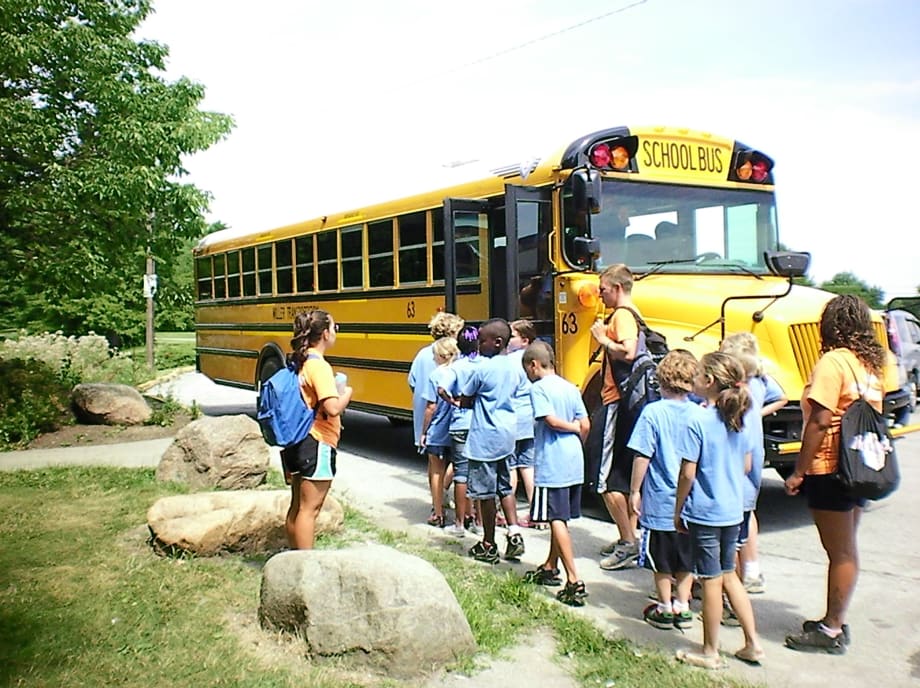
Miller Transportation's branch in Indianapolis provides transportation services during the local parks and recreation's summer camps. This type of work has helped to raise more than $2 million for the bus company.
With states across the nation cutting funding for education and education-related programs, money is tight for many operations.
Faced with this economic climate, pupil transporters at bus companies and school districts are coming up with ways to generate additional revenue, with promising results.
Operations from California to Indiana have raised $50,000 to more than $2 million through such efforts as establishing a mutual transportation agreement, permitting advertising on the exterior of their buses, providing transportation for organizations in their communities and implementing
a bus fee program.
Douglas County School District in Castle Rock, Colo., for instance, became the first school district in the state to charge a fee for bus service last fall. So far, the district has made $1.4 million, according to Director of Transportation Paul Balon, all of which is going toward the district's transportation department.
"Fee for service is here to stay. We were the first school district in the state to implement this kind of system, but now, for this coming school year, there are about seven other school districts that are getting ready to charge a fee. As the budgets dwindle, you have to find ways to generate revenue and offset some of the costs," Balon says.
Positive response to per-ride bus fee system
Under the program at Douglas County School District, the bus fee is based on usage rather than being a fl at price. The district is using Zonar Systems' ZPass system to track students on and off the bus and to charge 50 cents each way, with a maximum of $1 per day. The maximum that a parent would be charged for an entire school year is $173.
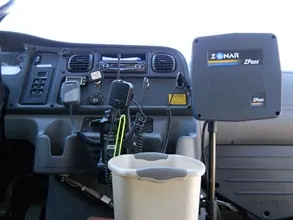
A reader for Zonar Systems' ZPass system is installed in each of Castle Rock, Colo.-based Douglas County School District's buses. The technology is used to track students on and off the bus as part of a per-ride bus fee system.
Each student has a ZPass card, and a reader is installed on each bus. When students board and disembark the bus, it is recorded into the ZPass reader.
"That Zpass information is downloaded into our Oracle system and from there, our Infinite Campus application determines what is and is not a chargeable ride," Balon explains.
He notes that the district's school bus ridership dropped by about 2,000 students when the per-ride fee system was implemented. Balon anticipated that might happen; however, he says that the district has since gained those 2,000 riders back. He attributes it to the rise in the price of fuel and parents not wanting to sit in bad traffic, especially during the winter months when the weather is undesirable.
"It costs us about $900 to transport one student for an entire year, and when parents see that they're only paying $173 of that, a lot of them have said that they understand and that it's a good value received," he adds.
Bus advertising brings in money for district's schools
Southeast of Colorado, in Texas, Houston Independent School District (ISD) is bringing in extra money through advertisements that run on the outside of the district's more than 1,000 buses.
When officials reviewed the district's budget last December, they recognized they were facing a budget shortfall across the board for education, according to Nathan Graf, general manager of transportation services at Houston ISD. School bus advertising was presented as an option to alleviate the shortfall, and the district's school board approved it in January. A contract was finalized in February, and the first advertisements arrived in April.
Graf says that while the ads ran during the last few months of the 2010-11 school year, they helped generate between $50,000 and $70,000.
"We expect that for the 2011-12 school year, conservatively, it will generate a little under $250,000. We hope in the following school year, it will be close to $500,000 and then continue to go up," he adds, saying that the money goes toward the district's schools for teaching supplies or other items needed at the campus level.
Houston ISD partnered with Steep Creek Media to offer advertising space on its buses. Steep Creek reaches out to companies on behalf of the district to find out whether officials there would be interested in placing ads on the buses.
A policy developed by the school board regulates what type of ads can run on the buses. As with other districts that permit school bus advertising, ads that have content of an adult or political nature are not allowed on Houston ISD buses.
Graf says that a committee — one person from transportation, one person from academics, one person from the district's legal team, one person from the media department and one person from senior administration — reviews all of the ads that come in to ensure that they are suitable for placement on the buses.
So far, the ads on Houston ISD buses have been from nonprofit organizations, such as the YMCA.
"We've had one ad from a nonprofit called the College Board Advocacy & Policy Center and it involves getting kids to recognize the importance of going to college," Graf says.
[PAGEBREAK]
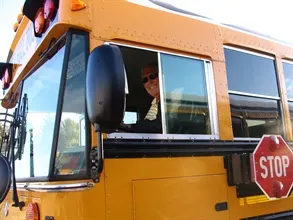
Bus drivers for Cottonwood-Oak Creek School District No. 6 in Cottonwood, Ariz., work on six to 12 charter trips annually, which Transportation Director Debbie Wheaton says generates some extra money for the district.
Service for community groups creates extra revenue, work for bus drivers
In addition to bus advertising, Graf says Houston ISD is reaching out to smaller school districts and school organizations to inquire about providing transportation for their areas of service.
"We have one organization that's interested. It will require about 25 additional routes for the district and will bring in about $1 million in revenue. From that revenue, we would have to pay our expenses," Graf says.
Providing services for other operations and groups within their communities is a way that many districts' transportation departments and bus companies generate extra revenue.
Balon says Douglas County School District's transportation department provides its services for approximately 2,400 field trips for church groups and private schools annually, which generates about $200,000 for the district.
For Miller Transportation, the company's work during the summer months results in a substantial amount of money. Todd Edwards, school bus operations manager for Miller Transportation's Indianapolis branch, says the company provides transportation for YMCAs in Marion, Hamilton, Hendrix and Boone counties, as well as all of the summer camp transportation for the Indianapolis Parks and Recreation Department.
"We have a couple of schools that we do field trip transportation for," Edwards adds. "Between all of the service, it generated a little over $2 million."
The money was used to purchase new school buses for the company.
Aside from offering information about its services on its website, Edwards says Miller Transportation gets much of its business through word-of mouth recommendations, achieved, he adds, through the company's effort to provide personal, one-on-one attention to all of its clients.
For the transportation staff at Cottonwood-Oak Creek School District No. 6 in Cottonwood, Ariz., requests for service for charter trips also come through word of mouth, according to Transportation Director Debbie Wheaton.
The operation only performs six to 12 charter trips per ye
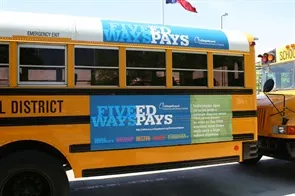
Houston Independent School District began running an ad from the College Board Advocacy & Policy Center on its school buses in April. Ads like this have helped to generate more than $50,000 for the district so far.
ar because Wheaton doesn't want to interfere with their home-to-school transportation service.
"I wouldn't say we generate a lot of money from these charters, but it does give drivers additional work and it puts a little change in our coffers from time to time," Wheaton says. "The money that we generate goes back into the transportion portion of the district's budget for fuel and for the drivers' wages."
Cottonwood-Oak Creek School District No. 6's transportation department charges a maximum of $14 per hour for charter trips, which is the hourly wage of the district's highest paid drivers.
"We charge the highest amount for wages because we never know who's going to do the trips. If it's a driver that makes $12 an hour, we're going to generate a little bit of money — the district would see a $2-an-hour profit," Wheaton explains.
Department benefits from mutual transportation agreement
The transportation department at Orange (Calif.) Unified School District has raised $90,000 in additional revenue by transporting students who attend other school districts in Orange County for home-to-school and activity/field trips.
The service is provided under a mutual transportation agreement that the operation participates in with other school districts in the county.
Pamela McDonald, transportation director at Orange Unified School District, decided to work on drafting a mutual transportation agreement after helping other districts in the county with transportation for field trips, grad nights and other activities over a period of several years.
"I got to thinking that instead of taking all of these individual agreements to our school board for approval, why don't we see if we can do a mutual agreement with the school districts in Orange County?" McDonald explains.
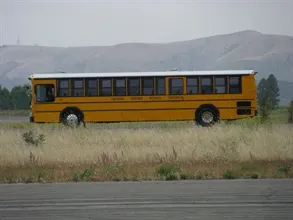
Orange (Calif.) Unifi ed School District's transportation department has made $90,000 by providing school bus service for other districts in Orange County under a mutual transportation agreement.
McDonald organized a meeting at the Orange County Department of Education in which individuals who oversee the districts' business offices were asked to attend. A legal advisor was also invited. McDonald says it took about a year and a half to finalize the first agreement, which then ran for a year and a half. When officials met to renew the agreement, it was set for five years. McDonald will meet with the legal advisor next year to draw up an agreement for another five years.
She says the agreement is good for field trips, home-to-school transportation (if it's an emergency) and times when a district has a homeless student who moves and needs immediate transportation to a school outside the district's area of service.
"It's important to note that it's not our intent to compete with private enterprise," Transportation Supervisor Ellen Johnson adds. "There's an agreement among us [the participating districts] that when you call needing assistance for transportation for things like grad night, it's because you've exhausted all other options from outside resources, like when all of the charter companies are booked."
Johnson also says that establishing a policy about driver pay was an important component that was discussed when drafting the mutual transportation agreement.
Under the agreement, the operation requesting service must pay the district the rate that it pays its bus drivers. For example, Orange Unified School District's bus drivers make their normal salary whether they're driving for their district or another operation.
In terms of handling transportation for other school districts, McDonald says she will often send her more senior, experienced drivers to the districts with route sheets, especially for home-to-school service. Orange Unified School District's substitute bus drivers then cover the veteran drivers' routes.
More Management
How to Build a Better Driver Training Program
Ready to boost up your school bus instructor training? Here’s how to pick the right talent and improve recruitment, retention, and safety.
Read More →
CALSTART and Forth Combine to Form Catalyst Mobility
The new name represents a renewed vision for the nonprofit focused on advancing clean, equitable, and affordable transportation solutions that move people and goods.
Read More →
What Makes a Great School Bus Driver Trainer?
Choosing the right school bus driver trainer takes more than experience. Learn six keys to selecting and developing trainers and evaluating program effectiveness.
Read More →


School Bus Contractors Expand Through New Deals, Acquisitions & Partnerships
STA's Canadian division acquires Ontario-based G&L Stevenson Transport while Durham School Services adds a new district contract in California, First Student adds a New Jersey contract, and Minnesota Coaches acquires Halo Transportation.
Read More →
Logan Bus Company Rolls Out AI Phone System for NYC School Bus Families
A summer pilot found that AI agents could handle most routine calls, freeing up time for customer service staff to focus on emergencies and complex family concerns.
Read More →
From Intent to Impact: What I Learned About Leadership from TAPT
A Texas transportation supervisor shares lessons on self-awareness, accountability, managing stress and building trust — and why investing in leadership development matters at every stage of your career.
Read More →
NAPT Names 2026 Award Recipients, Hall of Fame Inductee
Who earned national recognition for their work in student transportation? This year, NAPT named five recipients of its 2026 awards for service, safety, and leadership, plus its newest Hall of Famer.
Read More →
2026 State of Student Transportation Report
Driver shortages. Rising costs. Growing safety expectations. More data, but not enough time to act on it. The 2026 State of Student Transportation Report reveals what transportation leaders say is putting the most pressure on their operations—and where they’re investing next. See how your priorities compare.
Read More →
How to De-Escalate an Angry Person: 5 Steps for Handling Workplace Conflict
What makes emotions run high, and how should you handle an angry colleague or parent? Follow these steps for staying calm, listening, showing empathy, and resolving conflict.
Read More →
What Readiness Looks Like This School Year
Learn about the challenges shaping the 2026–2027 school year, from persistent driver shortages and budget pressure to technology and readiness gaps. See how school districts are responding and adapting in Zonar’s 2026 Back-to-School Readiness Report.
Read More →