




What's New in the Top 100?
Recent developments related to six of this year's largest school district fleets in the nation.

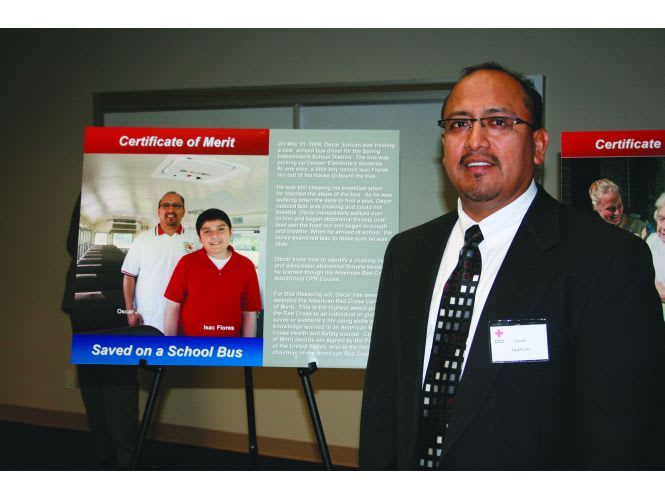
At an American Red Cross chapter meeting, Oscar Juracan stands in front of a poster that shows him with the student he rescued from choking.
Spring ISD trainer saves choking student
In June, Oscar Juracan of Spring (Texas) Independent School District (ISD) was honored for rescuing a student from choking.
Juracan, a transportation trainer for the district, was given an American Red Cross Certificate of Merit at the 93rd Annual Meeting of the Greater Houston Area Chapter of the American Red Cross.
The incident occurred on May 31, 2009, while Juracan was training a new school bus driver. An elementary student named Isac Flores ran out of his house to board the bus while still chewing his breakfast.
As Flores was walking down the aisle to find a seat, Juracan noticed that he was choking and not able to breathe. Juracan quickly and calmly walked over to Flores and began abdominal thrusts until the child spit the food out and began to cough and breathe.
Flores was examined by the school nurse to ensure that he was OK after he was delivered safely to school.
“It was a natural instinct for him to want to help, he had the skills to help correctly, and he made a difference,” said Brian Weisinger, Spring ISD transportation director.
Juracan learned how to identify a choking victim and administer abdominal thrusts in an American Red Cross adult/child CPR course that is required for all Spring ISD transportation trainers. The district’s transportation department requires all special-needs drivers, auxiliary drivers and trainers to take the CPR course, and most of the regular drivers have taken the training, which is provided by a cadre of CPR instructors at the transportation department.
“It takes a hero mentality to step into a situation and do what you have been trained to do,” said Denise Chuick, Spring ISD safety coordinator. “[Juracan] stepped up and did what was needed using a technique he had learned in the training.”
Los Angeles USD receives $43M green school bus grant
Earlier this year, the Los Angeles Unified School District (LAUSD) transportation services division was awarded a grant of $43 million for the purchase of 260 compressed natural gas (CNG) school buses.
With the addition of those buses, LAUSD’s fleet includes 403 CNG, 100 ultra low emission gasoline and 90 propane buses.
“We are excited to support those technologies that help to provide our students and our community with a healthy school environment to and from home,” Superintendent Ramon Cortines said.
In 2003, the LAUSD board of education adopted a “Healthy Breathing” initiative, which mandated that the district only accept bids to purchase or to contract buses powered by alternative fuels or green diesel school buses that meet strict emission standards.
The recent funds came from the South Coast Air Quality Management District (SCAQMD). While the CNG buses are valued at $180,000 each, the grant allowed LAUSD buy them for about $13,000 each.
“We appreciate our partnership with SCAQMD, who continue to help us with the financial challenges of school bus replacement,” Transportation Director Enrique Boull’t said. “Together, our goal is to provide new energy-efficient, lower-emission and safe school buses to our students.”
Columbus acquires six hybrids
Columbus (Ohio) City Schools continues to make progress in its goal of “greening” its fleet.
Last year, the district applied for and received a grant from the American Recovery and Reinvestment Act and National Clean Diesel Funding Assistance Program to replace six 1990 model year school buses with new hybrid diesel-electric buses. The funding totaled more than $1.1 million.
Steve Simmons, director of transportation at Columbus City Schools, reported that the hybrid buses were added to the fleet in August.
The district expects the hybrids to achieve a fuel economy increase of around 70 percent compared to a standard diesel. CO2 emissions are expected to be reduced by more than 40 percent.
[PAGEBREAK]
[IMAGE]585[/IMAGE]
Salem-Keizer earns accolades, hones policies
The past year was an eventful one at Salem-Keizer Public Schools in Salem, Ore., with a number of certifications and recognitions achieved and new policies developed.
The district’s business services division attained ISO 9001 certification, and fleet maintenance was recertified as an environmentally friendly shop under the Oregon Department of Environmental Quality’s stringent standards.
One of the district’s school bus drivers, Patrick McLaughlin, was the overall winner of the Oregon Pupil Transportation Association Safety Exercise. (To watch a video of McLaughlin demonstrating maneuvers required in such competitions, go to www.schoolbusfleet.com/videos.)
The district’s transportation department and the Association of Salem-Keizer Education Support Professionals union partnered in training 35 people in Stephen M.R. Covey’s The Speed of Trust, and 29 of the 35 participated in a year-long book study in preparation for the training.
“The results of the trust-building and relationships bore fruit during the process of taking dramatic reductions in dollars in the department — over $1 million in reductions,” said Michael Shields, the district’s director of transportation.
Three of Salem-Keizer’s mechanics attained ASE’s school bus master technician status. And head mechanic David Farley represented Oregon at the National Congress on School Transportation in May. Farley, a lieutenant colonel in the Army National Guard, was serving as a battalion commander and received special leave to attend the congress.
The Salem-Keizer transportation department recently began rewriting board policies and procedures for transportation, and it launched new guidelines through a cooperative effort with employee teams. The department was also tasked by the superintendent to reevaluate all bell schedules and service levels in the district for 2011-12, when new schools will be opening.
In conjunction with the district’s risk management department, city police and traffic engineers, the transportation department developed a process for assessing school traffic and parking and loading zones, as well as issues and criteria for student safety patrol and adult crossing guards.
Also, the routing team worked with the special-education and technology departments to develop a new electronic process with specific work instructions, responsibilities and timelines to improve efficiencies and promptness to better serve students.
Anoka-Hennepin drops $200 bus rider fee
The Anoka-Hennepin School District has eliminated its $200 bus rider fee for students who live between one and two miles from school for the 2010-11 school year.
The Coon Rapids, Minn.-based district instituted the fee in 2002 as a way to raise revenue in the midst of more than $10 million in budget reductions.
District officials gave two reasons for the decision to drop the fee. The first is that a demographic change is underway in the district — in 10 years, the percentage of students who qualify for free or reduced-price lunch has doubled. In 1999, it was 16.5 percent; in 2009, it was 30.7 percent.
Students who qualify for free or reduced-price lunches pay a reduced bus fee or no fee depending on their level of qualification. As more students qualify, the district must provide transportation to them, but it collects less revenue from fees. If this trend continues, district officials reasoned, fees eventually become irrelevant because so few students pay the full fee.
The second reason for eliminating the fee is that the district’s transportation department has worked closely with its contracted bus companies and negotiated no increase in the annual contract for this school year (the second freeze in as many years).
With no increase in expenses, the district can restore bus service to its pre-2002 levels and eliminate most adult crossing guard positions. The positions are not needed because buses will transport students across roads that are considered hazardous. This reduction, plus eliminating the cost of collecting fees, offsets the loss of the fee revenue.
“Economically, it makes sense,” said Keith Paulson, Anoka-Hennepin School District’s director of transportation. “But it makes the most sense to transport more students safely on buses — that’s what elimination of the fees really allows us to do.”
Douglas County launches per-ride bus fee system
Douglas County School District in Castle Rock recently became the first district in Colorado to charge a fee for bus service.
Interestingly, the fee is based on usage rather than being a flat price. The district is using Zonar’s ZPass system to track students on and off the bus and to charge 50 cents per ride.
“The safety and security provided by Z-Pass make the implementation well worth the money for the system,” said Paul Balon, the district’s director of transportation.
Beyond the security benefits, the program is expected to raise about $2 million, which would offset a substantial portion of the district’s $17-million budget for transportation.
“In the last two years, we have cut $2.4 million and $1.9 million from the transportation operational budget,” Balon notes.
More Management

How to Build a Better Driver Training Program
Ready to boost up your school bus instructor training? Here’s how to pick the right talent and improve recruitment, retention, and safety.
Read More →
CALSTART and Forth Combine to Form Catalyst Mobility
The new name represents a renewed vision for the nonprofit focused on advancing clean, equitable, and affordable transportation solutions that move people and goods.
Read More →
What Makes a Great School Bus Driver Trainer?
Choosing the right school bus driver trainer takes more than experience. Learn six keys to selecting and developing trainers and evaluating program effectiveness.
Read More →


School Bus Contractors Expand Through New Deals, Acquisitions & Partnerships
STA's Canadian division acquires Ontario-based G&L Stevenson Transport while Durham School Services adds a new district contract in California, First Student adds a New Jersey contract, and Minnesota Coaches acquires Halo Transportation.
Read More →
Logan Bus Company Rolls Out AI Phone System for NYC School Bus Families
A summer pilot found that AI agents could handle most routine calls, freeing up time for customer service staff to focus on emergencies and complex family concerns.
Read More →
From Intent to Impact: What I Learned About Leadership from TAPT
A Texas transportation supervisor shares lessons on self-awareness, accountability, managing stress and building trust — and why investing in leadership development matters at every stage of your career.
Read More →
NAPT Names 2026 Award Recipients, Hall of Fame Inductee
Who earned national recognition for their work in student transportation? This year, NAPT named five recipients of its 2026 awards for service, safety, and leadership, plus its newest Hall of Famer.
Read More →
2026 State of Student Transportation Report
Driver shortages. Rising costs. Growing safety expectations. More data, but not enough time to act on it. The 2026 State of Student Transportation Report reveals what transportation leaders say is putting the most pressure on their operations—and where they’re investing next. See how your priorities compare.
Read More →
How to De-Escalate an Angry Person: 5 Steps for Handling Workplace Conflict
What makes emotions run high, and how should you handle an angry colleague or parent? Follow these steps for staying calm, listening, showing empathy, and resolving conflict.
Read More →
What Readiness Looks Like This School Year
Learn about the challenges shaping the 2026–2027 school year, from persistent driver shortages and budget pressure to technology and readiness gaps. See how school districts are responding and adapting in Zonar’s 2026 Back-to-School Readiness Report.
Read More →