




Not all doom and gloom
As we monitor media outlets from all over the country to see what they have to report on pupil transportation matters, we’ve been coming across a lot ...
As we monitor media outlets from all over the country to see what they have to report on pupil transportation matters, we’ve been coming across a lot of bad news lately.
A back-to-school story topic that popped up in many newspapers is about how the local school district has scaled back its transportation services this year.
In some cases, walking distances have been increased. For example, children might have to live more than two miles from school to be eligible for a bus ride, whereas before it was 1.5 miles. In other cases, the number of bus stops has been significantly reduced.
Funding troubles
A report by the American Association of School Administrators (AASA) earlier this year gave an overview of what districts are facing. Seventy-five percent of administrators who responded to the survey described their districts as “inadequately funded.” That percentage increased eight points since October 2008, when 67 percent of administrators described their districts as such.
The AASA study asked what actions districts were taking in response to the economic downturn for the 2009-10 school year compared to the 2008-09 school year. Many of the findings are unsettling. They include:
The percentage of districts increasing class size more than tripled, from 13 percent in 2008-09 to 44 percent in 2009-10.
The percentage of districts laying off personnel quadrupled, from 11 percent in 2008-09 to 44 percent in 2009-10.
On the pupil transportation front, the percentage of districts cutting bus routes and availability rose from 14 percent in 2008-09 to 23 percent in 2009-10.
Finding the positives
While that last statistic may seem gloomy at first glance, we can also use it to look on the bright side: More than three-fourths (77 percent) of the districts that AASA surveyed are not making transportation service cuts this year.A reader poll on our own Website covered similar terrain. We asked pupil transporters how their 2009-10 operations budget compares to last year’s. As of this writing, 69 percent of respondents had said that their budget was the same as or larger than last year’s.
The Brownsville Herald in Texas offered an example of a district that’s not trimming bus service. This year, the newspaper reported, Brownsville Independent School District (BISD) will spend $15.4 million of its $493.1 million budget on student transportation. That’s an increase of 7.7 percent from the 2008-09 school year, when the district spent $14.3 million.
BISD is even providing bus rides home for students who stay for after-school tutorial sessions. Interim Superintendent Brett Springston told the Herald that school buses are part of the district’s success.
My point here is not to downplay the fiscal crises that so many school systems are experiencing, but rather to provide more perspective on the pupil transportation picture.
For districts that have had to make transportation cuts, Peggy Burns’ article in this issue gives excellent guidance on identifying and fixing potential legal issues related to cost cutting.
More Management
13 Industry Leaders Describe School Transportation in One Word
What word best describes the school bus industry today? We posed that question to over a dozen manufacturers, resulting in a revealing mix of perspectives on the challenges and opportunities ahead.
Read More →
Tyler Technologies Adds New AI, Transactions Leadership Roles
Two company executives are promoted to newly created C-suite positions to accelerate the company's long-term growth in both artificial intelligence and payments.
Read More →
Pro-Vision Acquires Convoy Technologies
The deal aims to broaden customer relationships and adds specialized vehicle video capabilities for commercial fleets.
Read More →


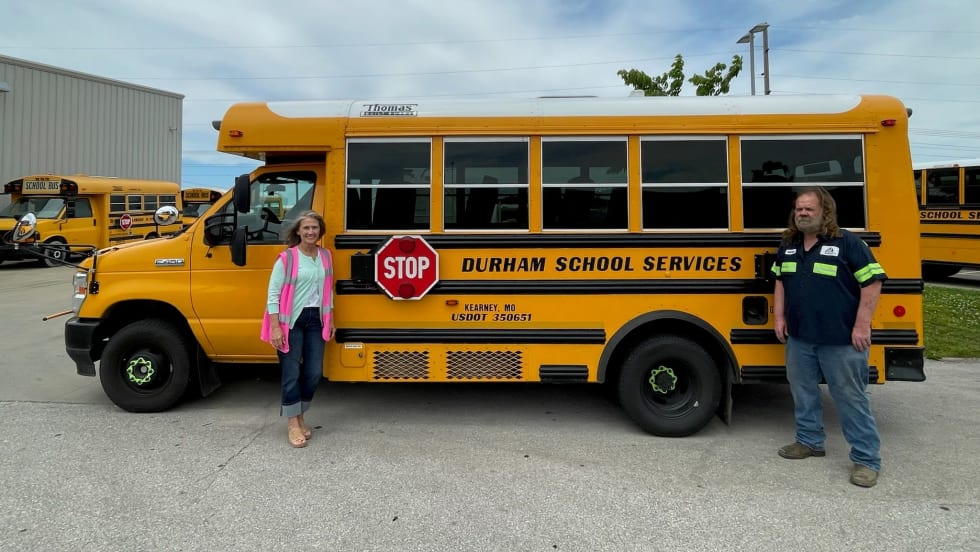
Durham School Services Maintenance Teams Earn Missouri Fleet Excellence Awards
Eight of the contractor’s school bus fleets achieved a distinction few maintenance teams earn during the state’s rigorous annual inspection program.
Read More →
How Incentives, AI, and Energy Markets Are Reshaping School Transportation
Sit down with Joe Annotti of TRC Companies to talk district grant funding, utility challenges, AI, and why school buses are evolving from transportation assets into energy assets.
Read More →
Inside the Contracting Shift: What School Transportation Operators Are Seeing Now
School transportation contractors weigh in on recent trends, costs, driver shortages, and the rise of multimodal student transportation.
Read More →
The No-Idling School Bus AC System
Take a peek at ExoAir Systems’ battery-powered cooling solution designed to run for up to 10 hours without the engine on, reducing fuel use and improving comfort for drivers and students.
Read More →
Geotab on Three Major Trends in School Transportation
School bus fleets are becoming more proactive than ever. From AI driver alerts to vehicle-to-grid opportunities, Geotab outlines the biggest technology trends transforming school bus operations.
Read More →
Gatekeeper Lands Major School Bus Deals as Revenue Surges
The video solutions provider announces contracts with Atlanta Public Schools and other fleet operators as it records quarterly revenue growth and expanding subscription business.
Read More →
Building Leaders Who Last: Creating a Successful Mentorship Program in Student Transportation
Discover five strategies for building an effective mentorship program to strengthen leadership development and support staff retention.
Read More →