




NAPT Gets Rolling in Grand Rapids
Pupil transportation officials waited anxiously outside the Grand Rapids, Mich., police department training facility as its Special Response Team evac...

Pupil transportation officials waited anxiously outside the Grand Rapids, Mich., police department training facility as its Special Response Team evacuated a school bus after a gunshot was fired on board.
The simulated crisis was one of the standout events at the NAPT’s 2007 Conference and Trade Show, held Oct. 28 to Nov. 1.
Lieutenant Dan Savage and his fellow officers approached this bus hijacking and hostage rescue using techniques that they employ in real emergency response incidents.
The officers approached from the rear of the bus (“You want to catch the suspect off guard,” Savage said). Once inside, they ordered the passengers to put their heads down and place their hands on their seats while they obtained the suspect. After the suspect was restrained, the officers ordered the passengers to place their hands on their heads, and they were evacuated one-by-one.
Savage explained that in real hostage situations, it is critical to gain control of the vehicle and make certain that everyone remains calm; this decreases the chance of human injury and facilitates efficient evacuation. Moreover, following an evacuation, the vehicle, as well as the passengers, would be searched to ensure that all involved were in no further immediate danger.
However, Savage also said that in a real hostage situation, this type of rescue and evacuation would be a last resort. He and his officers would attempt to negotiate with the suspect and de-escalate the situation from outside the school bus (or any vehicle) first, before entering and restraining him or her.
Preparing for emergencies
The simulated event wasn’t the only crisis-centered program on the agenda at NAPT. A former school bus driver and law enforcement officer shared expertise from both sides regarding emergency preparedness and crisis management at school districts.
Steve Harris, who now runs the Department of Homeland Security office at the University of Georgia and manages emergency preparedness for the institution, recommended that schools nourish a rapport with local police and first responders. They can do so by inviting firefighters and law enforcement officers to bus meetings and asking them to look at new bus models so they are familiar with the vehicles in case of an emergency.
Harris also explained that school districts, particularly transportation departments, should be continuously fine-tuning and practicing their emergency plans through tabletop drills and full-scale, live simulations in which resources are deployed. He also expressed that live drills should be as “real” as possible, not only for the accuracy of the school’s emergency planning, but to prepare students.
“We want to shelter kids and not expose them to too much, but we need to find a balance so they know enough to be prepared,” Harris said. Whatever form a school district’s emergency planning takes, “make sure you implement it and retrain your drivers,” Harris said. “Make sure that lessons learned are not lessons lost.”
Wide variety of workshops
Other workshops at NAPT took on an array of topics, from student discipline to special-needs transportation to managing e-mail.
In a seminar titled “Student Discipline: Avoiding Legal Detours,” Peggy Burns of Education Compliance Group Inc. covered district legal policies that have an impact on the day-to-day work of being a bus driver. Among these are the hands-off policies some districts maintain for faculty and staff, discrimination, instances of so-called false arrest, the implications of failure to train district employees and the 10-day rule. At each mention of these topics, nods and hums of recognition filled the room.
“We’re not in this for the discipline,” Burns said. “That’s the thing we don’t want to do.”
However, bus drivers will inevitably face difficulties with their passengers, and Burns outlined some policies and practices that transportation departments should have in place.
“We continue to be unsure of our authority to take disciplining action with all students — special or regular ed.,” she said. To clear up any confusion and avoid legal trouble, Burns recommended that employees learn a pre-discipline process, which would include setting rules and expectations with students and reiterating them often. Drivers should then learn to manage the behavior requiring discipline in order to maintain safety onboard the bus. Next, drivers should employ strategies to change behavior.
“I’m steering away from the term ‘discipline,’ which is punitive,” Burns explained. “You’re trying to change behavior. Discipline ought to be a strategy. Your policy ought to set forth a range of options for dealing with behavior.”
Lastly, Burns emphasized that school districts must notify parents of incidents on the bus as soon as possible after they occur to engender trust. After all, she pointed out, “happy parents don’t sue — mistrustful parents do.”
Watch for warning signs
Janice Cochran, safety trainer at Thompson School District in Loveland, Colo., discussed teen suicide prevention in her seminar. Because school bus drivers sometimes have close relationships with students, they are in a position of being able to recognize warning signs and take steps to reduce the risk of suicide.
Suicide among adolescents and young adults has increased 300 percent in the last 30 years and is the No. 3 cause of death for ages 15 to 24, Cochran said. She pointed out behaviors and activities that are red flag warnings for suicide in this age group as well as steps adults can take to help students in this situation.
In a dramatic illustration of Cochran’s topic, an NAPT attendee who came to the session explained that she saw a young man in an apparent suicide attempt standing on the railing of the bridge behind the convention center during the conference. She said that she spoke to the young man to find out what he was doing, and she called 911 when he said he wanted to kill himself.
“Suicide is a more prevalent problem with teenagers, and anything we can do to reduce incidence is a really positive thing we can do for our kids,” Cochran said.
Meeting special needs
Pete Meslin, transportation director for Newport-Mesa Unified School District in Newport Beach, Calif., encouraged transportation departments to build a strong relationship with the special-education department, as both departments provide related services and can share in the benefits of such a partnership.
At his district, the departments have integrated their computer systems to share data, share some costs for personnel key to both departments and hold joint in-service sessions. Meslin invites behavior specialists and zone coordinators from the special-education department to speak to his transportation staff. “Now your drivers are part of the educational team,” he explained.
Most importantly, Meslin makes sure that transportation staff sits in on every IEP meeting to ensure that as much information as possible is shared between departments in order to best serve students.
In a presentation titled “To Transport or Not,” Jean Zimmerman discussed the possibilities available to transportation employees when faced with the dilemma of a special-needs student whose equipment does not meet the department’s standards for use on a school bus.
Zimmerman posed this question to the seminar’s attendees: If a student’s wheelchair has broken wheel locks, lacks a positioning belt, has flat tires, has a non-standard sling seat or back, or is a sports or other type of non-transit wheelchair, can something be done to avoid denying the student transportation to school?
“Maybe there will be cases where we can still get these kids to school,” Zimmerman said. “This is their education. We can’t just say we’re not going to take them.”
Zimmerman presented anecdotes with photos of wheelchairs that she and wheelchair builders modified in order to transport students safely, despite variation in equipment.
She also emphasized that transportation departments need a back-up system in case a wheelchair breaks down, with loaner equipment and a budget for repairs. “Sometimes it takes up to six months to get a wheelchair fixed, and that’s way too long to leave a kid at home,” Zimmerman said.
Managing e-mail
For some, maintaining an organized e-mail account can seem like a daunting task. In a session titled “Tame the E-mail Beast,” Randall Dean, the self-proclaimed “Totally Obsessed Time-Management/PDA/E-mail Guy” and founder of Randall Dean Consulting & Training LLC, discussed 10 strategies on how to manage e-mail.
Creating multiple e-mail accounts (one for personal, one for business and one for Internet/e-commerce mail) to focus on relevant messages while at the office, immediately tackling tasks that can be accomplished in three minutes or less and working on the most pressing assignments first were among Dean’s tips. He also suggested resisting the temptation to constantly check for incoming messages.
“Thirty percent of professionals check their e-mails 20 or more times per day,” Dean said. “This can distract you from completing major projects. Instead, try to check your e-mail four to five times a day — this way you’ll balance productivity with responsiveness.”
Trade show highlights
There were many innovative products on display during the NAPT Trade Show, one of which was IC Corporation’s redesigned FE Forward Advantage school bus. The designers removed the bus’ “doghouse” (the engine cover that extends into the landing platform at the top of the stairs), enabling passengers to enter and exit the vehicle more easily.
Other features include a perpendicular stairwell, enhanced seal and heat protection, enhanced routing for fuel checks, a quick-release charge air cooler and a removable access panel in the landing area. These features are aimed at improving conditions for passengers, drivers and maintenance workers.
The FE Forward Advantage will go into production in July.
In a year that saw renewed debate over seat belts on school buses, belt-equipped bus seats were high-profile offerings at the trade show.
SafeGuard displayed its new FlexSeat, a standard 39-inch school bus seat that has three lap-shoulder belts installed in it, enabling accommodation of up to three students to avoid capacity loss.
During a demonstration, company officials explained how the seat can be used. When two large children are in the seat, the two outer lap-shoulder belts latch into a sliding dual buckle that is positioned in the seat’s center (the third buckle stows in the seat cushion). When three smaller children are in the seat, the dual buckle shifts to secure the lap-shoulder belts of two children; the additional buckle is pulled up from the recess in the seat cushion to be used by the third child.
M2K also displayed a new school bus seat with three-point belts. The seat, which is the same size as a conventional school bus seat, can accommodate three smaller grade school passengers or two larger high school passengers.
The seat and restraints fulfill all current and anticipated NHTSA and FMVSS requirements. Optional configurations include a new ballistic nylon fabric, which is tear-resistant and stain-proof.
Also at the trade show, SMI held an “Appreciation Hour” reception to celebrate the retirement of Buck Pearce at his last NAPT conference. Refreshments were served as attendees stopped by the booth to visit the well-known industry figure.
A considerable town
In the exhibit hall next to the trade show, local law enforcement officers and Michigan Association for Pupil Transportation (MAPT) members showed kindergartners “Safety Town.” The model town, complete with miniature storefronts, houses, a gas station and a life-size school bus, was the setting for safety training exercises. A police officer led children down the street, pointing out dangerous neighborhoods and teaching the kids how to say “no” to strangers.
Next, an MAPT representative demonstrated safe crossing procedures at the school bus, teaching children about the danger zone and explaining that they must make eye contact with the bus driver and wait for her signal before crossing. Buster the robotic school bus was also on hand to talk to kids about school bus safety.
Safety Town events are held nationwide by schools that partner with their local law enforcement agencies. Carol Miller, transportation supervisor for Eaton Rapids (Mich.) Public Schools helped organize the event during the NAPT conference.
The 2008 NAPT Conference and Trade Show will be held Oct. 26-30 in Myrtle Beach, S.C.
More Management
13 Industry Leaders Describe School Transportation in One Word
What word best describes the school bus industry today? We posed that question to over a dozen manufacturers, resulting in a revealing mix of perspectives on the challenges and opportunities ahead.
Read More →
Tyler Technologies Adds New AI, Transactions Leadership Roles
Two company executives are promoted to newly created C-suite positions to accelerate the company's long-term growth in both artificial intelligence and payments.
Read More →
Pro-Vision Acquires Convoy Technologies
The deal aims to broaden customer relationships and adds specialized vehicle video capabilities for commercial fleets.
Read More →


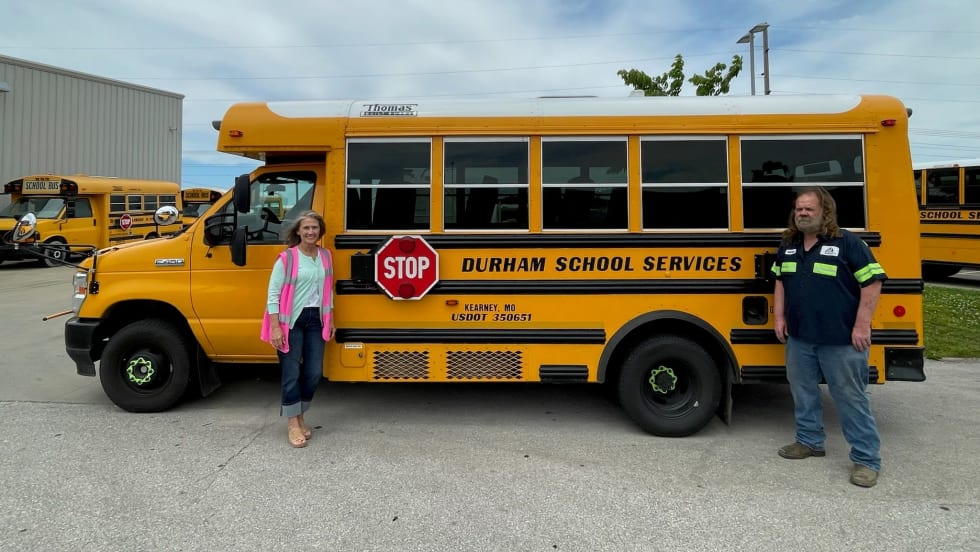
Durham School Services Maintenance Teams Earn Missouri Fleet Excellence Awards
Eight of the contractor’s school bus fleets achieved a distinction few maintenance teams earn during the state’s rigorous annual inspection program.
Read More →
How Incentives, AI, and Energy Markets Are Reshaping School Transportation
Sit down with Joe Annotti of TRC Companies to talk district grant funding, utility challenges, AI, and why school buses are evolving from transportation assets into energy assets.
Read More →
Inside the Contracting Shift: What School Transportation Operators Are Seeing Now
School transportation contractors weigh in on recent trends, costs, driver shortages, and the rise of multimodal student transportation.
Read More →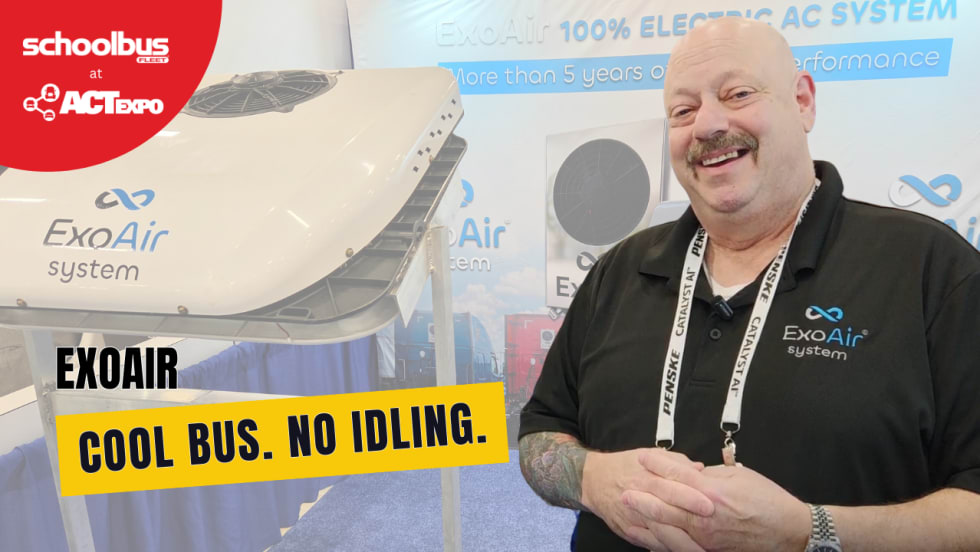
The No-Idling School Bus AC System
Take a peek at ExoAir Systems’ battery-powered cooling solution designed to run for up to 10 hours without the engine on, reducing fuel use and improving comfort for drivers and students.
Read More →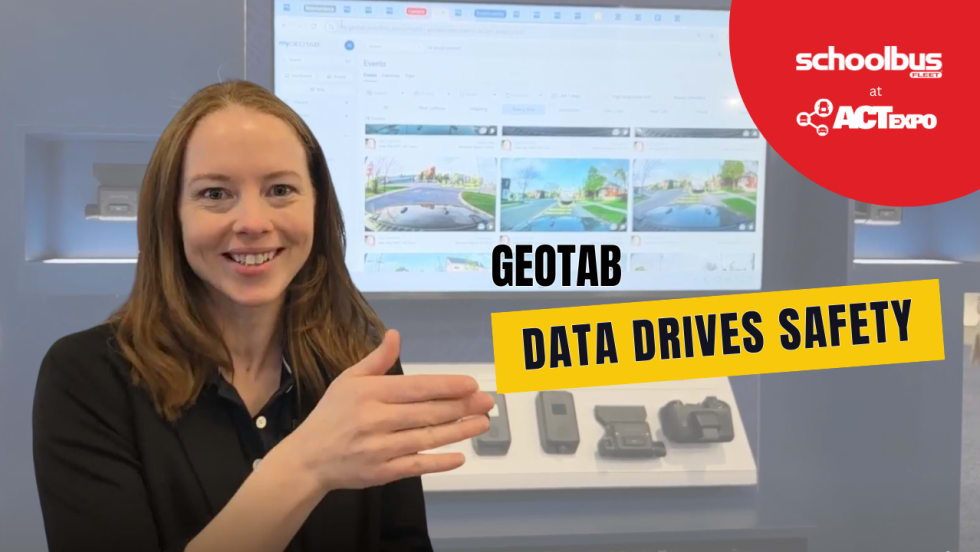
Geotab on Three Major Trends in School Transportation
School bus fleets are becoming more proactive than ever. From AI driver alerts to vehicle-to-grid opportunities, Geotab outlines the biggest technology trends transforming school bus operations.
Read More →
Gatekeeper Lands Major School Bus Deals as Revenue Surges
The video solutions provider announces contracts with Atlanta Public Schools and other fleet operators as it records quarterly revenue growth and expanding subscription business.
Read More →
Building Leaders Who Last: Creating a Successful Mentorship Program in Student Transportation
Discover five strategies for building an effective mentorship program to strengthen leadership development and support staff retention.
Read More →