



Routing Software the Key to Efficiency, Lowered Costs
Computers are no strangers to the classroom, and as technology has progressed and improved accordingly with society’s needs, many of these Pentium-pow...

Computers are no strangers to the classroom, and as technology has progressed and improved accordingly with society’s needs, many of these Pentium-powered machines have found their way into the realms of school bus transportation as well.
Since the advent of bus routing software, paper maps have increasingly been pushed to a new locale: the recycle bin. From small districts, which may bus as few as a couple of hundred students, to those whose ridership extends into the thousands, computerized routing has brought a huge sigh of relief to transportation departments.
“It’s the way of the future,” says Bonnie Smeltzer, training supervisor for the Orange (Calif.) Unified School District. “It simplifies things. All your data is in one place, and any department connected through the system can go in and find out what they need to find out.”
Time, money well saved
With school buses transporting what many consider the most precious of cargo, knowing where a child is supposed to be is important, but the responsibility of maintaining such information for so many students is a daunting task. The numerous pins, strings, markers and maps can lead to a tangled web of frustration, particularly during the summer months when most transportation departments rework their bus routes for the coming school year.
“You were essentially reinventing the wheel every August,” says Richard Hansen, transportation director at Crystal Lake (Ill.) School District.
By enabling data to be input daily throughout the current school year, bus routing software eases the summer stress. Also, with route information now readily available through a few mouse clicks, the usual flood of parent phone calls are handled with greater efficiency.
“Getting that information out to the consumer, to the parents, even to the kids, is really becoming an important element,” says Rick Bacchus, president of Trapeze Software Group, whose school transportation division is based in Cleveland. “Interactive voice and text-to-speech type technologies defer a lot of the calls so departments can spend more time dealing with the parents who really need the hand-holding.”
Many systems can leave automated voice messages for callers informing them of route changes and district news, such as snow days, leaving transportation personnel to deal with more serious inquiries or conduct other duties. “School districts have all commented on not getting [calls] every day about just general, typical things,” adds Bacchus.
At Matteson (Ill.) School District 162, for example, the assistant superintendent usually found himself at the mercy of the chiming phone during those busy rerouting months.
“I would have people here just to answer phones, and our assistant superintendent would be involved,” says Debbie Szczecina, transportation director. “Now that we have the software, he’s been able to go back and do his job, and we’ve been able to use our time better.”
Freeing up employees from their telephone perches has been a benefit for districts, saving not only time, but money, in that staff is put back to doing their “real” jobs, a crucial element now that budget cuts have become the norm.
Preparing for the future
But bus routing software programs do much more than track buses and students in a computerized mapping system. Boundary planning and “what if” scenarios are a couple of highly touted features.
For example, redistricting is now a common practice, particularly due to new housing developments sprouting up faster than districts can keep up with. As transportation departments know, many calls to their offices are in fact from realtors asking what schools new students will be attending and whether they will be eligible for transportation services.
“I had six different walkout scenarios I needed to do,” says Sandy Setlich, transportation supervisor for the Wickliffe (Ohio) City School District. By using its routing program and consulting with its software company, Setlich says she “saved eight full days of salary.” Much of that would have been spent manually drafting boundary shifts, some of which may never have been implemented.
Although routing software can’t predict the future, the implication of certain events, like population booms, can be analyzed, providing districts with multiple scenarios.
“If I’m in a district that is shrinking considerably or explosively growing, then all year I’m thinking about building schools, about population shifts, about feeder paths into schools,” says Terri Fallon, marketing director for VersaTrans Solutions Inc. of Latham, N.Y. “Districts need to especially keep their fingers on the pulse of where the feeder paths are going from the different schools.”
The benefit of these options provides some much needed flexibility to the department, adds Matteson’s Szczecina. “I can get a phone call at 6:30 in the morning telling me there’s a water main break,” she says, “and prior to the school buses starting their route at 7:30, I can have alternative route sheets printed and faxed to the bus companies.”
Going off the map
Still, bus routing software has more advantages than its name implies; creating and maintaining routing information is only one aspect of a program. Everything from maintenance records to student attendance can be tracked. Of course, using the software in this manner requires administration, transportation and other departments to be connected.
“It used to be as simple as taking kids to and from school,” says Mike Darling, director of the Internet division for Missoula, Mont.-based Education Logistics Inc. (Edulog). “Now transportation directors and departments are dealing with everybody — teachers, principals, school boards, superintendents, etc.”
According to Darling, technology has created a paradigm shift within society, increasing the expectations of transportation departments from a growing group of onlookers.
“The expectations being placed on transportation departments has really changed; it has drastically gone up,” Darling says. “Parents, for example, expect to be able to get information about student transportation immediately.”
This being an on-demand world, such information is now available at one’s fingertips. Yet with this accessibility comes the issue of security. Although most software programs have certain safety standards, which usually involve usernames, identification numbers, passwords or codes, the amount of information released is still strictly tied to each district’s comfort level. Even mailed information falls under the same security scrutiny.
“Normally, we would literally mail routing news to every citizen in the city,” says Setlich. “Now, only parents whose children are eligible to ride the bus receive those mailings, which is great because the privacy issue is covered too.”
Because there is no consensus as to what level of security districts are comfortable with or even what program options they find necessary, bus routing software does not come in a one-size-fits-all package.
Choose wisely
Programs are created in general terms and carry generic forms, but users can customize routing packages according to their individual specifications.
“New Jersey, for example, changes its state reports every year,” says Trapeze’s Bacchus. “Therefore, the software is an open system where user-definable instructions can be done either by the software companies or the districts themselves.”
Because of the ease of data manipulation, recognizing a department’s needs is of utmost importance before the “shopping around” process begins.
As attractive as the benefits of being computerized are, depending on size, districts will find the role of routing software shifts from community to community. In larger districts, fleet management and optimization are necessities, whereas data management takes on a bigger role in smaller districts.
“In very small districts, it may be less about bus routing and more about managing and distributing information,” says Darling. “Even if they only have six buses, they still have a community that expects information to be provided, and provided quickly.”
Fallon of VersaTrans suggests understanding feature sets and their differences, and to also think down the road as to how operations may be running. “Don’t just think of how you’re running today, but how you’d like to run your department five years from now,” she says.
Ask for company references, preferably of school districts the same size and with the same needs as your own. Districts with limited resources are not going to be capable of achieving the potential of their more affluent counterparts. The state of a department’s computer equipment and software compatibility is another important consideration.
“Be sure your own equipment is set up for what the requirement will be for the implementation of the routing software,” says Smeltzer of Orange Unified School District. “Also, a lot of newer programs are Internet-based, so be sure your department’s technology is ready for that.”
Finally, as with any major purchase, the final cost is always a relative factor.
“At first, yes, it’s a big check that you write, and it is labor intensive because you have to input all your little pieces of individual data, but you must be committed [to the project],” says Crystal Lake’s Hansen. “Do not buy the software and hardware, load your information, walk away and then get annoyed if six months later it doesn’t do what you need it to do. After all, the computer only does what you tell it.”
More Management
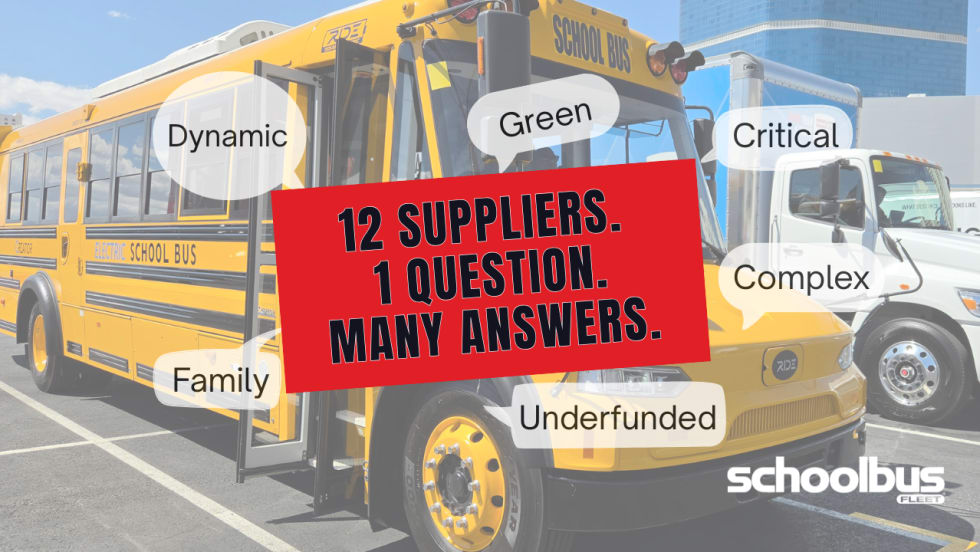
13 Industry Leaders Describe School Transportation in One Word
What word best describes the school bus industry today? We posed that question to over a dozen manufacturers, resulting in a revealing mix of perspectives on the challenges and opportunities ahead.
Read More →
Tyler Technologies Adds New AI, Transactions Leadership Roles
Two company executives are promoted to newly created C-suite positions to accelerate the company's long-term growth in both artificial intelligence and payments.
Read More →
Pro-Vision Acquires Convoy Technologies
The deal aims to broaden customer relationships and adds specialized vehicle video capabilities for commercial fleets.
Read More →


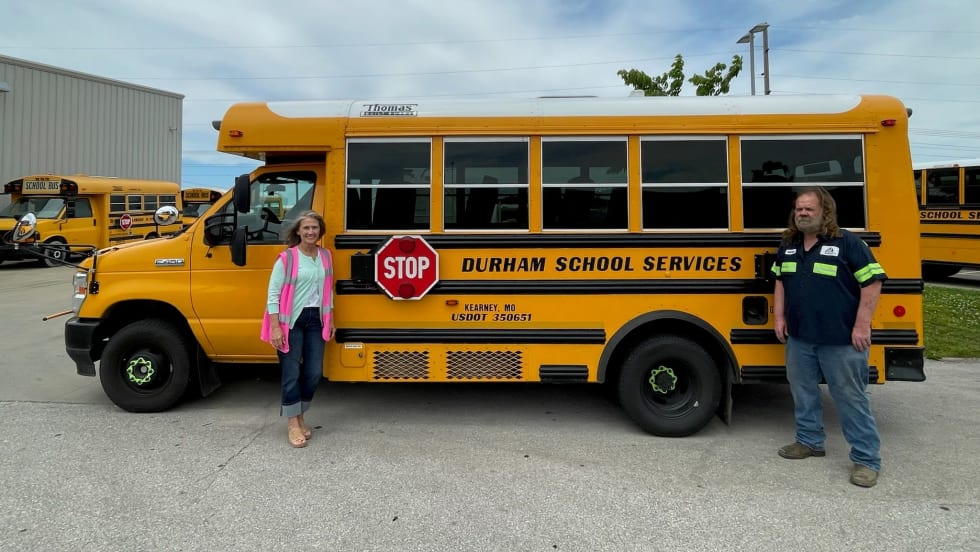
Durham School Services Maintenance Teams Earn Missouri Fleet Excellence Awards
Eight of the contractor’s school bus fleets achieved a distinction few maintenance teams earn during the state’s rigorous annual inspection program.
Read More →
How Incentives, AI, and Energy Markets Are Reshaping School Transportation
Sit down with Joe Annotti of TRC Companies to talk district grant funding, utility challenges, AI, and why school buses are evolving from transportation assets into energy assets.
Read More →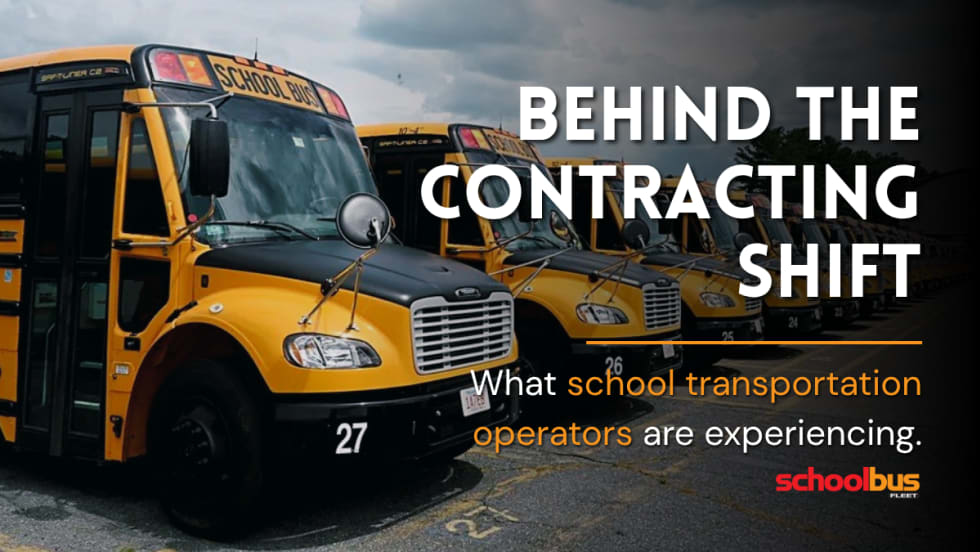
Inside the Contracting Shift: What School Transportation Operators Are Seeing Now
School transportation contractors weigh in on recent trends, costs, driver shortages, and the rise of multimodal student transportation.
Read More →
The No-Idling School Bus AC System
Take a peek at ExoAir Systems’ battery-powered cooling solution designed to run for up to 10 hours without the engine on, reducing fuel use and improving comfort for drivers and students.
Read More →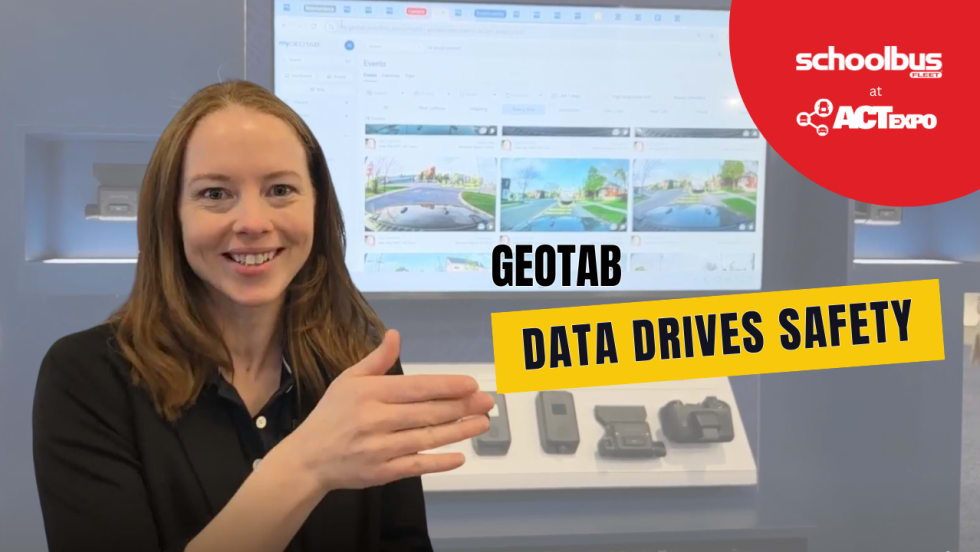
Geotab on Three Major Trends in School Transportation
School bus fleets are becoming more proactive than ever. From AI driver alerts to vehicle-to-grid opportunities, Geotab outlines the biggest technology trends transforming school bus operations.
Read More →
Gatekeeper Lands Major School Bus Deals as Revenue Surges
The video solutions provider announces contracts with Atlanta Public Schools and other fleet operators as it records quarterly revenue growth and expanding subscription business.
Read More →
Building Leaders Who Last: Creating a Successful Mentorship Program in Student Transportation
Discover five strategies for building an effective mentorship program to strengthen leadership development and support staff retention.
Read More →