




Putting Software to Work in the Bus Garage
By some accounts, Royce Gillespie, transportation supervisor at Kane County School District in Kanab, Utah, is a rare manager among his peers. Oversee...
By some accounts, Royce Gillespie, transportation supervisor at Kane County School District in Kanab, Utah, is a rare manager among his peers. Overseeing a fleet of just 16 buses, he recently purchased maintenance software to help organize his operation.
"We wanted to track costs and service schedules a little better," he says, "actually much better." To do this, Gillespie chose a package from Phoenix-based Ron Turley Associates.
Maintenance-specific software has long been common among the nation's bigger fleets, but its promise of greater efficiency and productivity has failed to attract many small operations. One study, conducted by Arsenault & Associates, a software provider in Atco, N.J., estimates that less than 25 percent of these fleets use such products.
Several factors contribute to this resistance. Chief among them is a lack of money, staffing and time. "A lot of these guys are always busy [responding to emergencies]," says Charles Arsenault, founder and CEO of Arsenault & Associates. "Maintenance software requires a shop to stop, collect and organize its data, then restart. That's pretty tough to do when you're already running at a full gallop every day."
Jumping the gun
Arsenault has been in the maintenance software business for 23 years, dating back to the early days of Microsoft's disk operating system, also known as DOS. At first, he says, the concept of computerized record-keeping seemed a little too advanced — or technically cumbersome — for most prospective buyers. "We were out there on the 'bleeding edge,'" he says, "so far out, in fact, that we nearly starved to death."
Fortunately for Arsenault, he believed in his product and continued to tout its potential. The market eventually started listening, motivated by Microsoft's introduction of its Windows operating system in 1985 and, shortly thereafter, the growing popularity of personal computers. Today, most fleets with more than 100 vehicles use some type of software, either dedicated or adapted, to log maintenance procedures and expenses.
"We haven't made a cold call since 1987," Arsenault says. "Most of our sales are done in response to inquiries."
One of those inquiries came from Neal Abramson, director of transportation at the Santa Monica-Malibu Unified School District in Santa Monica, Calif. About five years ago, Abramson started looking for software that could help him track parts and supplies. "Our inventory was out of control," he says. "Everything was organized well enough, but we simply didn't know what we had." After reviewing products from six software companies, Abramson chose Arsenault's Dossier32, partly "because it seemed the least difficult to operate at the time."
Painful setup process
Abramson says the product has lived up to his expectations: The level and flow of inventory are now accurately monitored, the operational cost of each vehicle is readily available and an assortment of internal and regulatory reports can be generated with just a few keystrokes. Reaching this computerized nirvana, however, hasn't been without challenges, the largest being the system's initial setup.
"That took some time," says Abramson, who oversees the maintenance of roughly 100 vehicles, 25 of them school buses. "Luckily, we had an extra person in the office back then, so I was able to stay focused on the project. I don't have any spare people now. If I were installing the software today, I'd probably need to come in during the weekends."
Not every fleet manager is willing to make that sacrifice. Chuck Manning, CEO of Albany, N.Y.-based VersaTrans Solutions, says that despite the growing acceptance of maintenance software, many sales are still lost because people consider the setup process too troublesome. "That's unfortunate," says Manning, "because those are probably the districts that, if their administrative capacity is already so overburdened, they're probably missing a lot of opportunities to improve fleet maintenance practices."
Manning says other emerging technologies could further streamline and enhance shop operations, far offsetting any setup hassles. These include bar code scanning, infrared data transfer (between vehicles and fuel pumps or shop receivers) and voice recognition — all designed to drastically cut the time spent massaging a computer keyboard.
Eliminating keystrokes
"Voice recognition is very interesting in this market," Manning says. "Frankly, most of the people entering data on a shop floor do so with just two fingers. Anything that will speed and simplify that input is worth working on."
Tom Mullins, president of FMS Group in Missoula, Mont., agrees that automated data gathering is the next big thing. A division of Edulog, his company has developed a system that enables bus drivers to "electronically write up" repair requests with a telephone call. But soon, he says, even that will be unnecessary: "I think we'll see 'smart buses' in the near future. Using the onboard computer or electronic control module (ECM), they'll be able to diagnose problems and transmit a report to their maintenance center. We're already doing this with our facilities management software for large freezers and HVAC systems."
Mullins is enthusiastic about these looming conveniences, but he has no illusions that everyone will want or need them. "Smaller operators might still feel that they can get along without any software and computers," he says. "And, indeed, they might. It really depends on their operations and procedures. A good paper system might be enough for some people. The disadvantage of paper is that information isn't easily accessible. It's tough to quickly calculate the per-mile cost of each bus. On the other hand, if you have only 10 buses, you probably already know which are costing too much. The trick is to identify those early and get rid of them."
Home-grown solutions
Some fleet managers, believing they need more than just paper files but less than purely maintenance software, take a middle approach, using popular spreadsheet programs to track their vehicle expenses. This method will work for some, but it also has drawbacks, says Deedee Gatz, vice president of product management at DP Solutions in Greensboro, N.C.
"Even if you're not a skilled programmer, you can probably set up a system in Microsoft Excel to track one type of item," she says. "But a maintenance application provides the links to all the other data that come into play in an operation. If you're going to overhaul an engine, for example, a well-designed maintenance program would be able to determine what parts were needed for the job, then search your inventory to make sure those parts were immediately available. Knowing this ahead of time would be helpful for scheduling the repair."
Not all homemade programs are one-trick ponies, however. Kristi Allen, transportation supervisor at the Wasatch County School District in Heber City, Utah, developed her own maintenance system with two Microsoft products, Access and Excel. She's been using it for about seven years and says it's sufficient for her current needs.
"I put my information into an Access database and use Excel when I want to run totals," Allen says. "The data transfer is easy, with about four mouse clicks. It will also produce all of my state reports."
Access can be a daunting program for someone unfamiliar with it. Describing herself as "tech-tarded," Allen says she had one advantage going into her project: "I formerly worked at a CPA firm that used Access for almost everything. This was back when it was DOS-based."
Despite her programming success, Allen says she'll probably buy a maintenance-specific package someday, "if we grow or software prices come down or someone gives me some money." Until then, she'll just keep sampling vendors' demo software and admiring their sleek, graphics-rich user interface.
"I already have enough data," she says. "More wouldn't necessarily be helpful. At some point, you can have too much information, and then you're just wasting time entering it into a computer."
Paul Hartley is a freelance writer in Northfield, Minn., and frequent contributor to SBF.
More Management
13 Industry Leaders Describe School Transportation in One Word
What word best describes the school bus industry today? We posed that question to over a dozen manufacturers, resulting in a revealing mix of perspectives on the challenges and opportunities ahead.
Read More →
Tyler Technologies Adds New AI, Transactions Leadership Roles
Two company executives are promoted to newly created C-suite positions to accelerate the company's long-term growth in both artificial intelligence and payments.
Read More →
Pro-Vision Acquires Convoy Technologies
The deal aims to broaden customer relationships and adds specialized vehicle video capabilities for commercial fleets.
Read More →


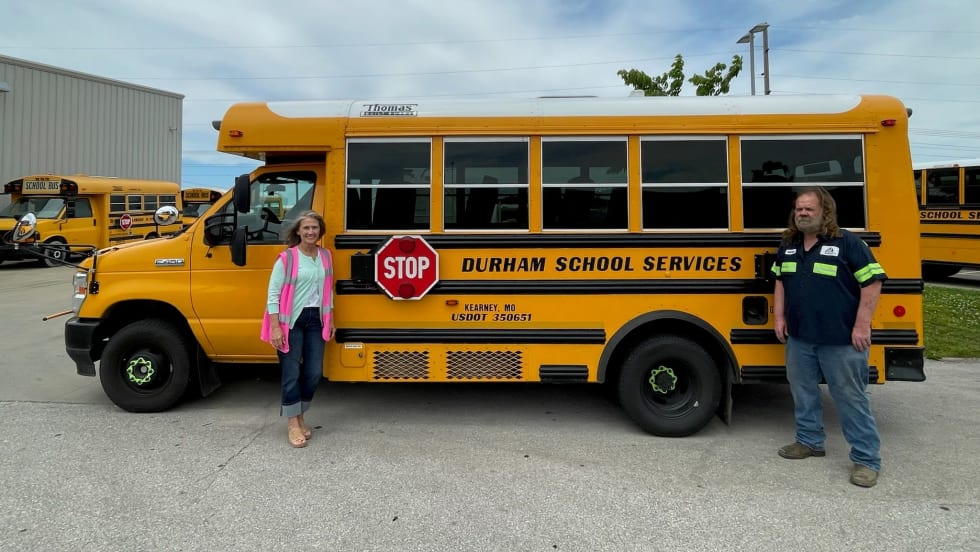
Durham School Services Maintenance Teams Earn Missouri Fleet Excellence Awards
Eight of the contractor’s school bus fleets achieved a distinction few maintenance teams earn during the state’s rigorous annual inspection program.
Read More →
How Incentives, AI, and Energy Markets Are Reshaping School Transportation
Sit down with Joe Annotti of TRC Companies to talk district grant funding, utility challenges, AI, and why school buses are evolving from transportation assets into energy assets.
Read More →
Inside the Contracting Shift: What School Transportation Operators Are Seeing Now
School transportation contractors weigh in on recent trends, costs, driver shortages, and the rise of multimodal student transportation.
Read More →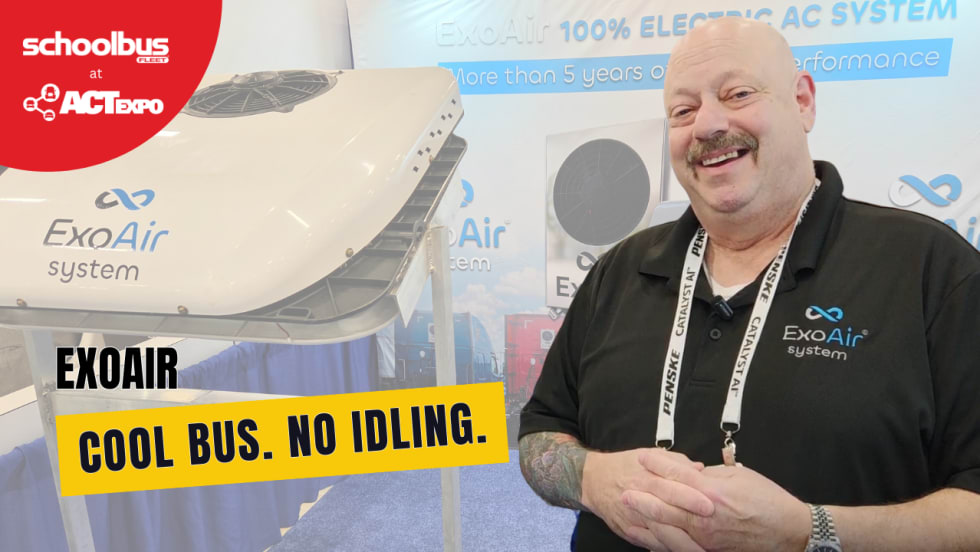
The No-Idling School Bus AC System
Take a peek at ExoAir Systems’ battery-powered cooling solution designed to run for up to 10 hours without the engine on, reducing fuel use and improving comfort for drivers and students.
Read More →
Geotab on Three Major Trends in School Transportation
School bus fleets are becoming more proactive than ever. From AI driver alerts to vehicle-to-grid opportunities, Geotab outlines the biggest technology trends transforming school bus operations.
Read More →
Gatekeeper Lands Major School Bus Deals as Revenue Surges
The video solutions provider announces contracts with Atlanta Public Schools and other fleet operators as it records quarterly revenue growth and expanding subscription business.
Read More →
Building Leaders Who Last: Creating a Successful Mentorship Program in Student Transportation
Discover five strategies for building an effective mentorship program to strengthen leadership development and support staff retention.
Read More →