




Lawsuits Lurk in the Back of the Bus
Teasing, name-calling and playful touching are everyday occurrences on school buses. While most of this may be harmless fun, some of it could be sexua...
Teasing, name-calling and playful touching are everyday occurrences on school buses. While most of this may be harmless fun, some of it could be sexual harassment. Transportation personnel must know how to differentiate the two and how to handle complaints alleging sexual harassment. In guidelines published in the Federal Register in March, the U.S. Department of Education's Office of Civil Rights (OCR) urges school officials to use "judgment and common sense" in determining what is sexual harassment. Certainly, 6-year-old Johnathan Prevette's headline-grabbing kiss of a classmate wouldn't qualify as sexual harassment, but a 14-year-old boy's crude jokes about a female classmate could be. On the school bus, sexual harassment can be especially damaging because the victim cannot easily escape his or her harasser. That's why it's important that drivers be taught how to identify the behavior and to understand the possible effect of the harassment on the victims. According to the OCR, sexual harassment can involve the following:
Sexual advances
Touching of a sexual nature
Graffiti of a sexual nature
Displaying sexually explicit drawings
Sexual gestures
Pressure for sexual favors
Touching oneself sexually or talking about one's sexual activity
Spreading rumors about or rating other students as to sexual activity or performance (It should be noted that only unwelcome conduct can be classified as sexual harassment.)
The transportation staff needs to be made aware that sexual harassment can have a devastating effect on its victims. Hopelessness, confusion and even suicidal thoughts can result from sexual harassment, especially if the situation is not addressed.
Don't ignore complaints
In dealing with student-to-student sexual harassment, school bus operators should encourage drivers to immediately report any complaints. The worst mistake that a transportation department can make is to ignore a complaint. Most likely, the harassing behavior will only become worse if it's allowed to continue. In addition, the courts have awarded damages to plaintiffs who have proved that school officials failed to act when notified of sexual harassment. "Once we hear about it, we act," says Brian Weisinger, transportation director at Friendswood (Texas) Independent School District. He says his school district has a written policy against sexual harassment, although there haven't been any severe cases in his two years as director. "One of the worst things you can do is hear about it and do nothing," says Ron Evans, transportation supervisor at South Ripley Community Schools in Versailles, Ind. As a former police officer, Evans is especially concerned about possible litigation caused by sexual harassment. "If you got through the court system, you just never know," he says. Patricia Boddy, a training consultant for Boddy Media Group in Des Moines, Iowa, says the transportation manager needs to tell drivers to document the fact that a peer harassment complaint has been lodged. The driver must do whatever his or her district requires and, along with any bus aides, must have a discussion with the transportation manager immediately following the complaint. Then, a thorough and impartial investigation must be conducted. Drivers should provide the identities of possible victims and perpetrators, anyone who may have observed the sexually harassing conduct and everyone mentioned by either the victim or the alleged harasser.Learn to recognize cues
Boddy says there are verbal and non-verbal cues that may indicate a charged situation. "If a student gets on the bus and the bus immediately goes quiet by his or her very presence, then that bus driver might have an indication that something funny is going on," she says. To prevent sexual harassment from becoming an issue on the school bus, there are steps that drivers can take, Boddy says. First and foremost, drivers should take control of their buses at the beginning of the school year. "That means laying out ground rules for how the school bus is going to operate and informing the children of that," Boddy says. "Drivers can also do a lot by learning the students' names. If they know that student's name, that student assumes they have a certain level of accountability."[PAGEBREAK]
Put it in writing
All school districts should have written policies outlining the grievance procedures for sexual harassment. According to the OCR's guidelines, schools are required to adopt and publish grievance procedures providing for prompt resolution of sex discrimination complaints, including those stemming from sexual harassment. This policy is based on Title IX, the 1972 U.S. education code amendment that prohibits schools that receive federal funding from sexual discrimination. Although some recent court cases have supported the OCR's interpretation of Title IX to include sexual harassment, not all federal courts agree. Joe Purcell, a driver for Wake County Public Schools in Raleigh, N.C., says a message was circulated among the drivers stating that sexual harassment will not be tolerated. He says, though, that the drivers haven't had any formal training. And although he says he hasn't observed sexual harassment on his bus, he nevertheless educates his elementary-age riders. "I say, 'You may compliment a girl, but don't force the issue.'"Focus on drivers, too
School bus operators also need to be wary of driver-to-student harassment. Certainly, driver harassment of students occurs, but in many cases, a driver's conduct has been misconstrued. "I believe there is a gray area out there where touchy-feely people get lumped in, and their behavior may or may not be sexual harassment," says James Southern, transportation director at Tacoma (Wash.) School District #10. "Through lack of education, they may not interpret what they're doing as sexual harassment, whether it is or not." Identifying sexual harassment can be difficult because it can be a matter of "his word vs. hers," Southern says. For example, a female student told her parents that a driver touched her inappropriately on the shoulder. The driver was suspended from driving for three months, although an investigation later cleared him, Southern says. To address the issue, Southern's department offers drivers an annual two-hour sexual harassment class. Taught by the district's diversity compliance officer, the class provides an overview of what sexual harassment is and how employees can respond appropriately to it. Although cases in which students harass drivers are less common than the converse, they do occur, and transportation managers need to be ready to respond appropriately. "One of the worst cases I've ever heard about is a kid calling a driver a sexist pig and a lesbian," says Andrew Waite, a driver for Ventura County (Calif.) School District. According to Waite, the driver had been trying to discipline the child. He says offending students are required to fill out a report that is given to their parents. Lamar Atkins, former transportation director and currently the district administrator and director of attendant services for Sumter (S.C.) School District, says the two-district county has seen and tried cases, including a male-to-male harassment incident and an alleged driver-to-student case. "Many families in South Carolina would like to think that something like this doesn't happen in their town, but it does," Atkins says. "There is no Smalltown U.S.A."Courts still uncertain about negligence issue
As most any teenager knows, sexual harassment is prevalent at school and on the school bus. According to a 1993 study by pollster Louis Harris, 81 percent of 1,600 eighth- through eleventh-graders have experienced sexual harassment. Of that figure, more than a quarter experienced such incidents on the school bus. According to the U.S. Department of Education, dozens of school districts are being investigated for student-to-student sexual harassment. In some cases, school districts have been successfully sued for failing to stem peer sexual harassment. A jury in Antioch, Calif., ordered a school district to pay $500,000 to a sixth-grade girl who said she was harassed the entire school year. Last fall, however, the U.S. Supreme Court refused to hear a case brought by Debbie Rowinsky and her two daughters against the Bryan (Texas) Independent School District. Rowinsky says school officials ignored complaints that her daughters were verbally and physically harassed on the school bus during the 1992-93 school year. Rowinsky took the case to the high court after the U.S. Court of Appeals for the 5th Circuit ruled that sexual harassment does not violate Title IX, the federal education amendment that prohibits gender discrimination. "The mere existence of sexual harassment [at school] does not necessarily constitute sexual discrimination," wrote Judge Jerry Smith.
More Management
13 Industry Leaders Describe School Transportation in One Word
What word best describes the school bus industry today? We posed that question to over a dozen manufacturers, resulting in a revealing mix of perspectives on the challenges and opportunities ahead.
Read More →
Tyler Technologies Adds New AI, Transactions Leadership Roles
Two company executives are promoted to newly created C-suite positions to accelerate the company's long-term growth in both artificial intelligence and payments.
Read More →
Pro-Vision Acquires Convoy Technologies
The deal aims to broaden customer relationships and adds specialized vehicle video capabilities for commercial fleets.
Read More →


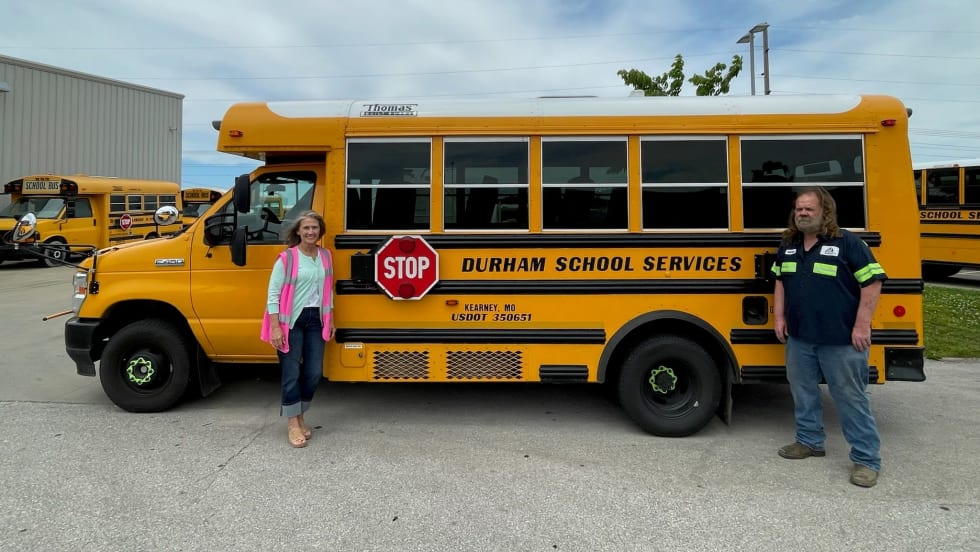
Durham School Services Maintenance Teams Earn Missouri Fleet Excellence Awards
Eight of the contractor’s school bus fleets achieved a distinction few maintenance teams earn during the state’s rigorous annual inspection program.
Read More →
How Incentives, AI, and Energy Markets Are Reshaping School Transportation
Sit down with Joe Annotti of TRC Companies to talk district grant funding, utility challenges, AI, and why school buses are evolving from transportation assets into energy assets.
Read More →
Inside the Contracting Shift: What School Transportation Operators Are Seeing Now
School transportation contractors weigh in on recent trends, costs, driver shortages, and the rise of multimodal student transportation.
Read More →
The No-Idling School Bus AC System
Take a peek at ExoAir Systems’ battery-powered cooling solution designed to run for up to 10 hours without the engine on, reducing fuel use and improving comfort for drivers and students.
Read More →
Geotab on Three Major Trends in School Transportation
School bus fleets are becoming more proactive than ever. From AI driver alerts to vehicle-to-grid opportunities, Geotab outlines the biggest technology trends transforming school bus operations.
Read More →
Gatekeeper Lands Major School Bus Deals as Revenue Surges
The video solutions provider announces contracts with Atlanta Public Schools and other fleet operators as it records quarterly revenue growth and expanding subscription business.
Read More →
Building Leaders Who Last: Creating a Successful Mentorship Program in Student Transportation
Discover five strategies for building an effective mentorship program to strengthen leadership development and support staff retention.
Read More →