




Q&A: Dirk Kempthorne Goes Yellow
The former senator, governor and secretary of the Interior is a high-profile fan of the school bus industry. Here Kempthorne, who will address the NAPT this fall, discusses budgets, energy and politics in an exclusive interview.

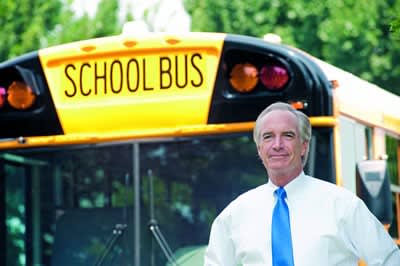
One of the school bus industry’s biggest fans has been in very high places.
Dirk Kempthorne, the former U.S. senator, Idaho governor and secretary of the Interior, uses terms like “great American success story” and “fabric of communities” when describing our nation’s school transportation system.
As he prepared to speak at the National Association for Pupil Transportation (NAPT) Summit — to be held Oct. 31 through Nov. 5 in Louisville, Ky. — Kempthorne shared his insights on such topics as school budgets, alternative fuels and unfunded mandates in an exclusive interview with SBF.
SBF: You’re doing a keynote address at the upcoming NAPT conference. What piqued your interest in doing that?
DIRK KEMPTHORNE: When I received the letter from Mike Martin [NAPT executive director] inviting me to give the keynote address, I was very impressed. Every time I see a school bus, anywhere in the country, my mind and my heart immediately say “precious cargo.” The responsibility that goes with that school bus is enormous because of who the passengers are.
I have such respect for the industry, so to be asked to come and address them, I felt honored. And I really believe that the school bus industry is one of the great American success stories, because through much of their own initiative, they have come to symbolize safety, convenience and reliability.
What do you consider some of the top issues facing the school bus industry?
With this state of the economy, and the fact that states and local communities are all feeling their budgets squeezed tremendously, and that pressure then on the school bus industry, that is something that is going to have to be dealt with. Then when we talk about energy, and we talk about the rising cost of fuel and what that does to continuing to provide the service that has been agreed to, and yet you must continue to meet that standard and those requirements. At the same time, your costs are going up on you.
And budgets are being squeezed. So there’s not the commensurate increase in a budget to cover all those increases. And so how do you adapt so that you are still effective, still providing the highest of standards? Because, again that is our precious cargo. There’s nothing more important than the safe transportation of those children in every community in America. And how do you do that with the paradox of budgets going down and costs going up? Then there are regulations and the impact they have upon the school bus industry.
The EPA’s 2010 standards will bring emissions from new school buses down to near-zero levels but will also substantially increase the price of buses. What are your thoughts on this issue?
Well, I think everyone is in agreement that there needs to be a glide slope on the reduction of emissions. It’s at what rate that glide slope is, what is doable and practical, and how do you do it so that you do not interrupt the main objective, which is the safe, reliable delivery of the children to the school and to their homes.
Also, when we talk about alternative fuels, yes, I think that the country should be looking at alternative fuels — which ones have pragmatic opportunity in the marketplace. But we need to keep in mind that it’s not just the fuel, but, significantly, it is the delivery system, the infrastructure. Because you could find in one region that the energy component works extremely well on that new fleet of buses, but you would have to travel so many miles to a neighboring community to fill up again that it’s impractical. So whether it’s an interstate truck, whether it’s our automobiles, whether it’s the school bus, we need to keep in mind the pragmatism of the delivery of that fuel.
When I was governor, I went to E85 in my vehicle, but you couldn’t find it. So I actually worked with a private vendor, and they were able to put in E85 pumps. But that was in just one downtown location. So for many, it was not practical to drive the distance. You lost any benefit of economy of scale by the distance traveled. There’s a history of innovation by the school bus industry. They really can be some of the laboratories to try new energy-efficient approaches, new technology. I think, for example, that some of the elements that have been incorporated in the past, it just shows that there is that very positive attitude and approach that they’ll still use.
Were there any school bus related issues that you dealt with as governor of Idaho?
One of the things that we endeavored to do was in the rural areas where in the morning, you had the pickup and delivery of the children, and then the buses were idle until the afternoon. What we endeavored to do was to then utilize those buses for the assistance and transportation of senior citizens where you didn’t have a mass transit system in place. You just didn’t have the critical mass so that you had transit buses. Well, here you have school buses. And by doing that, it further develops a constituent core that can be helpful to the school bus operators when it comes time for advocating for their budgets and their well-being. It was just greater utilization, more hours — both for the vehicles and for the drivers.
In the Senate, you wrote and won passage for a bill to end unfunded mandates on state and local governments. Is that an issue you still feel strongly about?
Absolutely. I believe in the Tenth Amendment, which is states’ rights. And there was a huge propensity or habit of the federal government passing laws, passing them on to the state and local governments and business but not paying for it. And so suddenly you had a brand new bill from Washington, D.C., that you had to pay at the state and local level, and it took a big chunk out of their budget. And how do you still meet the other needs that you still have at the state and local level? We were successful. If you contact the Congressional Budget Office, we have stopped unfunded federal mandates by Congress.
The system is very simple and straightforward. Anything that may have an impact of over, as I recall, $50 million, has to be scored by the Congressional Budget Office. And they have to identify whether or not there is an unfunded federal mandate within that legislation. If it is over the threshold, then any member of Congress can simply say, “I place this point of order, there is an unfunded federal mandate, and I call for a vote.” And it’s an up or down vote, so that everybody has to be on record that knowingly they either voted for or against an unfunded federal mandate. And that’s how we shut them down. I think you still are getting unfunded federal mandates from courts.
What do you consider some of your key accomplishments in your political career?
Taking very tough issues and finding a practical solution that involves the greatest number of people, so that they feel they’re a part of it. I mean, that’s a process, but that process is so important. That’s what democracy is about. Whether it was providing for outstanding education for our children in our school systems as a governor or providing for infrastructure for the highways so that they were safe — we had a number of highways that just were not safe, particularly for college students returning to school. And so we made safety a critical issue. Also: paying particular attention to our senior citizens and their needs as they achieve their golden years — to make sure those golden years truly are golden. And when I was governor, we had the single largest military deployment in our state’s history when our entire brigade was deployed to Iraq. To do that professionally, properly, so that the soldiers knew what their mission was, they could remain focused on their mission, we would focus on their family until they were reunited.
Then at the federal level, you mentioned the bill about the unfunded federal mandates. Also, the current safe drinking water law that’s on the books, I was the author of that. Then at the Department of the Interior, I was the architect for the Centennial Challenge for the national parks, for an infusion of new money into our national parks so that we can be ready for the centennial of the National Park System in the year 2016. Also: providing for greater opportunity for energy independence so that we could have both alternative energy but also the traditional fossil fuels developed in the most sensitive and environmentally appropriate fashion. And, Department of the Interior is the only department in the federal government within the continental United States that has schools, and it’s the Indian schools. So we paid great attention to the children in those school settings.
What has been your biggest challenge during your political career?
The biggest challenge is: When you’re hit with tough times, be tough. Be an example of strength. Right after 9/11, of course the entire nation was in mourning, I announced that we would hold a memorial on the steps of the state capitol. And that we would do it on that Friday, and that it would be ecumenical — it would be members of the Christian community, of the Muslim community, of the Jewish community, Catholic and Protestant. And I didn’t know how many people would attend. But we had 17,000 people that showed up. It just shows you that in tough times, people want to come together. So, be the catalyst to bring people together, because then you will solve problems and lead.
Did you ride the school bus at all as a child?
Yes, to the athletic events, whether it was football or tennis — or the different musical events. I will always remember what it felt like to get on a school bus. You’re with all of your buddies, and that driver sets the atmosphere, the rules, and you respect that. And both of my children certainly used school buses when they went to school. And my wife and I now have our first grandson, and within a few years — he’s not yet ready for school — I’m sure he’ll be another great customer of a school bus. It’s something that we’ve had as the fabric of communities for decades, and it will remain there for decades to come.
Bus makes memorable gift
While Dirk Kempthorne (left) was governor of Idaho, Rodney McKnight and Ray Merical of the state Department of Education presented him a wooden model of a school bus from NAPT. At right is Barry McCahill, a former National Highway Traffic Safety Administration official who works with NAPT and is a comrade of Kempthorne’s. The bus, Kempthorne says, was a constant reminder of children. “So much of the role and responsibility of a governor is to do what’s right for children. So I thought that was probably the best reminder of my responsibility, to have that school bus right in my office. There probably ought to be one in every governor’s office.”
More Safety
HopSkipDrive Reports Progress on Safety Advisory Council
More than a year after forming the council, independent safety experts have helped shape new rider-safety features and policy progress, with a new goal to address rider behavior.
Read More →
What the 2026 National School Bus Safety Month Resolution Means for Student Transportation
The bipartisan resolution highlights illegal school bus passing, student safety during loading and unloading, and the need for driver training and public education.
Read More →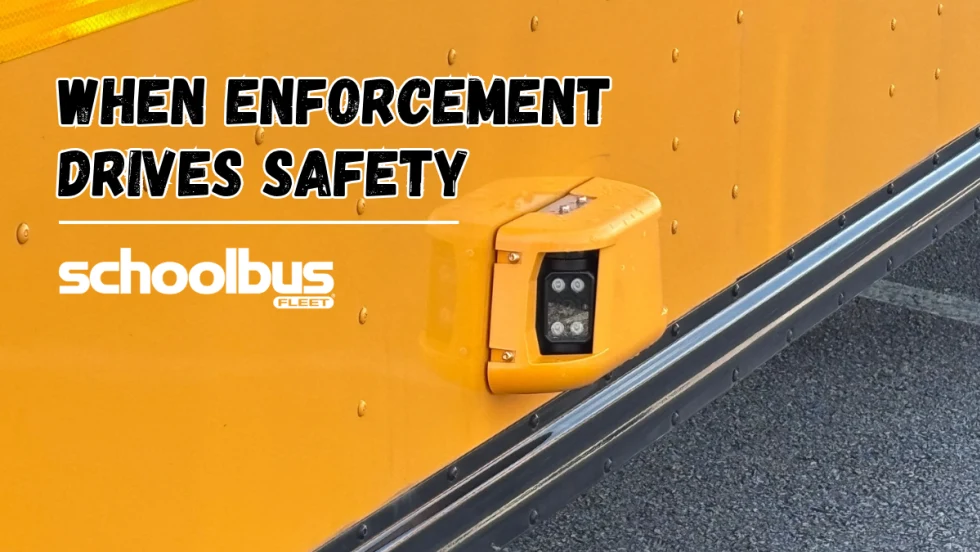
School Bus Stop-Arm Violations Decline 53% Across Verra Mobility Programs
Verra Mobility shares how school bus stop-arm cameras and school zone safety programs are changing driver behavior, reducing violations, and protecting students.
Read More →
Most Bus Crashes Aren’t Your Fault. Here’s How to Prove It.
A guide for what to do in between a school bus crash and a claim: what to preserve, who to notify, and how to keep the facts available when they matter.
Read More →
National School Bus Safety Week 2026: Tips, Toolkits & Resources to Keep Students Safe
School bus safety takes more than awareness. Explore expert tips, enforcement strategies, and free resources to help protect students on every ride.
Read More →
2 Killed, Dozens Injured in Florida School Bus Crash
A multi-vehicle collision caused a Polk County school bus carrying 37 students to overturn on its way to Winter Haven High School.
Read More →
Illegal School Bus Passing Drops 24% in New York Districts
With fewer than 5% of citations involving repeat offenders, Westchester County officials said enforcement, education, and community partnerships are helping change driver behavior.
Read More →
School's Back. Here's What Happened to Traffic, Speeding & Distraction
What happens to traffic when school resumes? New data analysis examines changes in distracted driving, congestion, and speeding around schools.
Read More →
Geotab Expands Fleet Safety Tools With Video Coaching, Risk Insights
New safety and video capabilities aim to help fleet managers assess risk, support drivers, and take targeted action through video coaching, red-light violation detection, and more.
Read More →
How to Build a Better School Bus Driver Training Program
Is it time to strengthen your driver training? Here’s how to pick the right talent and improve recruitment, retention, and safety. This video is brought to you by IC Bus.
Read More →