




Electric bus brings changes
Kings Canyon USD was the first district in the nation to receive an eTrans all-electric school bus from Trans Tech Bus. The district hopes to acquire five more within the next year.
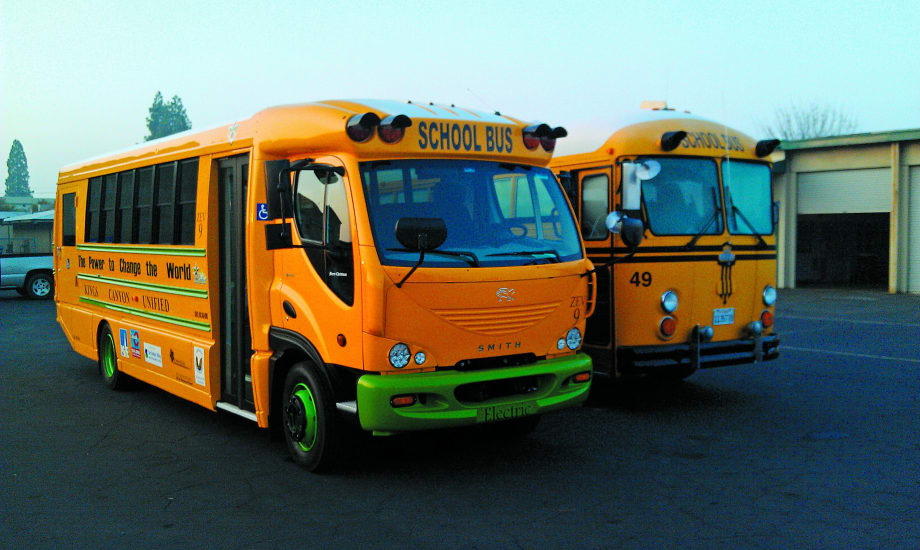
Kings Canyon USD was the first district in the nation to receive an eTrans all-electric school bus (at left) from Trans Tech Bus. The district hopes to acquire five more within the next year.
Kings Canyon Unified School District (USD) in Reedley, Calif., faces the unique challenge of transporting a population of students from the Central Valley floor to the Sierra Nevada Mountains each day — a change in elevation from 230 feet to 6,700 feet.
"A school day in transportation can begin in the mornings with dense fog in the valley and sunshine in the mountains and end with rain and winds in the valley and blizzard and snow conditions in the mountains," says Director of Transportation John Clements, who has been with the district for 37 years in various roles.
The district primarily serves students in rural areas, which makes school transportation even more essential.
"Due to our rural remoteness, we have no other transportation options to bring our students to school. Transit service is minimal or non-existent over much of our district," he says. "Only one in five families in our district even has a second car."
Introducing an electric bus
Kings Canyon USD was the first district in the nation to receive Trans Tech Bus' eTrans all-electric Type A school bus. It will replace the district's aging No. 9 bus, a gasoline-powered Thomas Built 1980 model Chevrolet. The No. 9 was the district's first wheelchair lift-equipped bus.
"[The No. 9] has several hundred thousand miles on it and is really too small and old for continued use in our fleet," Clements says.
According to Clements, the eTrans will complete two 20-mile round trips daily between two of the district's valley communities and "then provide door-to-door services within those communities to the schools of service" for special-needs students.
Kings Canyon is currently working on several clean air grant applications to obtain as many as five more eTrans buses in the next year.
"Several [of those buses will serve] as replacement buses and several as demonstration program buses to share with neighboring school districts to learn the advantages of electric school buses," Clements explains.
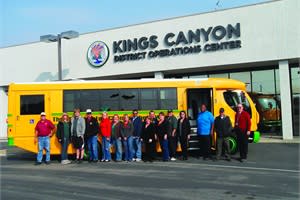
Director of Transportation John Clements (far right) and his staff rode the all-electric eTrans for the first time on the streets of Reedley, Calif., on Dec. 19.
The eTrans currently in the district's fleet has child integrated safety seats for preschoolers with special needs, as well as a Ricon wheelchair lift with Q-Straint securement devices.
"Receiving this eTrans school bus has been the most exciting professional adventure for me in some time," Clements says. "My great staff and district support have made it possible for me to have the fun and enjoyment I am experiencing as the eTrans is launched at Kings Canyon Unified."
Buses for special ed like any other bus
Since the mid-1980s, the district has worked with the local county Office of Education "to place special-needs students in their least restrictive environment that includes training to ride regular-education transportation," Clements explains.
"Even our special-needs routes transport regular-education students in remote areas to reach their school sites," he adds. "Our goal was to have these students not feel as if they were riding on a small special-education bus, but rather a school bus that looks like any other bus in our system."
The district currently uses its buses to transport three special-needs students to services outside the district. In the next few years, the district intends to increase its fleet size to assume more of the services that are contracted out.
[PAGEBREAK]
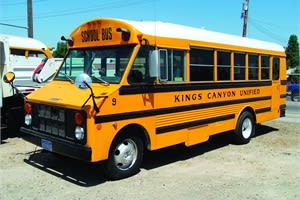
The district will use the new eTrans to replace its No. 9 bus, a 1980 model gasoline-powered bus.
Defect-free buses are a goal
The California Highway Patrol (CHP) requires that primary safety items in school buses be inspected every 3,000 miles or 45 calendar days, Clements explains.
He says Kings Canyon buses are usually serviced every 40 days or sooner, due to long routes and field trips.
"If a bus is scheduled on an extended trip to the Bay Area, central coast or the Southern California area, our bus may receive an additional inspection by the shop technicians," he explains. "Should defects be found by our service technicians or reported by our drivers, the bus is sent to our level two or level three technicians for repair or, for specialty items, to outside vendors located in Fresno."
The department's goal is to have defect-free buses that are clean inside and out.
"Our image of our school buses running throughout our district is a direct reflection upon our educational system, as more of the public comes in contact with our buses than the classroom environment," Clements says.
Staying prepared for inspections
Kings Canyon's fleet is subjected to two scheduled inspections by the CHP each year due to its size. CHP officers examine half of the fleet during each visit.
Additionally, there are two random annual inspections, in which 10 percent of the fleet is examined.
In the most recent inspection of 31 buses, CHP officers found only one warning light that had failed. Clements notes that the district has had a number of inspections over the past 20 years in which no defects were found.
Low turnover, community outreach
More than half of the Kings Canyon transportation department staff has more than 10 years of experience, and turnover is very low.
Employees are recognized for their long-term service and safe driving records with annual awards and CHP safe driving certificates. The department also gives awards to retirees and holds potlucks and breakfasts throughout the year to honor them.
Additionally, transportation staffers decorate school buses for annual community events such as Fiesta Day and the Christmas Electric Light Parade. The department also holds a bus evacuation program as part of the local fire department's open house.
Each day, "our people come together as a team to safely and efficiently move over 4,000 students in a two-hour period over our varying terrains to reach their education," Clements says. "However, the services provided to activity trips and the athletic programs affect the entire 10,000 student population of our district."
Fleet Facts
School buses: 67 with 3 additions arriving this spring
Students transported daily: 4,212
Those students with special needs: 104
Schools served: 19 district schools, 4 special-needs sites
Transportation staff: 62
Area of service: 599 sq. miles
More Alternative Fuels

CALSTART and Forth Combine to Form Catalyst Mobility
The new name represents a renewed vision for the nonprofit focused on advancing clean, equitable, and affordable transportation solutions that move people and goods.
Read More →
Alt-Fuel Moves: New Buses, Charging Hubs & Real-World EV Testing
Propane and electric school bus deployments continue to grow as districts add new vehicles, expand charging infrastructure, and gather more real-world operating data.
Read More →
Fewer Electric School Bus Models Reshape the U.S. Market
WRI’s latest buyer’s guide points to a consolidating electric school bus market, but fewer options may reflect a maturing industry rather than fewer meaningful choices for school bus operators.
Read More →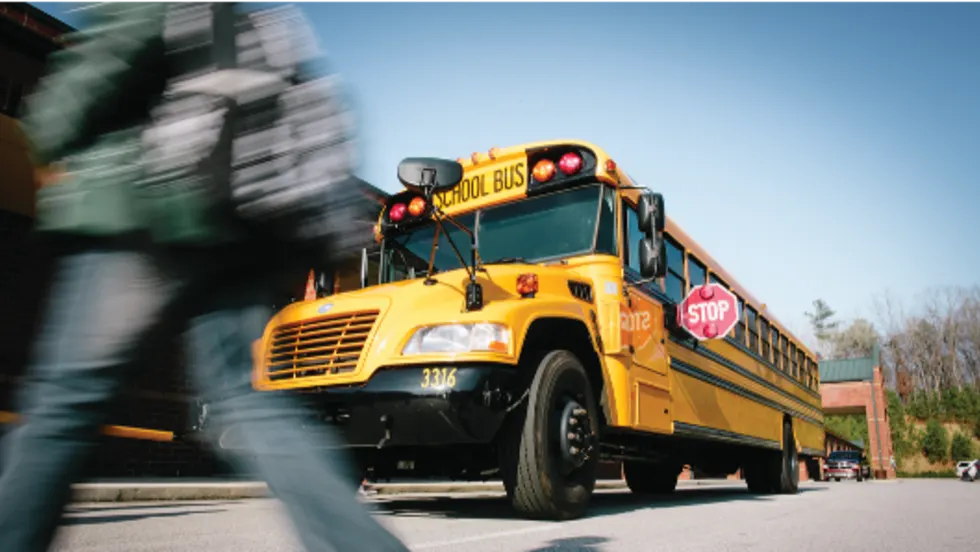
The Fuel Budget You Can Actually Predict: How Propane Autogas Keeps Money in the Classroom
Learn how propane autogas helps school districts manage fuel costs with predictable pricing, lower maintenance, and reduced emissions from former transportation director Joel Stutheit.
Read More →
Hendrickson, Driventic Introduce New Electric Powertrain for School Buses
ELECTRAAX, the electrified, lightweight drive axle offers integrated ePowertrain efficiency and modular flexibility for Class 6–7 school bus use.
Read More →
The Mobility House Joins PowerFlex in Fleet Electrification Deal
The acquisition combines intelligent charging software, bidirectional charging expertise, and fleet electrification services to support the growing adoption of electric school buses across North America.
Read More →
Alt-Fuel Moves: Electric School Bus Investments Hit the Road
See which districts across the U.S. are putting electric school buses into service, expanding charging infrastructure, and planning the next phase of fleet electrification.
Read More →
With Fuel Volatility Ahead, School Districts Turn to Propane
While diesel prices peaked above $5 this spring, districts with propane autogas-powered fleets paid under $2 per gallon, according to PERC.
Read More →
EPA Unveils Proposed Changes to 2027 Heavy-Duty Engine Rules
The federal agency has proposed changes to next year’s targets that would eliminate DEF derates, ease warranty requirements, and retain current NOx emissions standards.
Read More →
Alt-Fuel Moves: EV Charging & Infrastructure Projects Gain Momentum
The latest developments include new funding, charging infrastructure, utility investments, and fleet technologies designed to support the transition to electric school buses nationwide.
Read More →