




Navistar reveals new engine emission technology
The manufacturer will introduce a next-generation clean engine solution to meet the 2010 EPA emissions regulations and to position the company to meet greenhouse gas rules ahead of 2014 and 2017 requirements, officials announce. A Navistar spokesperson tells SBF that the short-term focus for the technology is on big-bore engines.

LISLE, Ill. — Navistar International Corp. will introduce a next-generation clean engine solution to meet the 2010 EPA emissions regulations and to position the company to meet greenhouse gas rules ahead of 2014 and 2017 requirements, company officials said on Friday.
Navistar's In-Cylinder Technology Plus (ICT+) combines advanced in-cylinder engine technology with urea-based aftertreatment. It is expected to become available in early 2013.
Navistar spokesperson Steve Schrier told SBF that the short-term focus for ICT+ is on the company's MaxxForce big-bore engines. For the mid-range engines — those used in IC Bus school buses, "we remain committed to our current in-cylinder Advanced EGR for the near future," Schrier said.
The company said in a press release that it intends to continue building and shipping current model EPA-compliant trucks in all vehicle classes "using appropriate combinations of earned emissions credits and/or non-compliance penalties (NCPs) during the transition to ICT+."
For more on the ICT+ announcement, click here.
More Alternative Fuels
Bipartisan Bill Seeks to Extend Clean School Bus Program Through 2031
The proposed legislation would renew federal support for cleaner school buses as districts navigate funding uncertainty, rising fuel and infrastructure costs, and fleet replacement needs.
Read More →
Alt-Fuel Moves: Electric Bus Rollouts, Bidirectional Charging & Propane Growth
See which fleets are adding electric and propane school buses as districts and operators invest in charging infrastructure, bidirectional technology, and alternative-fuel expansion.
Read More →
Nobody Told Diesel Prices They Were Supposed to Come Down
With diesel prices surging, school bus fleets have new reason to stress-test fuel costs, consider diversification, and calculate what each route really costs to operate.
Read More →
Why Gasoline School Buses Are Making a Comeback
Gasoline is gaining ground in full-size school buses. See how today’s options stack up against diesel on cost, maintenance, emissions, performance, and more.
Read More →
EPA Opens $180M DERA Funding Round for Diesel Upgrades
The 2026 Diesel Emissions Reduction Act program seeks applications from eligible organizations to accelerate the retirement of legacy diesel vehicles.
Read More →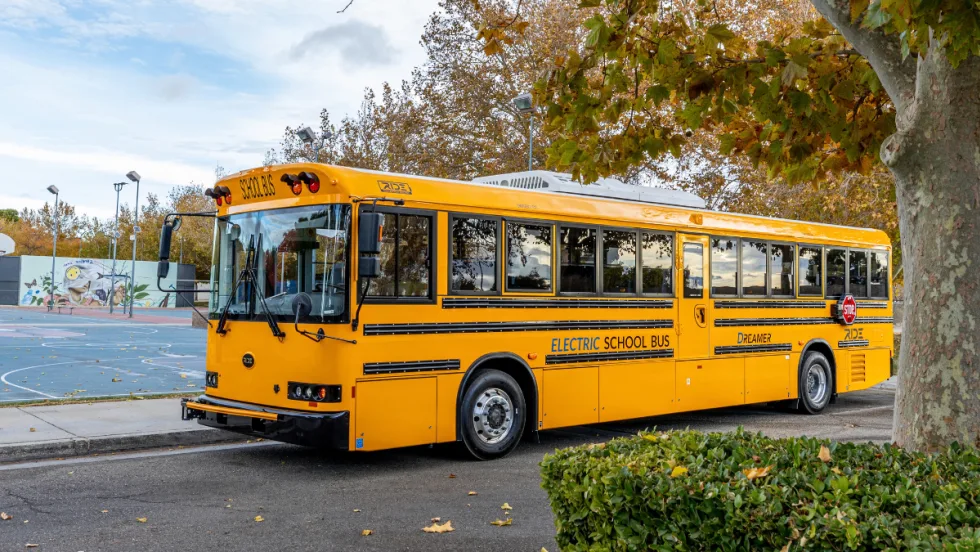
The Secret Life of an Electric School Bus Battery
Batteries change throughout years of daily routes, but degradation doesn’t necessarily mean the end. Here’s what operators should know about performance, safety, and second life.
Read More →
CALSTART and Forth Combine to Form Catalyst Mobility
The new name represents a renewed vision for the nonprofit focused on advancing clean, equitable, and affordable transportation solutions that move people and goods.
Read More →
Alt-Fuel Moves: New Buses, Charging Hubs & Real-World EV Testing
Propane and electric school bus deployments continue to grow as districts add new vehicles, expand charging infrastructure, and gather more real-world operating data.
Read More →
Fewer Electric School Bus Models Reshape the U.S. Market
WRI’s latest buyer’s guide points to a consolidating electric school bus market, but fewer options may reflect a maturing industry rather than fewer meaningful choices for school bus operators.
Read More →
The Fuel Budget You Can Actually Predict: How Propane Autogas Keeps Money in the Classroom
Learn how propane autogas helps school districts manage fuel costs with predictable pricing, lower maintenance, and reduced emissions from former transportation director Joel Stutheit.
Read More →