




Utah bus idling reduction program inspires statewide effort
Gov. Gary Herbert declares September 2011 “Idle Free Awareness Month,” and the declaration cites the success of Utah’s school bus idling reduction program as an example for the rest of the state. Murrell Martin of the Utah State Office of Education discusses with SBF the benefits of the program since its inception in 2008.

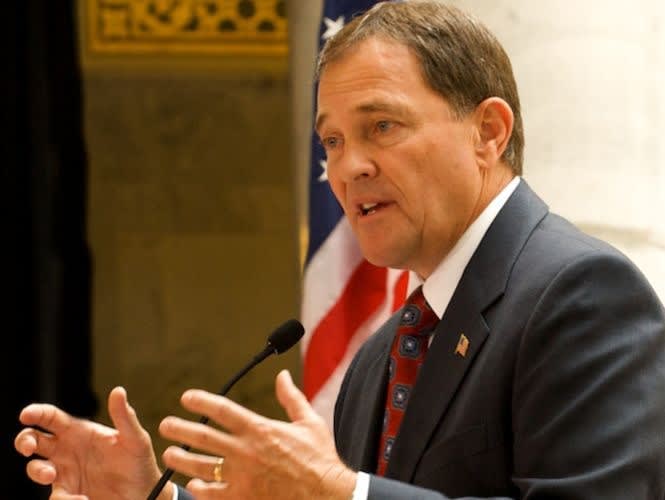
Utah Gov. Gary Herbert recently declared September as “Idle Free Awareness Month.” His declaration cites the success of Utah’s school bus idling reduction program as an example for the rest of the state.
SALT LAKE CITY — Gov. Gary Herbert has declared September 2011 “Idle Free Awareness Month,” and the declaration cites the success of Utah’s school bus idling reduction program as an example for the rest of the state.
The declaration outlines the development and benefits of the state’s school bus idling reduction program and then goes on to say that Utah residents can similarly improve the state’s air quality "if they turn off their vehicles whenever they need to idle more than 10 seconds.”
It also says that education about idling reduction can raise community awareness, encourage consumers to develop idle-free habits and influence adoption of idle-free policies within city and county governments, and that mayors and schools statewide have undertaken an idling reduction campaign to reduce greenhouse gas emissions and improve air quality.
In 2008, the National Energy Foundation, the Utah State Office of Education and all Utah school districts implemented the school bus idling reduction program in partnership with the Utah Clean Cities Coalition.
“In the past three years, this program has reduced consumption of over 276,000 gallons of fuel for a combined savings to school districts of over $700,000. There has also been a reduction of several tons — an estimated 15 tons — of harmful particulate matter to benefit Utah’s air quality,” Murrell Martin, pupil transportation director/specialist at the Utah State Office of Education, told SBF.
Martin also noted that the success of the program has been used as a model for other states and has been presented at three national conferences in the past year: The EPA National Clean Diesel 10 Conference in Washington, D.C., on Oct. 19, 2010, the National Association of State Directors of Pupil Transportation Services conference in Portland, Ore., on Nov. 1, 2010, and the U.S. Department of Energy Clean Cities Stakeholder Summit on June 28, 2011, in Indianapolis.
Pupil transportation supervisors, certified instructors and school bus drivers who have supported the program will receive special recognition at a future state board of education meeting — most likely on Oct. 7, according to Martin. (He said that while the Utah State Office of Education played a significant role in providing leadership and coordination in developing and implementing the curriculum, the focus for recognition will be on those individuals.)
Utah has also achieved success on statewide clean air efforts through its school bus retrofit and replacement project. The Utah State Office of Education, the Utah Division of Air Quality, county and municipal governments, and nonprofit organizations worked with school districts and assisted in securing federal grant funding to retrofit more than 1,200 school buses with emission-control devices and replace 27 buses.
Martin said that the following emission reductions are attributed to the project:
Through retrofitting buses with pollution-control devices
∙ Particulate matter — 309.82 tons over the life of the fleet
∙ Hydrocarbons — 854.30 tons over the life of the fleet
∙ Carbon monoxide — 4,693.78 tons over the life of the fleet
Through school bus replacement
∙ Nitrogen oxide — 844.86 tons over the life of the fleet
∙ Particulate matter — 33.83 tons over the life of the fleet
∙ Hydrocarbons — 43.55 tons over the life of the fleet
∙ Carbon monoxide — 285.06 tons over the life of the fleet
“The Utah State Office of Education played a significant role in providing leadership and coordination between the school districts and the Utah Division of Air Quality, but recognition for success will be focused on pupil transportation supervisors and bus shop supervisors who supported the project,” Martin added.
More Alternative Fuels
Alt-Fuel Moves: Electric Bus Rollouts, Bidirectional Charging & Propane Growth
See which fleets are adding electric and propane school buses as districts and operators invest in charging infrastructure, bidirectional technology, and alternative-fuel expansion.
Read More →
Nobody Told Diesel Prices They Were Supposed to Come Down
With diesel prices surging, school bus fleets have new reason to stress-test fuel costs, consider diversification, and calculate what each route really costs to operate.
Read More →
Why Gasoline School Buses Are Making a Comeback
Gasoline is gaining ground in full-size school buses. See how today’s options stack up against diesel on cost, maintenance, emissions, performance, and more.
Read More →
EPA Opens $180M DERA Funding Round for Diesel Upgrades
The 2026 Diesel Emissions Reduction Act program seeks applications from eligible organizations to accelerate the retirement of legacy diesel vehicles.
Read More →
The Secret Life of an Electric School Bus Battery
Batteries change throughout years of daily routes, but degradation doesn’t necessarily mean the end. Here’s what operators should know about performance, safety, and second life.
Read More →
CALSTART and Forth Combine to Form Catalyst Mobility
The new name represents a renewed vision for the nonprofit focused on advancing clean, equitable, and affordable transportation solutions that move people and goods.
Read More →
Alt-Fuel Moves: New Buses, Charging Hubs & Real-World EV Testing
Propane and electric school bus deployments continue to grow as districts add new vehicles, expand charging infrastructure, and gather more real-world operating data.
Read More →
Fewer Electric School Bus Models Reshape the U.S. Market
WRI’s latest buyer’s guide points to a consolidating electric school bus market, but fewer options may reflect a maturing industry rather than fewer meaningful choices for school bus operators.
Read More →
The Fuel Budget You Can Actually Predict: How Propane Autogas Keeps Money in the Classroom
Learn how propane autogas helps school districts manage fuel costs with predictable pricing, lower maintenance, and reduced emissions from former transportation director Joel Stutheit.
Read More →
Hendrickson, Driventic Introduce New Electric Powertrain for School Buses
ELECTRAAX, the electrified, lightweight drive axle offers integrated ePowertrain efficiency and modular flexibility for Class 6–7 school bus use.
Read More →