




Thomas Built celebrates environmental achievements
The school bus manufacturer has zero-waste-to-landfill operations, meaning that everything received or produced by Thomas Built is used, reused, recycled or sold, and nothing is sent to a landfill. The company is also participating in a solar panel project, and all of its manufacturing facilities became ISO 14001 certified last year.

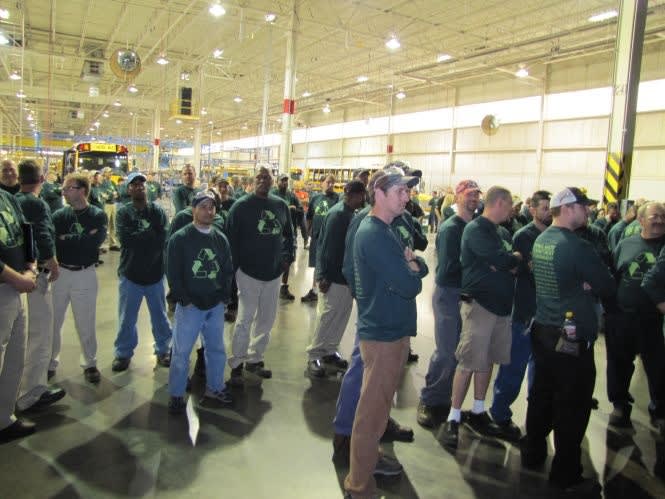
School bus manufacturer Thomas Built has achieved zero-waste-to-landfill operations. Pictured is a company-wide celebration held on Wednesday.
HIGH POINT, N.C. — Thomas Built Buses held a company-wide celebration here on Wednesday to honor its environmental achievements, including the fact that it has achieved zero-waste-to-landfill operations. This means that everything received or produced by the company is used, reused, recycled or sold, and nothing is sent to a landfill.
Using the company’s Truck Operating System continuous improvement program, Thomas Built employee teams identified the best options for reducing waste and recycling materials, whether it was reusing cartons for shipping, reclaiming solvent, working with supplier partners to reduce packaging or turning waste into energy.
“We carted our last load to the landfill in December and reopened as a zero-waste-to-landfill company in January. We are delighted to be starting the new year with a literal ‘clean slate,’” said Kelley Platt, president and CEO of Thomas Built Buses, which is a subsidiary of Daimler Trucks North America LLC (DTNA).
The zero-waste-to-landfill goal was initiated by Daimler AG to reduce the carbon footprint of manufacturing facilities under the Daimler umbrella.
“The journey to and achievement of zero-waste-to-landfill is just one example of Thomas Built’s commitment to sustainability," said Roger Nielsen, chief operating officer of DTNA. "With a system of continuous improvement, Thomas Built is shaping the future of school bus transportation through clean drive technologies and innovations that contribute to advances in safety, technology and environmental stewardship.”
Company officials said that every Thomas employee had a hand in realizing the goal, and from 2008 to 2010, the company nearly doubled its recycling of wood and nearly tripled its paper recycling. During the same time frame, Thomas Built has focused on reducing water consumption and decreasing its energy use overall.
Moreover, through a 25-year contract, Thomas Built is providing the land to support 1,690 solar panels owned and operated by Duke Energy. The Photovoltaic Solar Field project will produce 389 kilowatts of renewable energy for the Duke Energy power grid, which is enough electricity to power approximately 41 homes, officials said.
Installation in High Point began in July 2010, and Thomas-hosted panels went online Dec. 15. A second North Carolina DTNA facility will bring on an additional 1,560 panels later this year.
Thomas Built has also received ISO certification. All of the company’s manufacturing facilities became ISO 14001 certified in January 2010. The Saf-T-Liner C2 plant, chassis plant and Minotour production line earned ISO 14001 certification in December 2004.
In 2009, Thomas Built became a member of the EPA’s WasteWise program. Using a data management and reporting system, member sites collect, organize and analyze their municipal solid waste information, then track waste reduction activities.
Finally, the company manufactures hybrid-electric buses and buses that run on cleaner-burning fuels such as compressed natural gas (CNG). Officials said the company is also working to introduce Saf-T-Liner C2 and Minotour propane-powered school buses in 2012.
More Alternative Fuels
Alt-Fuel Moves: Electric Bus Rollouts, Bidirectional Charging & Propane Growth
See which fleets are adding electric and propane school buses as districts and operators invest in charging infrastructure, bidirectional technology, and alternative-fuel expansion.
Read More →
Nobody Told Diesel Prices They Were Supposed to Come Down
With diesel prices surging, school bus fleets have new reason to stress-test fuel costs, consider diversification, and calculate what each route really costs to operate.
Read More →
Why Gasoline School Buses Are Making a Comeback
Gasoline is gaining ground in full-size school buses. See how today’s options stack up against diesel on cost, maintenance, emissions, performance, and more.
Read More →
EPA Opens $180M DERA Funding Round for Diesel Upgrades
The 2026 Diesel Emissions Reduction Act program seeks applications from eligible organizations to accelerate the retirement of legacy diesel vehicles.
Read More →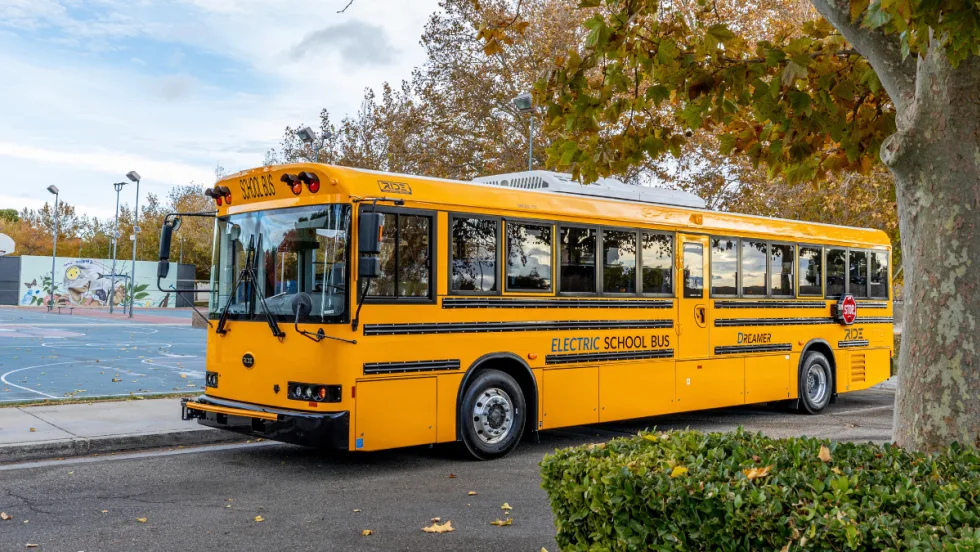
The Secret Life of an Electric School Bus Battery
Batteries change throughout years of daily routes, but degradation doesn’t necessarily mean the end. Here’s what operators should know about performance, safety, and second life.
Read More →
CALSTART and Forth Combine to Form Catalyst Mobility
The new name represents a renewed vision for the nonprofit focused on advancing clean, equitable, and affordable transportation solutions that move people and goods.
Read More →
Alt-Fuel Moves: New Buses, Charging Hubs & Real-World EV Testing
Propane and electric school bus deployments continue to grow as districts add new vehicles, expand charging infrastructure, and gather more real-world operating data.
Read More →
Fewer Electric School Bus Models Reshape the U.S. Market
WRI’s latest buyer’s guide points to a consolidating electric school bus market, but fewer options may reflect a maturing industry rather than fewer meaningful choices for school bus operators.
Read More →
The Fuel Budget You Can Actually Predict: How Propane Autogas Keeps Money in the Classroom
Learn how propane autogas helps school districts manage fuel costs with predictable pricing, lower maintenance, and reduced emissions from former transportation director Joel Stutheit.
Read More →
Hendrickson, Driventic Introduce New Electric Powertrain for School Buses
ELECTRAAX, the electrified, lightweight drive axle offers integrated ePowertrain efficiency and modular flexibility for Class 6–7 school bus use.
Read More →