




A/C units boost serviceability
Improved service access and convenient size are among key features of the latest air-conditioning systems for school buses.

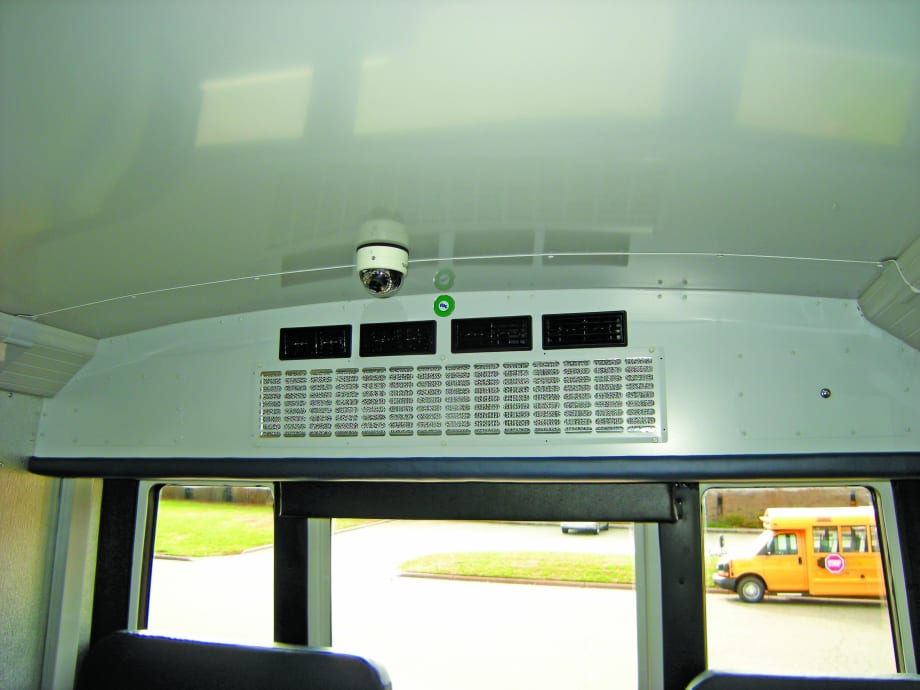
Rifled Air's BH-20 Evaporator has a rated capacity of 60,000 Btu/hour and is mounted in the front or rear bulkhead.
Evaporator has minimal cabin intrusion
For 2012, Rifled Air Conditioning Systems has made a variety of product enhancements for its most popular units, the BH-20 Evaporator and the RC-30 Condenser.
The BH-20 Evaporator has a rated capacity of 60,000 Btu/hour and is mounted in the front or rear bulkhead, with minimal cabin intrusion. Company officials said that the evaporator is "a complete blend of functional need, aesthetic design and serviceability access."
The BH-20's covers are contour fitted to each body manufacturer to give the appearance of an integrated, factory-installed evaporator. Product enhancements for 2012 include:
• A new deeper drain pan — with depth increased from 1 inch to 1.5 inches.
• A new four-drain multi-directional drain pan to allow for quicker, more efficient draining regardless of the orientation of the bus.
The RC-30 is Rifled Air's largest condenser and is most often used in hot climates on larger buses in combination with other condensers. It is mounted in the skirt location and has a rated capacity of 80,000 Btu/hour.
The RC-30 and Rifled Air's other weather pack condensers have environmentally sealed electrical connections designed to withstand exposure to extreme temperatures and moisture. Terminals are tin plated and have special core wings that allow crimp-only connections, eliminating the need for solder.
Product enhancements on the RC-30 for 2012 include:
• The new weather pack connectors replace the ring terminal connections on the face of the condenser, eliminating the potential for corrosion on the terminals.
• All connections are made of a male and female, plug-n-play style connection that improves installation and field service repair times.
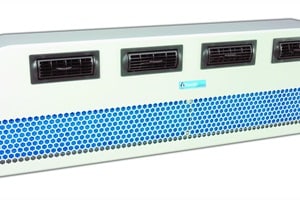
Trans/Air's FM50 features a low 10-inch-high profile and dual high-performance blowers.
Flush-mount evaporator suits height restrictions
Trans/Air Manufacturing has unveiled its new FM50 flush-mount evaporator. Specifically designed for school and commercial bus applications with bulkhead height restrictions, the FM50 has a low 10-inch-high profile.
Company officials said that the unit features a cosmetically pleasing metal cover, fully adjustable louvers, an innovative tapered drain pan for efficient removal of condensation, an aluminum seam welded cabinet and dual high-performance blowers.
Trans/Air has also developed a dash air heat/cool unit specifically for IC Bus RE applications and one specifically for Blue Bird Vision applications.
Officials at Trans/Air said that both dash units provide "total climate control to the driver's area." The units mount in the OEM heat-only location and are available with 44,000/25,000 Btu heat/cool capacity.
Both dashes feature dual high-performance blowers, digital temperature control and air outlets at the windshield, driver and entrance door.
Trans/Air officials said that the anticipated availability of the Blue Bird Vision Dash is in the first quarter of 2012. The IC Bus RE Dash is immediately available.
[PAGEBREAK]
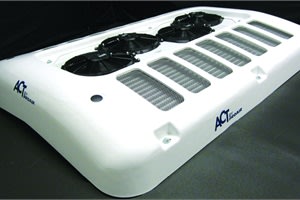
At less than 10 inches tall, ACT's CR-4 bus air-conditioning condenser unit increases roof clearance and eliminates the need to install a branch guard.
New rooftop condenser has low profile
American Cooling Technology (ACT) has released its new high-performance CR-4 roof-mount condenser unit.
Based on market feedback from customers who participated in field trials, ACT made the CR-4 unit smaller and lighter than other high-capacity roof-mount condensers.
At less than 10 inches tall, the CR-4 unit increases roof clearance and provides a cleaner, sleeker look to the air-conditioning installation. The low profile and tapered leading edge of the unit eliminate the need to install a branch guard, which is typically required on a standard rooftop condenser.
The CR-4 is available in both 12-volt and 24-volt models and can be supplied as a dual loop unit to be connected to two automotive-style compressors or as a single loop to connect to a single high-capacity transit compressor.
Company officials said that by relocating the air-conditioning condenser from the typical position under the bus floor to the roof of the bus, the capacity and operating efficiency of the air-conditioning system improve because it uses cleaner air from the top of the bus through the unit's heat exchanger.
All ACT split systems use non-ozone-depleting HFC-134a refrigerant, and the CR-4 delivers a high cooling capacity (165,000 Btu/hour IMACA).
Also, the CR-4's modular construction allows for improved access to the unit's internal components, making it easier to service. "This translates to less downtime, which is critical for bus fleets operating on tight budgets," the company said.
Cooling solutions to enhance serviceability
Officials at Thermo King, a global provider of transport temperature control systems and services and a brand of Ingersoll Rand, said that the company will be offering new robust cooling solutions for school buses in 2012 that offer improved serviceability.
More Maintenance
The essential guide to school bus maintenance and student safety
Reactive maintenance puts students at risk of breakdowns, delays and roadside emergencies. This guide gives transportation directors a data-driven framework to predict failures, extend bus lifespans and improve fleet reliability across every route.
Read More →
The Evolution of DEF Header Technology: What School Bus Operations Should Know at Replacement Time
See what school bus fleets should consider when replacing DEF headers to improve reliability, reduce repeat repairs, and control maintenance costs.
Read More →
Kerry Brothers Grows Michigan School Bus Repair Network
The acquisition of Downriver Truck and Bus expands Kerry Brothers’ school bus maintenance footprint across southeast Michigan, adding repair capacity, diagnostic resources, and state inspection support.
Read More →
Noregon Introduces CAN Bus Diagnostic Tool, Expands JPRO Features
CAN Mentor and the latest JPRO update aim to simplify vehicle network diagnostics and improve repair efficiency for technicians of all experience levels.
Read More →
Cummins on Smarter, Simpler Engine Innovation
Cummins discusses its first-ever gasoline engine for school buses, EPA 2027, and why bus fleets still want durable, simpler internal combustion options.
Read More →
Report: 72% of Diesel School Buses Now Use Advanced Low-Emission Engines
New data shows advanced low-emission diesel technology continues expanding across school bus fleets, even as electric bus adoption gains momentum.
Read More →
Vampire Tools' CAIMAN 7.5-Inch Multi-Purpose Screw Extractor Long-Nose Pliers with Crimper
Vampire Tools introduced the VAMPLIERS Caiman 7.5-inch multi-purpose pliers, combining screw extraction, cutting, crimping, and gripping functions into a single tool designed for fleet maintenance professionals.
Read More →
How Advanced Diagnostics Helps Bus Fleets Stay Ahead of Repairs
Chat with Noregon’s Kevin Smallhorn at ACT Expo about bus diagnostic tools, telematics integration, CNG maintenance support, and strategies to help reduce downtime and improve uptime.
Read More →
How School Bus Fleets are Getting Ahead of Breakdowns
Don’t let bus downtime wear you down. Here’s how bus operators are shifting from manual processes to AI-powered, data-driven maintenance systems for improved reliability and safety.
Read More →
Pennsylvania School Bus Maintenance Team Praised for Dedication to Safety
Matthews Bus Company’s West Jefferson received a letter of commendation from the Pennsylvania State Police for their fleet inspections.
Read More →