




Vehicle lifts: It's all about mobility
Officials at vehicle lift manufacturing companies say that the portability of mobile column units makes it easy to service buses, and each company’s lifts include numerous safety features, such as weight gauges and overload protection.
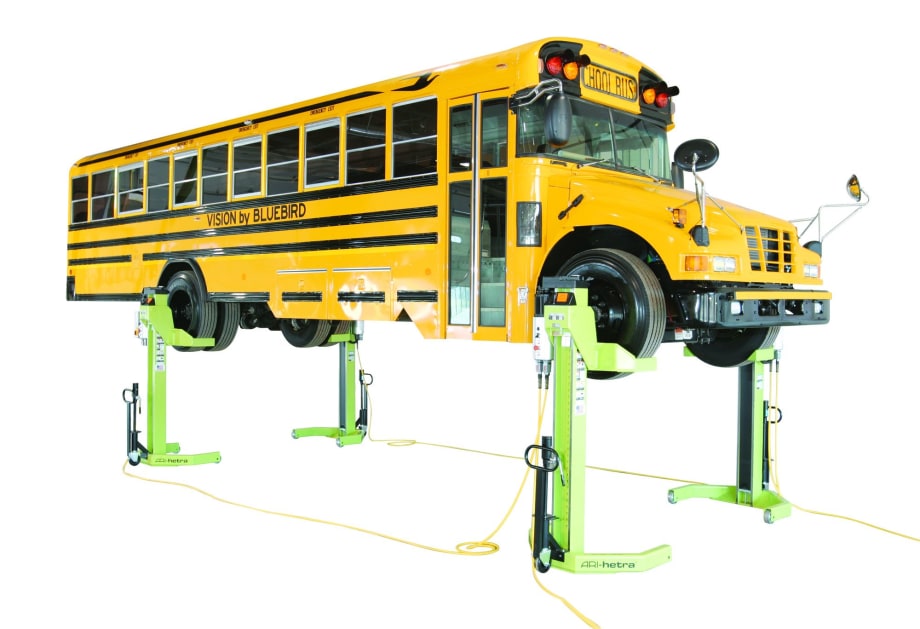
ARI-HETRA's HBP HDML (heavy-duty mobile lift) 8-4 is a hybrid lift that is battery powered.
Vehicle lifts can make all the difference when it comes to performing maintenance on a school bus. Finding the right lift can make the process safer, easier and more affordable.
SBF asked four vehicle lift companies about what lifts are popular among their customers in the school bus industry. The flexibility and portability of mobile column lifts makes them great for servicing a variety of bus types with ease, officials say.
ARI-HETRA
ARI-HETRA’s HBP HDML (heavy-duty mobile lift) 8-4 is a hybrid lift that is battery powered, says Bill Gibson, the company’s general manager.
“When you lift a bus, the lift uses battery power, and when you lower it, the lift uses the weight of the vehicle to recharge the battery,” he explains.
The battery can also be charged by a single 110-volt outlet.
The HBP HDML 8-4 is not hydraulic. ARI-HETRA uses a ball-bearing screw to raise and lower the lift.
“This mechanical system is more efficient than a hydraulic system,” Gibson says. “[With the HBP HDML 8-4], you’ve got that mechanical safety, where with a hydraulic system, if there’s a leak in the hydraulic seals or hoses, you could be in trouble.”
Additionally, if a technician attempts to raise a bus that weighs more than the lift is rated for, the electronic overload protection will shut the system down.
The columns are completely portable, “so when you’re done working on your bus, you can roll them into the corner of your shop and they’re out of the way,” Gibson adds. Using ARI-HETRA’s support stands, technicians can prop up a bus and move the columns to a different bay to start work on another bus.
The support stands are equipped with a nitrogen gas-activated spring that allows for easy and safe height adjustment.
“ARI-HETRA manufactures, sells and services all of our lifts,” Gibson says. “Our guys know this equipment very well, and if there’s a problem while you’re working on a vehicle when you’ve got it up in the air [on a lift], you want to make sure the company you’re dealing with can be very responsive.”
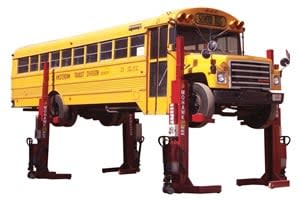
Mohawk offers mobile column lifts in three different sizes, with lifting capacities that range from 18,000 pounds to 30,000 pounds.
Mohawk Lifts
Mohawk Lifts’ mobile column lifts have been gaining in popularity every year for several years straight, according to Steve Perlstein, sales manager.
Mohawk offers 18,000-pound, 24,000-pound and 30,000-pound capacity mobile column lifts (the MP-18, MP-24 and MP-30, respectively) that operate hydraulically.
“The mobile column lift is great because you take the school bus, you send it 6 feet up in the air, and if by chance you’re waiting around for parts to arrive … you can put the bus on high-rise jack stands,” Perlstein says. “Those stands are going to allow you to move the columns away from the school bus and put them in an adjoining bay.”
The company’s lifts are equipped with adjustable lifting forks to accommodate wheels from 13 to 24 inches in diameter, and up to 48 inches. No wheel reducer sleeves are needed.
“If you don’t have adjustable forks [on your lift], then that’s an option that people have to buy in order to service that smaller size tire,” Perlstein explains.
Mohawk’s mobile column lifts communicate with one another through cables, which Perlstein says prevents the interference that can occur in wireless mobile column lifts.
The lifts also have a safety weight gauge to indicate to a technician if the lift is overloaded, as well as a slope indicator. Mohawk’s mobile column lifts allow for a 3-degree slope.
“Garages always have sloped floors, wash drains and oil separators and things like that,” Perlstein says. “If the lift is only allowed to be used on a perfectly level floor, that’s not a good choice of lift.”
[PAGEBREAK]
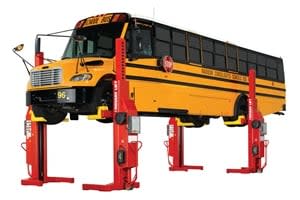
Rotary Lift's MACH 4 mobile column lift is equipped with retractable cord reels.
Rotary Lift
Rotary Lift’s MACH 4 mobile column lift offers versatility and time-saving features, according to Northeast Regional Fleet Manager Jay Ashworth.
The lift’s hydraulic cylinder “is inverted and the chrome piston rod is protected from debris and damage at all times, extending the life of the product and substantially reducing maintenance costs,” Ashworth says.
Retractable cord reels keep the cables that connect the lift’s columns out of the way and off the floor. The lift, Ashworth says, can go from wired to wireless and back again with the “flip of a switch.”
He adds that the lift automatically re-establishes communication between columns if the signal is dropped, so there is no need to reset communication errors.
The lift is battery operated with an onboard, waterproof charger, which Ashworth says can be used in wash bays.
The MACH 4 also comes equipped with high-efficiency LED lighting. “This single-touch operation system provides hands-free lighting under the vehicle, conveniently operated from the lift’s control panel,” Ashworth says.
An optional weight gauge will approximate the weight being lifted by each column, and extended forks and support legs are available to support inboard tires on dual-wheeled axles.
“Every Rotary lift is designed and tested to withstand 20,000 cycles with the rated capacity load. That’s over 15 years of service in the average shop,” Ashworth says. “Our arms are subjected to a 150-percent load test to demonstrate our commitment to quality and safety where it counts.”
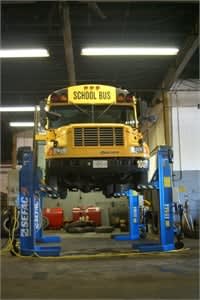
SEFAC's S3 mobile column lift has up to 108,000 pounds of lifting power.
SEFAC
SEFAC’s S3 mobile column lift is one of the company’s most popular products. At an 18,000-pound capacity per column, the unit has up to 108,000 pounds of lifting power and can be operated from any column.
“The reason that we manufacture mobile lifts is because they’re portable; there’s flexibility,” says Gary Mason, vice president of sales. He says this is important for districts, because mobile lifts can be used to raise any size bus.
The columns of the S3 lift can be moved by one technician and allow
unobstructed access to the underbody of the bus. The columns communicate through cables.
“We use cables to connect the columns so you’ve got constant power to each column, and the safety circuit is constant as well,” Mason explains.
Also, the lifts are equipped with self-locking Acme threaded screws and bronze load nuts that do not require mechanical backup locks.
In addition, SEFAC provides accessories for its mobile column lifts, including two sizes of a heavy-duty jack stand, small tire adapters, transmission jacks, chassis cross-beams and wheel dollies, which allow technicians to remove wheels safely and quickly.
The most important thing SEFAC offers, according to Mason, is extensive service.
“All of our technicians are SEFAC-employed technicians,” he says. “When there’s an issue with a service or a breakdown, a SEFAC technician will turn up with — most of the time — everything in his van that he needs to put the lift right.”
SEFAC also certifies lift operators and provides regular training.
More Maintenance
The Essential Guide to School Bus Maintenance and Student Safety
Your district's buses carry students to school every day. This guide shows how predictive maintenance powered by fleet data helps keep buses reliable, drivers accountable and students safer from the first bell to the last stop.
Read More →
Kerry Brothers Grows Michigan School Bus Repair Network
The acquisition of Downriver Truck and Bus expands Kerry Brothers’ school bus maintenance footprint across southeast Michigan, adding repair capacity, diagnostic resources, and state inspection support.
Read More →
Noregon Introduces CAN Bus Diagnostic Tool, Expands JPRO Features
CAN Mentor and the latest JPRO update aim to simplify vehicle network diagnostics and improve repair efficiency for technicians of all experience levels.
Read More →
Cummins on Smarter, Simpler Engine Innovation
Cummins discusses its first-ever gasoline engine for school buses, EPA 2027, and why bus fleets still want durable, simpler internal combustion options.
Read More →
Report: 72% of Diesel School Buses Now Use Advanced Low-Emission Engines
New data shows advanced low-emission diesel technology continues expanding across school bus fleets, even as electric bus adoption gains momentum.
Read More →
Vampire Tools' CAIMAN 7.5-Inch Multi-Purpose Screw Extractor Long-Nose Pliers with Crimper
Vampire Tools introduced the VAMPLIERS Caiman 7.5-inch multi-purpose pliers, combining screw extraction, cutting, crimping, and gripping functions into a single tool designed for fleet maintenance professionals.
Read More →
How Advanced Diagnostics Helps Bus Fleets Stay Ahead of Repairs
Chat with Noregon’s Kevin Smallhorn at ACT Expo about bus diagnostic tools, telematics integration, CNG maintenance support, and strategies to help reduce downtime and improve uptime.
Read More →
How School Bus Fleets are Getting Ahead of Breakdowns
Don’t let bus downtime wear you down. Here’s how bus operators are shifting from manual processes to AI-powered, data-driven maintenance systems for improved reliability and safety.
Read More →
Pennsylvania School Bus Maintenance Team Praised for Dedication to Safety
Matthews Bus Company’s West Jefferson received a letter of commendation from the Pennsylvania State Police for their fleet inspections.
Read More →
From Chaos to Clarity: How School Districts Are Running Leaner Transportation Operations
Covering 38 routes on a Friday afternoon. Buses idling while routes overlap. Parents calling nonstop about late arrivals. Sound familiar? This whitepaper explores how district transportation leaders solved these exact problems — and what measurable results followed.
Read More →