




Proactive Customers Boost Lift User Safety
The features of today’s vehicle lifts help prevent technician injuries, but to maximize their safety, pupil transporters must ensure that the lift is certified, that their shop can properly house the equipment, that techs are trained to operate it and that the lift is inspected annually.

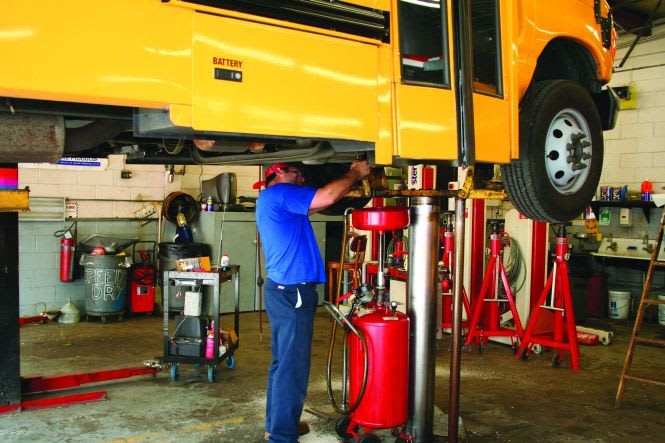
Photo by Louise Foerschner, Nassau Board of Cooperative Educational Services (Garden City, N.Y.)
Vehicle lifts make technicians’ jobs much easier, but given the size and weight of a school bus, working on one while it is elevated cannot be taken lightly.
Fortunately, in addition to designing products that effectively lift and support vehicles while they are up in the air, manufacturers have equipped their lifts with features and technology to maximize user safety.
Wireless systems, locks and automatic shutoff ability reduce hazards
Stertil-Koni now offers wireless mobile lifts. “There are no connection cables or wires between the lifts’ columns, which gives technicians unimpeded access to the vehicle and eliminates the tripping hazard that wires presented,” President Jean Dellamore says.
The company’s Skylift (a platform lift) models are also free from obstruction between the legs. Dellamore says there are no crossbeams, so there is clear-floor access all the way around the vehicle.
Gray Mfg. Co. Inc.’s Wireless Portable Lift Systems also utilize wireless technology to facilitate communication between the columns.
Locking mechanisms that prevent a vehicle from moving and the lift from dropping quickly in the event of a malfunction is another common feature among vehicle lifts. Todd Michalski, vice president of sales and marketing for Gray Mfg., says the company’s Wireless Portable Lift Systems feature two locking systems — a hydraulic holding device, as well mechanical down-stops. If a hydraulic failure occurs, the lift descends slowly a maximum of three inches before it comes in contact with a mechanical down-stop.
Likewise, Rotary Lift’s Modular and Environmentally Friendly In-Ground Lift is equipped with mechanical and hydraulic locks. “The lift is also equipped with electrical devices that ensure that both ends of the vehicle are at the same height and prevent the lift from moving if someone is underneath it,” says Roger Perlstein, director of heavy-duty.
Gary Mason, vice president of sales for SEFAC Inc., says the company’s S1 Mobile Column Lift offers inherent safety for lift users through its self-locking Acme threaded nut and screw drive. The lift stops immediately when power is removed and cannot move again until power is restored.
Finally, Railquip Inc.’s RQL-70 Heavy Duty Mobile Column Lifts feature three modes of operation and detection of load nut failure. (A re-circulating ball bearing screw-nut assembly suspended from the top of the columns provides the lifting power for these units.) Automatic shutoff capability increases user safety as well.
Railquip also offers the EGSXL-85 Series of mobile lifts for school buses. These lifts are equipped with a control console that has a display panel that will alert the lift operator of a system malfunction with an error message. The message will specify which column is the source of the malfunction; in addition, if an error is detected, the lift’s central control unit computer will automatically stop the operation.
Lifts and their accessories should be certified
The wireless technology, locking devices and shutoff systems on today’s vehicle lifts are only one key to maximizing technicians’ safety while they are maintaining buses. There are several steps that customers must take both prior to and after the purchase of a lift to help prevent employee injuries.
Steven Perlstein, sales and marketing manager for Mohawk Lifts, manufacturer of the TR-25 Four-Post Ramp Lift, says one of the first steps is confirming, prior to purchasing a lift, that it meets the national mechanical and electrical safety standards set for vehicle lifts, that it has been certified by the Automotive Lift Institute (ALI) and that it meets the building codes for the state or province where the lift will be operated.
“An educated customer is our best customer,” Perlstein says, adding that the ALI Website, www.autolift.org, offers a directory of vehicle lifts that have been certified in accordance with the requirements of the ALI/ETL (Intertek Testing Laboratories) Certification Program, and a list of companies that are ALI members. The Website also contains information on state and provincial codes. (Click on “ALI Knowledge Center” on the left-hand side of the home page, then “Code Enforcement.”)
Dellamore also emphasizes the importance of purchasing ALI/ETL-certified vehicle lifts and recommends that anyone who is considering buying a vehicle lift should do so from a manufacturer that is a member of the ALI.
Moreover, Steven Perlstein says that making sure that accessories purchased with a vehicle lift are certified is just as important as lift certification.
“If you have an uncertified accessory on a certified lift, it voids the certification of the lift,” he explains.
Assess the structure and condition of your shop
Regardless of whether an operation purchases an ALI/ETL-certified lift, technicians could still be at risk of sustaining injuries if the operation’s maintenance garage is not built to properly house a vehicle lift.
Mason suggests checking the shop floor — a vehicle lift must be installed on level ground, so the floor cannot have too large a slope.
Michalski agrees. “You have to make sure that the ground will support the vehicle lift; it shouldn’t have more than a three-degree slope,” he says. “You also have to make sure that the entire footprint of the lift is on the ground. There shouldn’t be ripples, depressions or a seam in the cement that would take some of the footprint off of the ground.”
Additionally, Mason and Michalski say that there must be adequate clearance above the lift to enable full elevation of the vehicle without obstruction. If a vehicle strikes rafters, heating ducts or anything else as it is being lifted, it could damage the vehicle or the garage as well as lead to someone getting hurt.
[PAGEBREAK]
Make sure that technicians receive training
There is consensus among manufacturers that training for technicians is paramount for them to understand how to safely operate vehicle lifts. At a basic level, manufacturers recommend that technicians read the lift’s owners manual from cover to cover to become familiar with its safety features and how to operate the lift. Dellamore notes that technicians should also receive training from the manufacturer.
SEFAC provides a training session for its customers after they have purchased a lift that covers a variety of scenarios, including what could happen if the lift is not operated properly.
“The training is very detailed and structured. We go through the basics, from parking the vehicle to how the lifts should be positioned under the vehicle’s tires,” Mason says.
At the end of the session, the company receives a certificate of competency indicating that the staff has been trained on how to use the lift.
The ALI Website also provides training resources for technicians. Steven Perlstein recommends the Lift Operator/Inspector Training Pack. The pack includes a 20-minute video, and at the end there is a test that covers vehicle lift safety principles and practices. (For more information about the pack, visit the ALI Website and click on “ALI Store.”)
Perlstein says technicians should take the test annually because Occupational Safety and Health Administration (OSHA) officials who may periodically visit pupil transportation operations will not only check to confirm that vehicle lifts are properly certified, they will also ask whether the technicians have been trained to use the lifts.
Roger Perlstein says that along with receiving annual training, a lift’s “lock-out, tag-out” protocol must be communicated to technicians at least once a year.
“Lock-out, tag-out signifies that you’ve identified that there’s something about the machine that isn’t right, something that makes it dangerous. As soon as you become aware of it, you must lock that machine out so that nobody can use it until it is repaired and safe to use,” Perlstein explains, adding that communicating lock-out, tag-out protocol to end users is an OSHA requirement.
Inspect vehicle lifts regularly
Just as school buses must be inspected and maintained on a regular basis to function properly, Dellamore emphasizes the importance of inspecting vehicle lifts at least once annually to make certain that they are well maintained and operating correctly.
Roger Perlstein says the inspection should involve checking the anchors that are holding the lift to the ground — they should be secure. Also, lifting cables should be intact (i.e., not frayed).
Rotary Lift is informing vehicle lift users of the once-a-year inspection requirement and is helping them to understand the role they play in preventing lift hazards through an awareness campaign called “Inspect to Protect.”
The company provides lift users with documentation from OSHA Region 8 indicating that agency officials will visit operations to determine whether their vehicle lifts meet construction standards for safety, whether the lift is being maintained and if the operations can provide all records of lift maintenance.
“OSHA wants to make sure that the bolts that hold the lift down are tight, that the welds aren’t broken, that there’s nothing on the lift that is bent, that the locking system locks, etc., and they want to see a document that indicates that a qualified individual is looking for these kinds of things on a regular basis. They want to see a maintenance log,” Roger Perlstein explains.
Steven Perlstein concurs, saying that OSHA officials will want to see documentation that vehicle lifts are regularly inspected.
To assist technicians in performing vehicle lift inspections, he recommends utilizing two booklets that contain the national standards for vehicle lifts: The ANSI/ALI ALOIM Standard booklet outlines safety requirements for the operation, inspection and maintenance of automotive lifts. The ANSI/ALI ALIS Standard booklet outlines safety requirements for installation and service of automotive lifts. Both booklets are available on the ALI Website store.
More Maintenance

Cummins on Smarter, Simpler Engine Innovation
Cummins discusses its first-ever gasoline engine for school buses, EPA 2027, and why bus fleets still want durable, simpler internal combustion options.
Read More →
Report: 72% of Diesel School Buses Now Use Advanced Low-Emission Engines
New data shows advanced low-emission diesel technology continues expanding across school bus fleets, even as electric bus adoption gains momentum.
Read More →
Vampire Tools' CAIMAN 7.5-Inch Multi-Purpose Screw Extractor Long-Nose Pliers with Crimper
Vampire Tools introduced the VAMPLIERS Caiman 7.5-inch multi-purpose pliers, combining screw extraction, cutting, crimping, and gripping functions into a single tool designed for fleet maintenance professionals.
Read More →
How Advanced Diagnostics Helps Bus Fleets Stay Ahead of Repairs
Chat with Noregon’s Kevin Smallhorn at ACT Expo about bus diagnostic tools, telematics integration, CNG maintenance support, and strategies to help reduce downtime and improve uptime.
Read More →
How School Bus Fleets are Getting Ahead of Breakdowns
Don’t let bus downtime wear you down. Here’s how bus operators are shifting from manual processes to AI-powered, data-driven maintenance systems for improved reliability and safety.
Read More →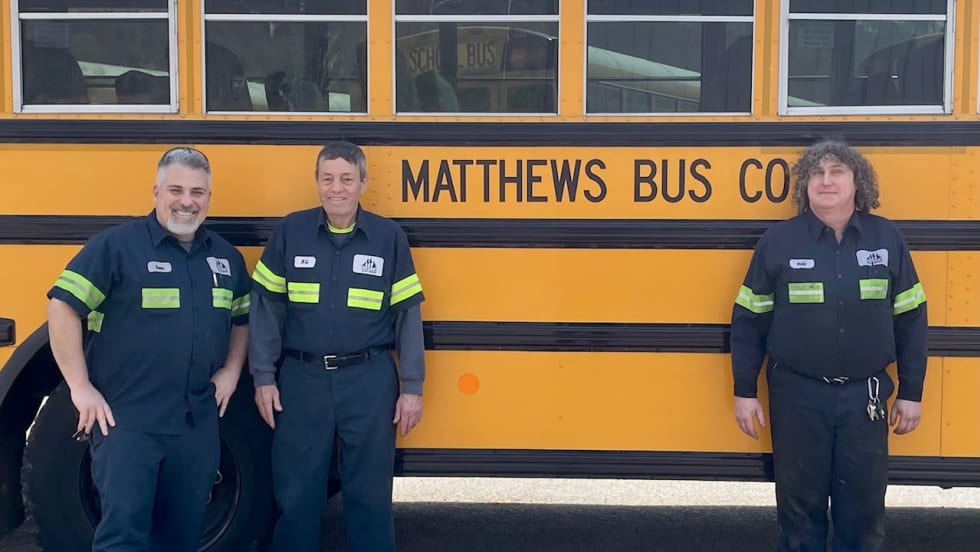
Pennsylvania School Bus Maintenance Team Praised for Dedication to Safety
Matthews Bus Company’s West Jefferson received a letter of commendation from the Pennsylvania State Police for their fleet inspections.
Read More →
2026 State of Student Transportation Report
Student transportation teams are being asked to do more with less, facing driver shortages, rising costs, and increasing safety expectations. This report uncovers how fleets are adapting, where technology is making the biggest impact, and why student ridership tracking is emerging as a top priority. Download the report to explore the key trends shaping 2026 and what they mean for your operation.
Read More →
From Chaos to Clarity: How School Districts Are Running Leaner Transportation Operations
Covering 38 routes on a Friday afternoon. Buses idling while routes overlap. Parents calling nonstop about late arrivals. Sound familiar? This whitepaper explores how district transportation leaders solved these exact problems — and what measurable results followed.
Read More →
The New Playbook for Safer, Smarter School Bus Maintenance
As school districts juggle aging buses, technician shortages and rising safety expectations, proactive fleet maintenance is becoming essential. This guide explores how telematics, predictive maintenance and real-time vehicle data can help transportation departments reduce breakdowns, extend vehicle life, improve compliance and keep students safer on the road.
Read More →
2026 School Bus Fleet Vendor Directory & Buyer's Guide
Searching for the right equipment, technology, or services for your school transportation program? This industry guide brings together manufacturers and suppliers across the entire school bus market, all in one place. Download it to find the partners who can help move your operation forward.
Read More →